
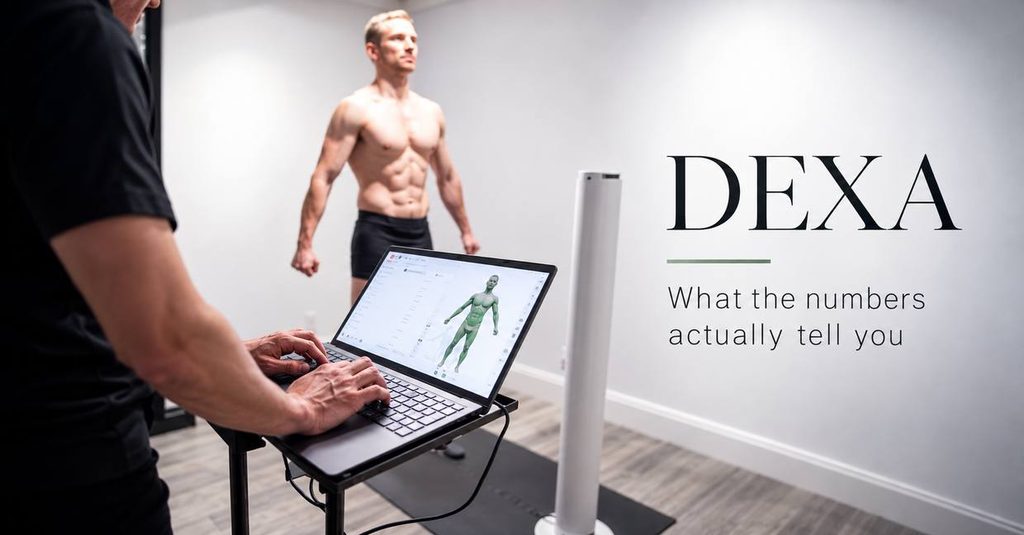
I like data, being German and all. Big fan. But we live in a time where we are swamped with data and the question becomes: who interprets it?
DEXA scans have become increasingly popular for measuring body composition. Clients come in with reports showing body fat percentage, lean mass, bone mass and even where they carry their fat.
That’s useful information, no questions.
But then someone tells me:
“I’m 18.2% body fat.”
Maybe.
A DEXA scan is a very good measurement tool. It is not a photograph of every pound of fat and muscle in your body.
How does the DEXA actually work?
DEXA stands for dual-energy X-ray absorptiometry.
The scanner sends two very low-dose X-ray beams through the body. Because bone, lean tissue and fat attenuate those beams differently, the software can estimate three major compartments:
- Bone mineral content
- Lean soft tissue (please note I did not say muscle mass)
- Fat mass
It can also show regional differences, arms, legs and trunk, and some systems estimate visceral fat.
That makes it much more useful than simply stepping on a scale.
So how accurate is it?
This is where people get confused.
DEXA is very precise under standardized conditions, meaning repeated scans can produce very similar results when the person is prepared and positioned consistently. Research using standardized positioning has shown excellent test-retest reliability.
But precision and absolute accuracy are not the same thing.
DEXA still estimates body composition based on assumptions and algorithms. Results can vary with the machine and software, technician analysis, positioning, body size, hydration and other factors.
So if your report says 18.2%, don’t get emotionally attached to the decimal point.
You didn’t suddenly become a different person because another machine says 19.1%.
Water is counted as lean mass
This is probably the biggest thing people misunderstand.
DEXA doesn’t directly measure your muscle tissue.
It measures lean soft tissue, and lean tissue contains a lot of water.
Hydration, glycogen, food intake and exercise can therefore affect the reading. Research has shown that eating, drinking and exercising before a scan can alter body-composition estimates.
So imagine this:
You do one scan depleted after dieting, having low carbed for 10 days. Three days later, you arrive well-fed, hydrated and carrying more glycogen.
The machine will report an increase in lean mass.
Did you build muscle? No, sorry. You just carbed up.
Not every pound of additional “lean mass” on a DEXA report is necessarily a pound of new muscle.
That’s an important distinction.
The biggest mistake: comparing bad data
If you’re using DEXA to track progress, don’t obsess about making the scan perfect but make it repeatable. Same food, time, hydration etc.
Otherwise, you may spend eight weeks celebrating, or panicking about, a change that partly reflects how you showed up for the scan.
So do I recommend DEXA?
Yes.
Used properly, I think it’s an excellent tool.
It gives us considerably more information than body weight alone and can be very useful for establishing a baseline and monitoring longer-term changes.
But I would never coach someone based solely on one number from one machine.
I want the DEXA as one part of the puzzle but we also need body weight, measurements, progress photos, strength, training performance and, most importantly, what I see happening to the person standing in front of me.
Use data to make better decisions. Don’t let the data make the decisions for you.
Maik Wiedenbach
And one DEXA every 6 months is plenty.
Have a DEXA report sitting around?
Send it over and tell me which number confused you most. I’d rather talk about what it actually means than watch you obsess over one percentage.

Maik Wiedenbach is a Hall of Fame swimmer turned bodybuilding champion and fitness model featured in Muscle & Fitness and Men’s Journal. An NYU adjunct professor and award-winning coach, he founded New York’s most sought-after personal training gym.