
In bodybuilding, we’ve been discussing growth hormone and insulin for decades. The idea of injecting or manipulating hormones to build a better physique is hardly new.
What has changed is the marketing. Now you have compounds such as CJC-1295 being promoted as a more sophisticated way to stimulate growth hormone production. Fair enough, it can raise GH levels.
But will that actually make a trained person bigger or stronger? We don’t have convincing evidence for that. More growth hormone does not mean automatically more muscle mass, women produce more GH than men yet are smaller.
Then there’s collagen, which is also sold as peptides, although we’re simply talking about processed dietary protein.
So the term covers a rather strange assortment of products. Some have legitimate medical uses. Others are experimental, despite their popularity in bodybuilding.
It’s worth understanding what each type actually does before deciding whether it has anything to offer.
What Are the Main Types of Peptides?
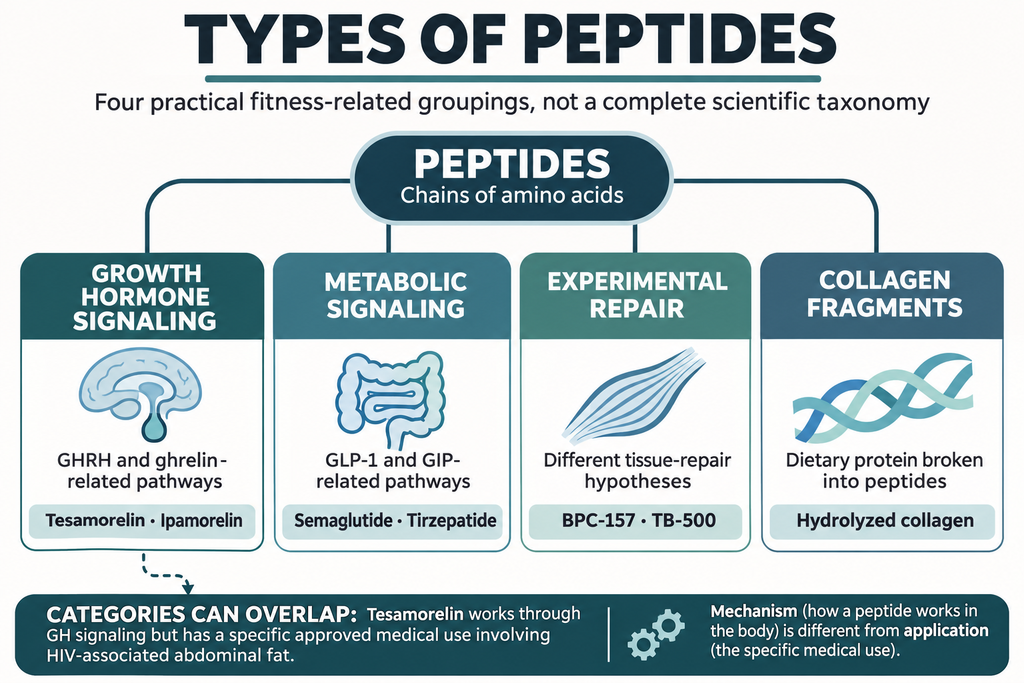
Peptides can be classified by their structure or biological function, but there is no universally accepted number of types. In fitness, four useful categories are growth hormone-related peptides, metabolic peptides, experimental recovery peptides, and collagen peptides.
The National Human Genome Research Institute generally describes peptides as chains of two to 50 amino acids, although that isn’t a strict cutoff. Insulin, for example, contains 51 amino acids and is still considered a peptide hormone.
In bodybuilding, we tend to group compounds by what we expect them to accomplish. CJC-1295 gets associated with muscle growth because it stimulates growth hormone release. BPC-157 comes up in discussions about injury recovery.
I think it’s more useful to look at what has actually been demonstrated.
| Type of peptide | Examples | What the evidence supports |
| Growth hormone | Tesamorelin, sermorelin, CJC-1295, ipamorelin | These compounds stimulate growth hormone release. Tesamorelin has a specific FDA-approved medical use, but muscle-growth benefits from experimental compounds remain unproven. |
| Metabolic | Semaglutide, tirzepatide, liraglutide | These drugs influence appetite and blood glucose regulation. Large human trials support their use for specific medical conditions, including weight management. |
| Experimental recovery | BPC-157, TB-500 | Investigated or promoted for tissue repair, but convincing human evidence for sports-injury recovery is lacking. |
| Collagen | Hydrolyzed bovine or marine collagen | Fragments of dietary protein, with mixed human evidence for skin and joint benefits. |
These categories aren’t formal scientific families. They’re a convenient way to organize the compounds people encounter in fitness.
And that’s sufficient for our purposes. Once we know which compound we’re discussing, we can examine its actual effects rather than judging it by the category someone has put it in.
How Do Growth Hormone Peptides Work?
Growth hormone peptides stimulate the pituitary gland to release growth hormone (GH). Some mimic growth hormone-releasing hormone (GHRH), a natural signal from the brain. Others activate the ghrelin receptor, which also influences GH secretion.
Unlike taking growth hormone directly, these compounds stimulate the body’s own production. GH is normally released in pulses, and increasing those levels doesn’t necessarily mean more muscle growth.
GHRH Analogs: What Do Sermorelin, Tesamorelin, and CJC-1295 Have in Common?
Sermorelin, tesamorelin, and CJC-1295 all mimic GHRH, but their medical uses and regulatory status differ considerably.
Sermorelin is a shortened version of GHRH. It was previously available in FDA-approved products under the name Geref. Those products were discontinued, although the FDA determined in 2013 that they had not been withdrawn for safety or effectiveness reasons. That doesn’t make today’s commercially available sermorelin preparations FDA-approved.
Tesamorelin is an approved prescription medication, but for the purpose of reducing excess abdominal fat in adults with HIV-associated lipodystrophy. Its FDA-approved labeling explicitly states that it isn’t indicated for weight-loss management.
CJC-1295 is experimental. Small human studies have demonstrated increases in GH and IGF-1 levels, but they haven’t established that the compound improves muscle growth or strength in healthy lifters.
Ghrelin-Pathway Secretagogues: How Is Ipamorelin Different?
Ipamorelin stimulates growth hormone release by activating the ghrelin receptor rather than mimicking GHRH. GHRP-2 and GHRP-6 work through this pathway as well.
In bodybuilding, you’ll sometimes see these compounds discussed alongside GHRH analogs, with the idea that stimulating both pathways should produce a greater response.
That may sound reasonable from a hormonal perspective. But we still need evidence that the combination produces better training results without unacceptable risks.
Another compound frequently mentioned here is MK-677, also called ibutamoren. It activates the ghrelin receptor, but chemically it’s a small molecule, not a peptide. It gets included in peptide discussions because of its effects on growth hormone.
Can Growth Hormone Peptides Build Muscle?
There isn’t convincing evidence from controlled human trials that experimental growth hormone secretagogues increase muscle size or strength in healthy lifters.
We’ve established that some of these compounds can raise GH levels. What hasn’t been established is whether those hormonal changes produce meaningful improvements in muscle growth during resistance training.
That’s what I’d want to see before considering them useful for bodybuilding.
There’s also the issue of competitive sport. Several of these compounds, including CJC-1295 and ipamorelin, are prohibited under World Anti-Doping Agency rules.
What Are Healing Peptides Supposed to Do?
Healing peptides are compounds promoted for faster tissue repair, particularly tendon and ligament injuries. BPC-157 and TB-500 are popular examples in bodybuilding, but controlled human trials have not established that either helps injured athletes recover faster.
I understand the interest. A persistent tendon injury can interfere with training for months, and the idea of speeding up recovery is appealing.
But improving a repair-related process in a laboratory isn’t the same as restoring a person’s ability to train.
BPC-157: What Do the Human Studies Actually Examine?
BPC-157 has been studied in humans, but the available research doesn’t establish that it improves recovery from sports injuries.
It’s a synthetic peptide consisting of 15 amino acids. Much of the interest comes from animal experiments investigating tissue repair.
An October 2026 systematic review identified three published human studies involving just 30 participants.
Only one examined a musculoskeletal complaint. It involved 16 people receiving BPC-157 for knee pain, with researchers looking back at their reported symptoms. There was no control group to establish whether the treatment was responsible for any improvement.
The other studies involved 12 people with bladder symptoms and a two-person safety investigation.
So yes, human research exists. But these studies don’t demonstrate that BPC-157 repairs damaged tendons or gets athletes back to training sooner. They also aren’t sufficient to establish its safety.
TB-500: Why the Fragment Isn’t the Parent Protein
TB-500 is commonly identified as a seven-amino-acid fragment of thymosin beta-4, a larger protein involved in several biological processes. Research on the full-length protein doesn’t automatically establish what the smaller fragment does.
This is where some of the marketing gets rather creative.
Thymosin beta-4 has been investigated in wound healing and other medical research. But much of that work didn’t involve TB-500 itself.
A 2026 review of the evidence found no controlled human studies demonstrating that marketed TB-500 improves musculoskeletal recovery. Researchers also noted that products sold under this name aren’t always clearly identified.
Combining TB-500 with BPC-157 in the so-called Wolverine stack doesn’t solve the evidence problem. We still don’t know whether the combination works or is safe.
Both substances are also prohibited under WADA rules.
Where Does Copper Peptide GHK-Cu Belong?
GHK-Cu is a copper-binding peptide studied mainly for skin-related effects. It hasn’t been shown to improve muscle or ligament healing in humans.
Small studies of topical GHK-Cu have investigated cosmetic outcomes, including changes in skin appearance. Results have been mixed, and the clinical research remains limited.
But applying a peptide to the skin is quite different from injecting it to treat an injury. The FDA has raised safety concerns about injectable GHK-Cu, including potential immune reactions associated with peptide impurities.
From a training perspective, I’d want to know whether an injured person can regain strength and return to their normal workload.
Until these compounds demonstrate that kind of benefit in proper clinical trials, diagnosis and appropriate rehabilitation remain the more sensible approach.
What Are Metabolic Peptides?
Metabolic peptides are hormones or peptide-based medicines that help regulate appetite and blood sugar. Some, including semaglutide and tirzepatide, can produce substantial weight loss in people with obesity. However, they primarily achieve this by reducing food intake, not by directly increasing fat burning.
In bodybuilding, we’ve had compounds that increase energy expenditure for decades. Modern GLP-1 medications approach weight loss differently by making eating less considerably easier.
GLP-1 and GIP: Two Signals, Different Treatments
GLP-1 and GIP are hormones released by the intestine after eating. Both help the pancreas release insulin when blood sugar rises. GLP-1 also plays a role in appetite regulation.
Semaglutide and liraglutide activate GLP-1 receptors. Tirzepatide activates both GLP-1 and GIP receptors.
These medications have demonstrated substantial benefits in clinical trials, particularly for people with obesity. I consider that genuine medical progress.
But someone losing weight because they’re less hungry isn’t necessarily improving their physical fitness. That’s where nutrition and resistance training still have a role.
I’ve discussed this further in my article on semaglutide for weight loss.
And despite their association with injections, peptide medications aren’t necessarily injectable. FDA-approved oral semaglutide tablets are now available for weight management in eligible adults.
Why Do Some “Fat-Burning Peptides” Turn Out Not to Be Peptides?
Products marketed as fat-burning peptides sometimes include experimental compounds with unproven benefits, or substances that aren’t peptides at all.
AOD-9604 is an example worth examining. It’s a peptide fragment derived from growth hormone that was investigated as a possible obesity treatment.
Unlike many experimental peptides discussed in bodybuilding, AOD-9604 has actually been studied in a relatively large human trial.
Unfortunately, the results weren’t particularly encouraging.
According to an FDA review of the research, a placebo-controlled trial involving 502 adults with obesity found no statistically significant improvement in weight loss with AOD-9604. The company subsequently discontinued its development for obesity.
So we have more than a theoretical mechanism here. We have human testing that failed to demonstrate the intended benefit.
Then there’s 5-amino-1MQ, which isn’t a peptide. It’s a small molecule designed to inhibit an enzyme called nicotinamide N-methyltransferase (NNMT), which participates in cellular metabolism.
A 2018 study reported reductions in body weight and fat tissue in obese mice treated with 5-amino-1MQ. That makes it interesting for further research, but we don’t have clinical trials establishing weight-loss benefits in humans.
Tesamorelin is another compound you’ll encounter on these lists. As discussed earlier, it has an FDA-approved use for excess abdominal fat associated with HIV-related lipodystrophy, not general weight management.
For someone interested in losing body fat, I’d be more concerned with the results demonstrated in humans than with which compounds a peptide retailer happens to put in its weight-loss category.
What Are Collagen Peptides?
Collagen peptides are small fragments of collagen protein, usually obtained from animal connective tissue and sold as dietary supplements. They’re produced by hydrolysis, a process that breaks collagen into shorter chains that are easier to digest.
Collagen is particularly rich in glycine and proline, including the modified amino acid hydroxyproline. These amino acids are important components of the collagen found naturally in your tendons and skin.
But consuming collagen doesn’t mean your body automatically sends it to a damaged tendon. We need to look at what happens after digestion.
Do Collagen Peptides Survive Digestion?
Yes. Some collagen peptides survive digestion as small fragments and enter the bloodstream. They aren’t all broken down into individual amino acids.
A 2024 randomized crossover study tested collagen hydrolysates from different animal sources in six healthy adults.
Researchers detected small collagen-derived peptides in their blood, including proline-hydroxyproline (Pro-Hyp).
That’s interesting because it shows that some fragments remain intact during absorption.
However, the study involved only six participants, had substantial industry involvement, and measured absorption rather than any health benefit.
We still don’t know whether those circulating peptides reach an injured tendon in sufficient amounts to improve healing.
What’s the Difference Between Collagen Types I, II, and III?
Types I, II, and III refer to different forms of collagen found in the body. Type I is abundant in tendons and skin, type II is characteristic of cartilage, and type III is found in tissues such as skin and blood vessels.
Supplement labels can make this unnecessarily confusing.
Bovine collagen generally comes from cattle, while marine collagen usually comes from fish. Those names tell you the animal source, not necessarily the collagen type or the effects you can expect.
There’s also a difference in processing.
Hydrolyzed collagen has been broken down into smaller peptides. Undenatured type II collagen retains much of its original protein structure and has been investigated for joint health through a different proposed mechanism.
So you cannot assume that research on one preparation applies to another.
And buying a supplement containing five collagen types instead of two doesn’t automatically mean you’re getting a better product.
What Have Studies Actually Shown for Joints and Tendons?
Collagen supplementation may improve certain measurements of tendon structure when combined with exercise, but we don’t have convincing evidence that it makes people stronger or reliably speeds up injury recovery.
A 2026 systematic review examined eight randomized trials involving 257 participants.
All eight studies included resistance or plyometric exercise.
Three of the four studies measuring tendon cross-sectional area found greater increases with collagen supplementation than with placebo. Two studies using higher collagen amounts also reported greater improvements in tendon stiffness.
Now, these findings are worth investigating. Tendon structure matters for handling mechanical loads.
But the trials were small, lasted only three to 15 weeks, and included just 11 women. More importantly, collagen did not provide additional improvements in maximal muscle strength beyond those achieved through training.
We also shouldn’t assume that increased tendon thickness means an injured tendon has healed or that someone can return to heavy lifting sooner.
For joint pain, the evidence isn’t particularly convincing either. The 2026 VA/DoD osteoarthritis guideline found insufficient evidence to recommend for or against collagen supplements for hip or knee osteoarthritis.
So I wouldn’t dismiss collagen entirely, but I also wouldn’t put it anywhere near the top of my priorities for someone trying to get stronger or recover from an injury.
And collagen isn’t a replacement for whey or other complete proteins when building muscle. It lacks tryptophan and provides relatively little of several essential amino acids needed for muscle protein synthesis.
If muscle growth is the goal, I’d focus on sufficient high-quality protein and progressive resistance training first.
Are There Other Types of Peptides?
Yes. Peptides have functions well beyond muscle growth, metabolism, or tissue repair. Some regulate nerve signals, while others help the body defend itself against infections. Several are also used as medicines.
Insulin is a good example. Bodybuilders have been discussing it for decades, but its established medical use is controlling blood sugar in people with diabetes. It’s a peptide hormone, although it has practically nothing in common with a collagen supplement.
Then you have substance P, a neuropeptide involved in pain signaling. Oxytocin helps regulate childbirth and milk release, while vasopressin helps the kidneys control water balance. The body also produces antimicrobial peptides that help fight certain microorganisms.
So the four categories we’ve covered are useful for understanding peptides commonly discussed in fitness. They’re not a complete classification of peptide biology.
Are Different Types of Peptides Safe and Legal?
Some peptides are FDA-approved medicines, while others are sold as supplements or used in experimental treatments. Their legal status depends on the specific product. And being legally available doesn’t automatically mean something is safe or effective.
Take semaglutide. It has been studied in large clinical trials and is approved for specific medical uses. But it can cause gastrointestinal side effects, and in November 2026, the FDA required additional warnings concerning a potential increased risk of a rare eye condition that can cause sudden vision loss.
So even established medications carry risks.
The situation with experimental peptides is more complicated.
In October 2026, the Department of Health and Human Services introduced an interim policy covering the compounding of six peptides: BPC-157, TB-500, MOTS-c, epitalon, KPV, and Semax.
Under specified conditions, HHS does not intend to take enforcement action against qualifying licensed compounders preparing these products for individual patients.
The conditions are quite specific. They include requirements for the peptide’s identity and permitted formulation, manufacturing documentation, and patient-specific prescriptions. The policy also limits qualifying preparations to a single active ingredient.
But this isn’t FDA approval.
It doesn’t establish that BPC-157 heals tendons or that TB-500 improves recovery. Those claims still need proper clinical trials.
And it doesn’t mean combining experimental peptides into a bodybuilding stack is covered by the policy.
Collagen supplements and cosmetic peptides are regulated differently. Their availability in stores shouldn’t be confused with FDA approval of their claimed benefits.
Personally, I would be far more interested in what a compound has demonstrated in humans than whether someone has found a legal way to sell it.
What Changes for Tested Athletes in 2027?
Under the announced 2027 WADA rules, BPC-157 and TB-500 remain prohibited, along with growth hormone-related compounds such as ipamorelin and MK-677. Insulin is also prohibited unless the athlete meets the applicable therapeutic-use exemption requirements.
According to the US Anti-Doping Agency’s 2027 guidance, semaglutide and tirzepatide are monitored rather than prohibited. Monitoring allows anti-doping authorities to study their use in sports; it doesn’t mean athletes commit a doping violation simply by using them.
The 2027 rules take effect on January 1, 2027. Until then, the 2026 list remains in force.
For competitive bodybuilders and other tested athletes, the practical question is straightforward: check the exact substance before using it. A product being available through a pharmacy or peptide supplier doesn’t establish that it’s permitted in competition.
How Can You Tell What Type of Peptide You’re Looking At?
Start by identifying the actual compound and what it has been shown to do in humans. Its mechanism explains how it works, but the clinical evidence tells us whether it’s useful for the purpose being advertised. Also check whether the product is FDA-approved or still experimental.
Take tesamorelin. You’ll find it discussed in fat-loss circles because it can reduce abdominal fat in adults with HIV-associated lipodystrophy. That’s its approved medical use. It doesn’t mean a healthy bodybuilder will get leaner by taking it.
Then there’s MK-677. It’s often sold alongside growth hormone peptides because it stimulates the same hormonal pathway as certain peptide compounds. Chemically, however, it’s a small molecule, not a peptide. There are some indications that is furthers the growth of cancer cells. Stay away!
Collagen powder is different again. It’s processed dietary protein, and its potential benefits for skin or joints need to be judged on the research for those outcomes.
From a coaching perspective, I’d also question why someone is considering a peptide in the first place.
If your strength has stalled, I’d look at your training program before worrying about growth hormone. If you’re dealing with a persistent injury, you need to establish what’s wrong rather than assume an experimental compound will repair it.
And if there’s a genuine medical condition, treatment belongs with a qualified physician.
For healthy lifters, there is no established peptide treatment that reliably delivers both greater muscle growth and fat loss. I’d want to see proper human trials demonstrating those results before recommending one.
Maik’s View: Know What the Compound Is Before Asking What It Can Do
Bodybuilding, like any sport, has always been interested in compounds that might provide an advantage. That’s not news. But understanding the effects and knowing whether it’s worth using are two separate considerations.
If a peptide raises growth hormone, fine. Show me what that does for muscle growth in trained people. If it’s supposed to accelerate recovery, I want to know whether injured athletes actually returned to training sooner.
Otherwise, we’re dealing with an interesting theory, not a proven benefit.
And before spending money on experimental compounds, I’d make sure your training and diet are in order. You’d be surprised how much progress people leave on the table simply because their programming isn’t particularly good.
That’s something we can work on.
Book a complimentary 60-minute personalized fitness session with our New York City team, and we’ll look at what your training needs.
Frequently Asked Questions About Types of Peptides
Are Peptides the Same as Steroids?
No, peptides are not the same as anabolic steroids. Peptides are chains of amino acids, while anabolic-androgenic steroids have a different chemical structure and generally act through different mechanisms. Some peptides affect hormone signaling, but that doesn’t make them chemically equivalent to steroids or necessarily safer.
Is Every Peptide a Hormone?
No, not every peptide is a hormone. Insulin and oxytocin are peptide hormones, while collagen peptides are fragments of dietary protein. Other peptides have roles in immune defense or nervous system signaling. The word “peptide” describes a molecule’s structure, not its biological function.
Are All Peptides Broken Down Before They Reach the Blood?
No, not all peptides are completely broken down before entering the bloodstream. Human studies have detected small collagen-derived peptides in blood after oral collagen consumption. However, their presence in circulation doesn’t prove they reach an injured tendon or joint in meaningful amounts, or that they improve healing.
Is MK-677 a Peptide?
No, MK-677 (ibutamoren) is not a peptide. It’s a small-molecule growth hormone secretagogue that acts through the ghrelin receptor. Although it’s frequently marketed alongside performance-related peptides, it has a different chemical structure. MK-677 is also prohibited under WADA anti-doping rules.
What Peptide Medicines Are FDA-Approved?
FDA-approved peptide medicines include specific formulations of semaglutide, tirzepatide, liraglutide, tesamorelin, and insulin. These medications have approved uses for particular medical conditions, such as diabetes, obesity, or certain forms of excess abdominal fat associated with HIV. FDA approval doesn’t extend to every product containing the same peptide or to unapproved compounded preparations.
Can I Take Peptides Without Injections?
Yes, some peptides are available without injections. Collagen peptides are sold as oral supplements, certain cosmetic peptides are applied to the skin, and FDA-approved oral peptide medications exist. However, many peptides are broken down during digestion, so swallowing them doesn’t necessarily produce the intended effect. Effectiveness depends on the specific formulation and clinical evidence.
This article is for educational purposes and isn’t individualized medical advice. It does not recommend experimental peptide treatments. Clinical and regulatory information should be verified before publication.

Maik Wiedenbach is a Hall of Fame swimmer turned bodybuilding champion and fitness model featured in Muscle & Fitness and Men’s Journal. An NYU adjunct professor and award-winning coach, he founded New York’s most sought-after personal training gym.