
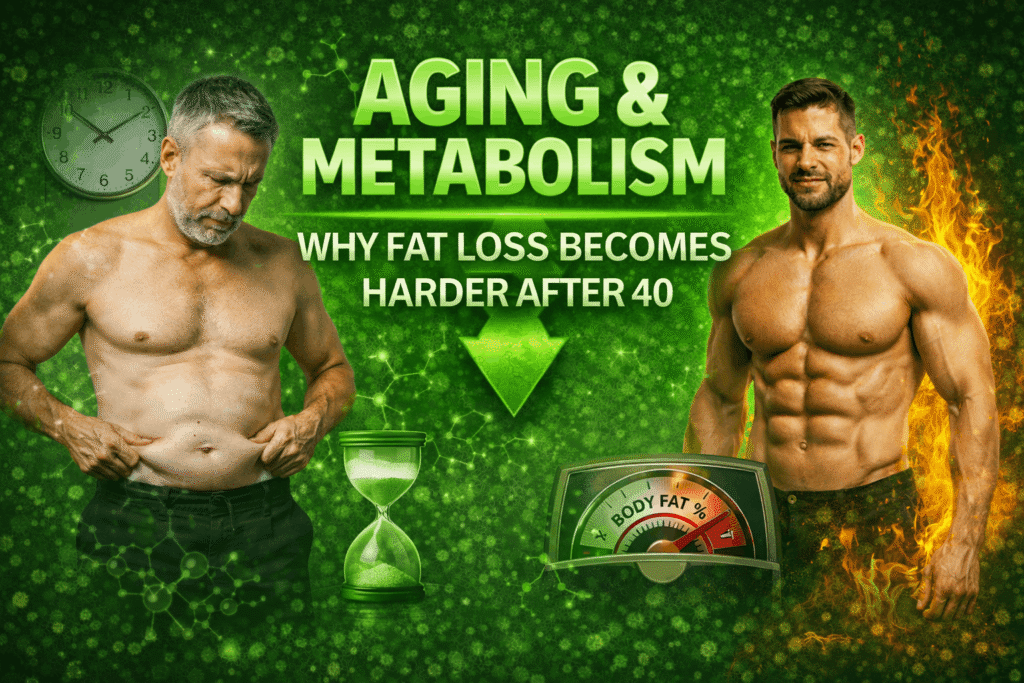
Every few weeks, someone sits down in my gym for an initial consultation and says some version of the same thing: “I used to eat whatever I wanted and stay lean. Now I look at bread and gain five pounds.”
I hear you. And I’m going to tell you something the fitness industry profits from keeping vague.
Your metabolism did not break. It did not shut down. It did not betray you on your 40th birthday.
What happened is more nuanced, more fixable, and honestly more within your control than you’ve been led to believe. The supplement companies want you to think your metabolism is shattered so they can sell you a pill. The crash diet influencers want you to think it’s all about eating 1,200 calories and doing more cardio. Neither of those is the answer.
Here’s what actually changed. You lost muscle. Gradually, over years, without noticing. You moved less during the day. Your hormones shifted. Your sleep got worse. And all of those factors compound quietly until one day your jeans don’t fit and you assume your metabolism gave up.
It didn’t give up. It adapted. And you can adapt right back.
I’ve spent over 20 years training clients over 40 in New York City. Men and women who walked in frustrated, confused, and ready to blame their age for everything. Most of them transformed their body composition within months. Not by finding some metabolic hack. By understanding what actually changed and addressing it with precision.
This article is the full picture. What science says. What the myths are. And the practical framework that works when you’re done chasing quick fixes.
Over 40 and struggling to lose fat? Start with a free consultation.
Does Metabolism Really Slow After 40?
Yes. But far less dramatically than you’ve been told. Let’s define metabolism at first: the main players ( think 90% ) are brain, lungs, liver and kidneys. They do not slow down until you are in your 70s
What the Research Actually Shows
A landmark 2021 study published in Science, one of the largest analyses of human metabolism ever conducted, found that metabolic rate remains remarkably stable between the ages of 20 and 60. The decline in that window? Roughly 0.7 percent per year. Not the catastrophic freefall the wellness industry describes.
After 60, the decline accelerates slightly, but even then, the primary driver is not age itself. It’s the loss of metabolically active tissue. Muscle.
The National Institute on Aging confirms that maintaining a healthy weight remains achievable throughout midlife with appropriate lifestyle strategies.
What really changes? People move less and have more disposable income to spend on food.
Muscle Mass and Energy Expenditure
This is the core of the issue. Muscle is metabolically expensive tissue. Every pound of muscle burns approximately 6 to 7 calories per day at rest. Fat burns about 2 calories per pound. The more muscle you carry, the higher your basal metabolic rate (BMR).
Starting around age 30, adults who don’t engage in resistance training lose approximately 3 to 8 percent of muscle mass per decade. This process, called sarcopenia, accelerates after 40. By the time you’re 50, you may have lost 10 to 15 percent of the muscle you had at 30 if you haven’t actively worked to maintain it.
That lost muscle translates directly to fewer calories burned at rest. If you’ve lost 8 pounds of muscle over two decades, that’s roughly 50 fewer calories burned per day. Sounds small? Over a year, that’s 18,000 calories, or about 5 pounds of potential fat gain, without eating a single extra bite.
Key Takeaway: Metabolism does not suddenly crash at 40, but gradual muscle loss and reduced daily movement can lower total calorie burn over time. You combine this with an increased caloric intake and you have a recipe for disaster. The slowdown is real but largely preventable.
Why Is It Harder to Lose Weight After 40?
The difficulty is real. But it’s not one thing. It’s the convergence of several factors that stack up simultaneously.
Hormonal Changes in Women
Perimenopause typically begins in the early to mid-40s, and with it comes a progressive decline in estrogen and progesterone. These hormonal shifts have direct metabolic consequences:
Estrogen decline changes fat distribution. Fat storage shifts away from the hips and thighs toward the abdomen. Visceral fat, the metabolically active fat that wraps around organs, increases. This isn’t just a cosmetic concern. Visceral fat drives insulin resistance, inflammation, and cardiovascular risk.
Insulin sensitivity decreases. With less estrogen, the body becomes less efficient at managing blood sugar. More insulin circulates. More energy gets stored as fat. The same meal that your body handled effortlessly at 35 now produces a stronger fat-storage signal at 45.
Progesterone decline affects sleep. Progesterone has a calming, sleep-promoting effect. As levels drop, sleep quality often suffers, which triggers a cascade of metabolic disruption (elevated cortisol, increased hunger hormones, reduced recovery capacity).
The Office on Women’s Health provides detailed resources on menopause symptoms and health impacts.
Testosterone Changes in Men
Men experience a more gradual hormonal shift, sometimes called andropause. Testosterone declines approximately 1 percent per year after age 30. By 45, many men are operating with meaningfully lower testosterone than they had a decade earlier.
Lower testosterone directly affects muscle maintenance and growth. Less muscle means a lower metabolic rate. Lower testosterone also reduces energy and motivation, which indirectly decreases training intensity and daily movement. The result is a slow erosion of the metabolic infrastructure that kept body composition in check during younger years.
Lifestyle Factors That Compound the Problem
Hormones get the headlines, but lifestyle shifts often do more damage:
NEAT declines. Non-exercise activity thermogenesis (all the movement you do outside of formal workouts) tends to decrease significantly in your 40s. More desk time. Less spontaneous movement. Fewer stairs. NEAT can account for 15 to 30 percent of total daily energy expenditure. When it drops, calorie burn drops with it.
Sleep deteriorates. Both quality and quantity tend to worsen with age. Poor sleep elevates cortisol, increases ghrelin (hunger hormone), suppresses leptin (satiety hormone), and impairs insulin sensitivity. One bad night of sleep can increase calorie intake by 300 to 400 calories the following day.
Stress peaks. Career demands, family responsibilities, financial pressure. The 40s are often the highest-stress decade of adult life. Chronic stress keeps cortisol elevated, which promotes visceral fat storage and muscle breakdown simultaneously.
Key Takeaway: Fat loss becomes harder after 40 largely due to muscle loss, hormonal shifts, and reduced daily movement rather than a dramatic metabolic shutdown.
Metabolic Factors: What Changes After 40
| Factor | What Happens | Impact on Metabolism | Controllable? |
| Muscle mass | Declines 3-8% per decade | Reduces BMR directly | Yes (resistance training) |
| Estrogen (women) | Declines during perimenopause/menopause | Shifts fat to abdomen, reduces insulin sensitivity | Partially (HRT, lifestyle) |
| Testosterone (men) | Declines ~1% per year after 30 | Reduces muscle, lowers energy | Partially (TRT, lifestyle) |
| NEAT | Decreases with sedentary lifestyle | Reduces TDEE by 15-30% | Yes (daily movement) |
| Sleep quality | Often worsens | Disrupts hunger hormones, cortisol | Yes (sleep hygiene) |
| Insulin sensitivity | Decreases with age | Promotes fat storage | Yes (training, nutrition) |
| Stress/cortisol | Often peaks in midlife | Promotes visceral fat | Yes (stress management) |
How Do Hormones Affect Metabolism With Age?
Let me separate the signal from the noise here, because the internet is full of oversimplified hormone content.
Estrogen and Fat Storage
Estrogen does not directly control your metabolic rate. What it does is influence where fat is stored and how efficiently your body manages insulin. When estrogen drops during menopause, two things happen: fat redistributes toward the abdomen, and insulin sensitivity decreases. Both of these make fat loss harder, but neither makes it impossible.
Women who maintain muscle mass through resistance training and adequate protein intake can significantly offset the metabolic impact of estrogen decline. The training doesn’t replace the hormone. It compensates for the metabolic consequences of losing it.
Progesterone and Sleep
Progesterone’s most underappreciated role is its effect on sleep. It promotes relaxation and deep sleep. When progesterone drops (often the first hormone to decline in perimenopause), sleep suffers. And as we’ve covered in our sleep optimization guide, poor sleep is one of the most destructive forces for metabolism and body composition.
Testosterone and Lean Mass
In men, testosterone is the primary anabolic hormone responsible for maintaining muscle mass. Its decline creates a double problem: less muscle is maintained (lowering metabolic rate) and less muscle is built in response to training (reducing the return on exercise investment).
This is why many men over 40 feel like they’re training hard but not seeing results. Their hormonal environment has changed. The solution isn’t to train harder. It’s to train smarter (progressive overload, adequate volume, sufficient recovery) and address the hormonal environment through lifestyle, and when clinically appropriate, through medical intervention like TRT.
Thyroid Function
Thyroid hormones (T3 and T4) directly regulate metabolic rate. Hypothyroidism, which becomes more common with age, can meaningfully reduce energy expenditure, increase fatigue, and promote weight gain. If you’re doing everything right and still not losing fat, a thyroid panel is a reasonable conversation to have with your physician.
The National Institute of Diabetes and Digestive and Kidney Diseases provides clinical information on thyroid disorders and their metabolic effects.
However, subclinical thyroid issues are often blamed for weight gain when the real culprits are muscle loss, poor sleep, and inactivity. Get the bloodwork. But don’t assume your thyroid is the problem until the data confirms it.
Highlight: Hormones vs. Lifestyle After 40
Hormonal shifts account for a portion of metabolic change after 40, but lifestyle factors (muscle loss, reduced movement, poor sleep, chronic stress) are responsible for the majority of metabolic decline. Addressing the lifestyle factors first often produces significant results before any hormonal intervention is needed.
Is Weight Gain Inevitable in Midlife?
No. Full stop.
Weight gain in midlife is common. It is not inevitable. Those are two very different statements. The fact that most people gain weight after 40 reflects common lifestyle patterns, not biological destiny.
Energy balance still governs fat loss at every age. If you consume fewer calories than you expend, you will lose fat. The challenge after 40 is that your expenditure has likely decreased (less muscle, less movement, disrupted hormones) while your intake has stayed the same or increased.
Body recomposition, losing fat while maintaining or building muscle, remains entirely possible after 40. I’ve helped hundreds of clients achieve it. The process is slower than at 25. The margin for error is smaller. But the outcome is absolutely attainable with the right approach.
Need a plan built for your body after 40? Talk to our coaching team.
Can You Speed Up Metabolism After 40?
“Speed up” is the wrong framing, but the intent behind the question is valid. You can absolutely increase your daily calorie burn and improve your metabolic efficiency after 40. Here’s how, in order of impact.
Strength Training: The Non-Negotiable
Resistance training is the single most effective intervention for metabolic health after 40. Nothing else comes close.
Building and preserving muscle directly increases your basal metabolic rate. Beyond the resting calorie burn, strength training also produces excess post-exercise oxygen consumption (EPOC), which elevates your metabolism for 24 to 48 hours after a session. And the improved insulin sensitivity from regular resistance training makes your body more efficient at using food for fuel rather than storage.
Aim for 3 to 4 sessions per week with progressive overload, train the whole body twice with sufficient intensity and track progress.
Protein Intake: The Muscle Preservation Tool
Protein does three critical things for metabolism after 40:
Supports muscle protein synthesis. Your body needs adequate amino acids to maintain and build muscle tissue. After 40, the anabolic response to protein becomes somewhat blunted (a phenomenon called anabolic resistance), which means you actually need more protein than you did at 25 to achieve the same muscle-building effect.
Has the highest thermic effect. Protein requires more energy to digest than carbs or fat. The thermic effect of protein is approximately 20 to 30 percent of calories consumed, compared to 5 to 10 percent for carbs and 0 to 3 percent for fat. Eating more protein literally costs your body more energy to process.
Increases satiety. Protein keeps you fuller longer, which makes maintaining a caloric deficit more sustainable.
Aim for 0.7 to 1 gram per pound of bodyweight daily. Spread across 3 to 4 meals.
Daily Movement: The Silent Calorie Burner
NEAT is the metabolic variable most people overlook entirely. Your formal training sessions might burn 200 to 400 calories. Your total NEAT across a day can account for 300 to 800 calories or more.
Target 7,000 to 10,000 steps per day. Take calls standing. Walk after meals. Park farther away. These sound trivial. They add up to hundreds of calories daily.
Sleep and Stress: The Hormonal Regulators
Chronic sleep deprivation and unmanaged stress both elevate cortisol, suppress anabolic hormones, impair insulin sensitivity, and increase hunger. Fixing sleep (7 to 9 hours, consistent schedule) and implementing stress management practices can create measurable metabolic improvement without changing a single thing about your training or diet.
Key Takeaway: The most effective way to increase metabolism after 40 is to build and preserve muscle through resistance training and adequate protein intake.
What Is the Best Strategy for Fat Loss Over 40?
Here is the framework I use with every client over 40. It’s not exciting. It doesn’t sell supplements. But it works consistently.
Prioritize Muscle Above Everything
This is the foundational principle. Muscle is your metabolic engine. Every decision in your fat loss strategy should protect and build lean mass. Lift 3 to 4 times per week. Use compound movements. Apply progressive overload. Do not sacrifice training to do more cardio.
Use a Moderate Caloric Deficit
A deficit of 300 to 500 calories below maintenance is the sweet spot after 40. Aggressive deficits (800+ calories) accelerate muscle loss, trigger adaptive thermogenesis, tank your energy, and are unsustainable. You’ll lose weight fast and regain it faster.
Expect 0.5 to 1 percent of bodyweight loss per week. For a 180-pound person, that’s roughly 1 to 1.5 pounds per week. Slow feels frustrating. Slow also means you’re keeping the muscle that keeps your metabolism intact.
Track Body Composition, Not Just the Scale
The scale is a blunt instrument after 40. If you’re resistance training in a moderate deficit, you can lose fat and gain muscle simultaneously (body recomposition). That might show as minimal scale change while your waist decreases, your strength increases, and your clothes fit differently.
Use waist measurements, progress photos, and strength logs as your primary metrics. If available, periodic DEXA scans provide the most accurate body composition data.
Address Hormones If Clinically Indicated
If you’ve dialed in training, nutrition, sleep, and stress and still aren’t progressing, a comprehensive hormonal panel is warranted. This means checking total and free testosterone, estradiol, thyroid function (TSH, free T3, free T4), fasting insulin, and cortisol.
Work with a physician. Avoid self-diagnosis based on internet symptom checklists. And avoid the temptation to pursue hormonal optimization before you’ve honestly addressed the lifestyle fundamentals.
Explore our training programs built for clients over 40.
How Many Calories Do You Need After 40?
There’s no single number that applies to everyone. But here’s how to find yours.
Step 1: Estimate your Total Daily Energy Expenditure (TDEE). Multiply your bodyweight in pounds by 13 to 15 for a moderate activity level. A 180-pound person with moderate activity lands somewhere around 2,340 to 2,700 calories per day.
Step 2: Adjust for lean mass. If you carry more muscle than average, lean toward the higher multiplier. If you’re relatively sedentary outside of training, lean lower.
Step 3: Apply a moderate deficit. Subtract 300 to 500 calories from your estimated TDEE. That becomes your daily target.
Step 4: Monitor for 2 to 3 weeks. Track your weight, measurements, and energy levels. If you’re losing at the expected rate (0.5 to 1 percent of bodyweight per week), hold steady. If nothing’s changing, reduce by another 100 to 200 calories and reassess.
Step 5: Avoid going below BMR. Your basal metabolic rate is the minimum energy your body needs for basic functions. For most adults, this falls between 1,200 and 1,800 calories. Eating below this threshold accelerates muscle loss, triggers metabolic adaptation, and is unsustainable.
Calorie Estimation Guide After 40
| Body Weight | Estimated TDEE (moderate activity) | Fat Loss Target (moderate deficit) | Minimum Threshold (BMR estimate) |
| 140 lbs | 1,820 – 2,100 | 1,420 – 1,700 | ~1,250 |
| 160 lbs | 2,080 – 2,400 | 1,680 – 2,000 | ~1,400 |
| 180 lbs | 2,340 – 2,700 | 1,940 – 2,300 | ~1,550 |
| 200 lbs | 2,600 – 3,000 | 2,200 – 2,600 | ~1,700 |
| 220 lbs | 2,860 – 3,300 | 2,460 – 2,900 | ~1,800 |
These are estimates. Individual variation based on muscle mass, activity level, and hormonal status can shift these numbers meaningfully.
The Dietary Guidelines for Americans provides population-level calorie recommendations by age and activity level as a reference starting point.
What Foods Boost Metabolism?
Let me be straightforward here. No single food will meaningfully “boost” your metabolism. The idea that eating certain superfoods will rev your metabolic engine is marketing, not science.
That said, your food choices do influence metabolic function through several real mechanisms:
High-protein foods (chicken, fish, eggs, Greek yogurt, lean beef, legumes) have the highest thermic effect of any macronutrient. Eating 30 grams of protein costs your body roughly 6 to 9 calories just to digest. That adds up across a day of high-protein eating.
High-fiber foods (vegetables, fruits, whole grains, legumes) support insulin sensitivity, blood sugar regulation, and satiety. They also support gut health, which emerging research links to metabolic function.
Caffeine does temporarily increase metabolic rate by 3 to 11 percent, depending on dose and individual tolerance. A cup or two of coffee in the morning is a modest but real metabolic assist. Just keep it before early afternoon to protect sleep quality.
Spicy foods and green tea have measurable but tiny effects on metabolic rate. We’re talking about 10 to 30 extra calories per day. Not meaningless, but not a strategy.
The bottom line: eat enough protein, eat plenty of fiber-rich whole foods, and stop looking for the magic ingredient that doesn’t exist.
Is Metabolic Damage Real?
This is one of the most misunderstood topics in fitness, and it deserves a clear, honest answer.
“Metabolic damage” as commonly described online is not real. Your metabolism does not permanently break due to dieting.
What IS real is adaptive thermogenesis. When you diet, especially aggressively, your body adapts by:
- Reducing resting metabolic rate (your organs and muscle become slightly more efficient)
- Decreasing NEAT (you move less unconsciously)
- Lowering the thermic effect of food (you absorb more from what you eat)
- Adjusting hunger hormones (ghrelin increases, leptin decreases)
These adaptations can lower your TDEE by 10 to 15 percent below what would be predicted by your new body weight. This is your body’s survival response. It’s working as designed.
The critical point: these adaptations are reversible. Returning to maintenance calories, rebuilding muscle through resistance training, and restoring sleep and daily movement will bring metabolic rate back toward expected levels. The timeline varies, typically 4 to 12 weeks of eating at maintenance, sometimes longer after very aggressive or prolonged diets.
This is why crash dieting after 40 is especially counterproductive. You lose muscle (reducing BMR permanently unless rebuilt), trigger aggressive adaptive thermogenesis, and create a hormonal environment that promotes fat regain the moment calories increase.
Key Takeaway: While prolonged dieting can temporarily reduce metabolic rate, true “metabolic damage” is rare and often reversible with adequate nutrition and resistance training.
Meet our trainers who specialize in sustainable fat loss programming.
The Practical Fat Loss Framework After 40
Here’s the protocol, in priority order. Simple. Proven. Repeatable.
1. Lift weights 3 to 4 times per week. Compound movements. Progressive overload. This is the single most important thing you can do for your metabolism and body composition after 40.
2. Eat 0.7 to 1 gram of protein per pound of bodyweight daily. Spread across 3 to 4 meals. Non-negotiable for muscle preservation and satiety.
3. Maintain a moderate caloric deficit of 300 to 500 calories. No crash dieting. No extreme restriction. Patience wins.
4. Walk 7,000 to 10,000 steps per day. NEAT is your secret weapon for daily calorie burn.
5. Sleep 7 to 9 hours per night. Consistent schedule. Cool, dark room. This is a metabolic intervention, not a luxury.
6. Monitor progress for 8 to 12 weeks before changing anything. Body composition changes take time. Two weeks is not enough data to draw conclusions.
Key Takeaway: Fat loss after 40 is absolutely achievable. The key is preserving muscle, managing calories strategically, and maintaining consistency rather than chasing quick metabolic fixes.
Fat Loss Priority Stack After 40
| Priority | Intervention | Metabolic Impact | Difficulty |
| 1 | Resistance training (3-4x/week) | Very high | Moderate |
| 2 | Protein intake (0.7-1g/lb) | High | Low-Moderate |
| 3 | Moderate caloric deficit | Very high | Moderate |
| 4 | Daily steps (7,000-10,000) | Moderate-High | Low |
| 5 | Sleep (7-9 hours) | High | Low-Moderate |
| 6 | Stress management | Moderate | Variable |
| 7 | Hormonal evaluation (if needed) | Variable | Requires physician |
Start at the top. Don’t move to step 7 until steps 1 through 5 are honestly locked in for at least 8 weeks.
Expert Viewpoint: Your Metabolism Didn’t Quit on You
Fifteen years of training clients over 40 in New York City has made one thing crystal clear to me. The metabolism narrative is wrong.
Not slightly off. Fundamentally wrong.
The story most people believe goes like this: you turn 40, your metabolism crashes, and now you’re stuck fighting biology for the rest of your life. That story sells supplements, sells fad diets, and sells despair. It does not sell truth.
The truth is that metabolism declines modestly with age. The primary driver of that decline is muscle loss. Muscle loss is preventable. It is even reversible in many cases. Resistance training, adequate protein, quality sleep, and daily movement can maintain and rebuild the metabolic infrastructure that people assume is gone forever.
I’ve watched 48-year-old women who hadn’t lifted a weight in their lives build visible muscle and lose significant body fat in under six months.
None of them took a magic pill. None of them found a secret hack. They trained consistently. They ate enough protein, slept and stuck with it
Your metabolism hasn’t quit on you. You just need to give it the right inputs. And then give it time.
Ready to build your metabolism back? Learn more about our approach.
Frequently Asked Questions
Does Metabolism Slow After 40?
Yes, but the decline is gradual (roughly 0.7 percent per year) and primarily driven by muscle loss rather than aging itself.
Can I Boost Metabolism Naturally After 40?
Resistance training and adequate protein intake are the most effective natural methods to increase resting metabolic rate by building and preserving muscle.
Does Menopause Slow Metabolism?
Menopause contributes to metabolic change through estrogen decline, which shifts fat distribution and reduces insulin sensitivity, but the impact is manageable with resistance training and nutrition.
How Does Testosterone Affect Metabolism in Men Over 40?
Testosterone supports muscle maintenance and growth, so its gradual decline after 40 reduces lean mass and lowers resting metabolic rate if not addressed through training.
Is Weight Gain Inevitable After 40?
No, weight gain in midlife is common but not inevitable, and energy balance combined with muscle preservation determines body composition at any age.
What Foods Boost Metabolism After 40?
High-protein foods have the greatest thermic effect and support muscle retention, but no single food meaningfully “boosts” metabolism on its own.
How Many Calories Do I Need After 40?
Multiply your bodyweight by 13 to 15 for an estimated TDEE, then subtract 300 to 500 calories for a moderate fat loss deficit appropriate for preserving muscle.
Is Metabolic Damage Real?
Adaptive thermogenesis from prolonged dieting is real and can temporarily lower metabolic rate, but it is reversible with adequate nutrition and resistance training.
Can Strength Training Increase Metabolism After 40?
Yes, resistance training is the most effective intervention for increasing resting metabolic rate after 40 by building and preserving metabolically active muscle tissue.
Maik Wiedenbach is a New York City-based personal trainer, fitness author, and founder of Maik Wiedenbach Fitness. He has spent over 20 years helping clients over 40 reclaim their metabolism, build muscle, and achieve sustainable fat loss through evidence-based training and nutrition.

Maik Wiedenbach is a Hall of Fame swimmer turned bodybuilding champion and fitness model featured in Muscle & Fitness and Men’s Journal. An NYU adjunct professor and award-winning coach, he founded New York’s most sought-after personal training gym.