
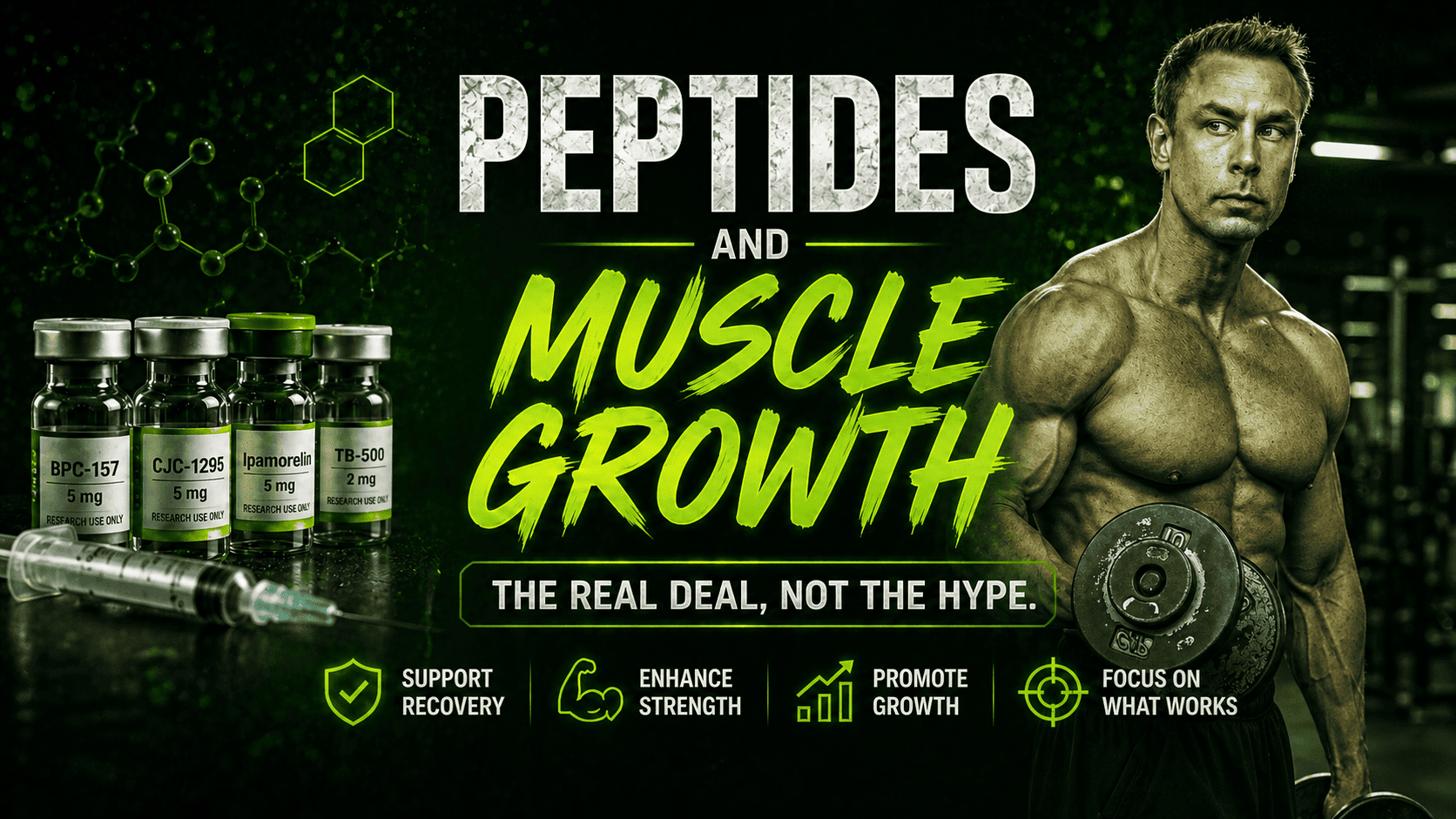
A client texted me last fall with a screenshot. He’d been scrolling Instagram, and an “anti-aging coach” was promoting a peptide stack for muscle growth. CJC-1295. Ipamorelin. BPC-157. Promises of dramatic transformation, faster recovery, and accelerated hypertrophy. The total monthly cost ran north of $700. The Instagram coach had no medical credentials, no published evidence, and no apparent oversight from any prescribing physician.
My client wanted to know if it was worth it. He was 41, training four days a week, eating decent but not great, sleeping six hours on a good night, and frustrated that his lifts hadn’t moved in nine months.
The honest answer wasn’t about the peptides. The honest answer was that his protein intake was 110 grams on a 200-pound frame, his sleep was a wreck, his deload weeks were nonexistent, and he was paying attention to peptide marketing instead of the basic training and recovery variables that would have actually moved his lifts.
This is the pattern with peptides for muscle growth. The compounds with the strongest evidence work modestly, under physician supervision, in specific clinical contexts. The compounds being marketed most aggressively often work less than the marketing suggests, and the fundamentals deliver more muscle growth than any peptide stack at zero medical risk.
This article is the honest breakdown of which peptides have real evidence for muscle growth, which are overhyped, and how to evaluate whether peptide therapy makes sense for your specific situation. I’m a trainer, not an endocrinologist or a prescribing physician, so the medical decisions here belong to your doctor. What I can offer is the framework that separates legitimate use cases from marketing hype.
Considering peptides and want an honest evaluation? Start with a free consultation.
What Are Peptides for Muscle Growth and How Do They Actually Work?
Peptides are short chains of amino acids that signal specific responses in the body. The peptides marketed for muscle growth generally work through one of three mechanisms: stimulating the pituitary to release more growth hormone, signaling local tissue repair and regeneration, or modulating insulin-like growth factor 1 pathways. None of them works like anabolic steroids, and none of them produces the dramatic muscle growth that steroid use can drive.
The Three Categories Worth Understanding
Growth hormone-releasing hormones and growth hormone-releasing peptides
These compounds stimulate the pituitary gland to release more endogenous growth hormone. CJC-1295 (a GHRH analog) and Ipamorelin (a GHRP) are the most common examples, often used in combination. The body still produces its own growth hormone in response to these signals, which is why they’re called secretagogues. They don’t replace the hormone directly.
Repair and recovery peptides
Compounds like BPC-157 and TB-500 are studied for their effects on tissue repair, gut health, inflammation modulation, and connective tissue healing. They don’t directly stimulate muscle growth. They support recovery, which can indirectly help muscle gain by allowing more consistent training.
IGF-1 modulators and analogs
Compounds that directly affect the IGF-1 pathway. These are tightly regulated, often prohibited by athletic governing bodies, and rarely prescribed outside specific medical conditions.
How Muscle Growth Actually Works
Muscle growth happens when training stress signals muscle protein synthesis, and adequate nutrition and recovery support that signal. The primary drivers are:
Resistance training with progressive overload. Heavy enough to challenge the muscle. Frequent enough to provide repeated stimulus. Recovered enough to allow adaptation.
Adequate protein intake. Roughly 0.7 to 1 gram per pound of bodyweight daily, distributed across multiple meals.
Sleep and recovery. Growth hormone peaks during deep sleep. Testosterone responds to total sleep duration. Most muscle protein synthesis happens during rest, not during training.
Caloric availability. Building muscle requires energy, which means either a slight caloric surplus or sufficient maintenance calories during a recomposition phase.
Peptides can support some of these variables in specific contexts, but they don’t replace any of them. A lifter with broken sleep, poor protein intake, and inconsistent training will get worse results from peptides than a lifter with dialed-in fundamentals would get from no peptides at all.
Best Muscle Growth Peptides to Gain Lean Size Quickly
The peptides with the most evidence-supported use cases for muscle growth or related goals fall into a relatively short list. None of them produces dramatic muscle gain in healthy lifters who already have normal hormone levels. They work in specific contexts under medical supervision.
The Compounds Worth Understanding
CJC-1295. A long-acting growth hormone-releasing hormone analog. Often stacked with Ipamorelin to produce sustained growth hormone elevation. Used clinically for documented adult growth hormone deficiency. Sometimes prescribed off-label in wellness contexts.
Ipamorelin. A growth hormone-releasing peptide that triggers pulsatile growth hormone release with relatively selective action and fewer side effects than older GHRPs. Commonly stacked with CJC-1295.
Sermorelin. Another growth hormone-releasing hormone analog, shorter-acting than CJC-1295. Used in similar clinical contexts.
Tesamorelin. A growth hormone-releasing hormone analog with FDA approval for HIV-associated lipodystrophy. Produces a measurable reduction in visceral fat. Its use for muscle growth in healthy populations is off-label.
BPC-157. A peptide derived from a human gastric protein, studied primarily for tissue repair, gut health, and inflammation modulation. The strongest evidence comes from animal studies. Human clinical data is limited.
The Realistic Outcomes
| Peptide | Primary Action | Realistic Outcome | Evidence Level |
| CJC-1295 | Growth hormone release amplifier | Modest support for recovery and body composition under supervision | Moderate (clinical use cases) |
| Ipamorelin | Pulsatile growth hormone release | Modest body composition support, often stacked with CJC-1295 | Moderate |
| Sermorelin | Endogenous GH support, shorter-acting | Gradual hormonal support in deficient populations | Moderate |
| Tesamorelin | Visceral fat reduction (FDA-approved indication) | Strong for FDA indication, off-label for general use | Strong (specific indication) |
| BPC-157 | Tissue repair, gut health | Indirect support for training capacity through recovery | Emerging, limited human data |
The honest framing: none of these peptides produces dramatic muscle growth in healthy lifters with normal hormone levels. They have specific clinical use cases under physician supervision, and they support muscle growth indirectly when prescribed appropriately. They are not shortcuts to substantial hypertrophy.
Peptide Cycles for Muscle Growth and Recovery Optimization
The structure of peptide cycles depends entirely on the specific compound, the prescribing physician’s protocol, and the patient’s individual response. There is no universal cycle that applies across compounds, and dosing decisions belong to the prescribing physician, not a fitness article. What I can describe is the general concept of why pulsatile dosing matters and what monitoring looks like in a quality-prescribed protocol.
Why Pulsatile Dosing Matters
The body’s natural growth hormone release happens in pulses, not as a continuous flow. Continuous elevation of growth hormone signaling can lead to receptor desensitization and reduced response over time. This is why growth hormone secretagogues are typically prescribed in pulsatile patterns rather than continuous high doses.
The same principle applies to receptor downregulation more broadly. Compounds that work through signaling pathways often produce diminishing returns with continuous high-dose use, and the prescribing protocols reflect this through scheduled cycles, washouts, or off periods.
What Quality Monitoring Looks Like
A well-supervised peptide protocol includes baseline bloodwork, ongoing labs at scheduled intervals, and adjustments based on objective markers. Relevant labs typically include IGF-1 levels, fasting glucose and insulin, lipid panels, and any hormone markers relevant to the specific compound being used.
The patients I see who get the best results from peptide therapy are the ones in tightly monitored, physician-supervised programs. The patients who see no results, side effects they didn’t anticipate, or rebound issues after discontinuation are usually the ones who got their peptides through low-oversight channels.
Discussing Cycles With Your Physician
If you’re considering peptide therapy, the conversation with your prescribing physician should cover:
Baseline labs before starting. Expected cycle length and dosing schedule. Specific markers to monitor during use. Side effect signs that warrant discontinuation or dose adjustment. Discontinuation protocol and what happens to the results after stopping. Integration with your current training, nutrition, and lifestyle.
If your provider doesn’t engage with these questions in detail, the prescribing relationship is probably not the right one.
How to Pick the Safest Peptides for Muscle Building
The safest peptides for muscle building are the ones prescribed by a qualified physician, sourced from regulated pharmacies, monitored with baseline and ongoing bloodwork, and integrated with a structured training and nutrition program. Safety is not primarily a function of which compound you choose. It’s a function of how the prescribing relationship is structured.
Sourcing and Pharmaceutical Quality
The peptide market has three main sourcing categories, and the quality varies dramatically.
Regulated pharmacies dispensing FDA-approved compounds. This is the gold standard. Quality, purity, and sterility are regulated. Dosing is consistent across batches.
Compounding pharmacies dispensing physician-prescribed peptides. Quality varies significantly between compounding pharmacies. The reputable ones have rigorous quality control, third-party testing, and clear sourcing documentation. The less reputable ones don’t.
Research peptides sold online are labeled “not for human use.” This is the highest-risk category. No regulatory oversight, no quality control, no sterility guarantees, no batch consistency. These compounds are marketed to a population that intends to use them personally despite the disclaimer language.
For any peptide therapy, the sourcing question is more important than the compound selection. A poorly sourced compound can be contaminated, mislabeled, or contain substances other than what’s claimed on the label.
Red Flags in Peptide Sourcing
Lack of clear pharmaceutical sourcing or compounding pharmacy documentation. Generic vials without batch numbers or quality certifications. Suspiciously low prices compared to regulated providers. Resistance from the prescribing party to discuss sourcing details. Marketing through influencers or non-medical channels rather than through medical channels.
The Baseline Bloodwork Requirement
Quality peptide therapy starts with baseline bloodwork. Comprehensive metabolic panel. Hormone markers relevant to the compounds being prescribed. IGF-1 levels for growth hormone secretagogue protocols. Lipid panel. Inflammation markers. Sometimes, more specific panels are used depending on the protocol.
Without baseline bloodwork, the prescription is happening without the data needed to monitor effects, identify side effects, or adjust the protocol intelligently. Any provider who skips this step is not practicing quality medicine.
Schedule a consultation before starting any peptide-adjacent protocol.
Most Effective Peptide Stacks for Muscle Growth and Strength
Peptide stacking refers to using multiple compounds together to target different mechanisms simultaneously. The most studied stack is CJC-1295 combined with Ipamorelin, which pairs a GHRH analog with a GHRP to produce more sustained growth hormone elevation than either compound alone. Other stacking strategies exist with varying evidence quality.
The Stacking Logic
The basic principle is that combining compounds with different mechanisms can produce synergistic effects. A GHRH analog like CJC-1295 increases the size of growth hormone pulses, while a GHRP like Ipamorelin triggers the pulses to occur. Used together, the combination produces stronger and more sustained growth hormone elevation than either compound alone.
This stacking principle applies in clinical contexts under physician supervision. The recreational version, where people stack multiple compounds based on Instagram recommendations, is fundamentally different and carries significantly higher risk.
Stack Combinations Worth Understanding
| Stack | Primary Goal | Suitability | Considerations |
| CJC-1295 plus Ipamorelin | Sustained growth hormone elevation | Most-studied stack in clinical use | Strong evidence base for the combination |
| BPC-157 plus TB-500 | Tissue and joint repair | Recovery-focused use | Limited human trial data |
| Sermorelin plus Ipamorelin | Gradual growth hormone optimization | Conservative approach | Slower onset than CJC-1295 combinations |
| Tesamorelin plus Ipamorelin | Body recomposition focus | Higher cost, stricter monitoring | Tesamorelin has FDA approval for a specific indication |
These are physician-supervised stacks in clinical contexts. The recreational stacking world is dramatically wider and dramatically less evidence-supported.
Why More Compounds Doesn’t Mean More Results
Stacking five or six peptides together doesn’t produce five or six times the muscle growth. It produces five or six times the cost, five or six times the side effect risk, and a much harder time identifying which compound is responsible for which effect (or which problem).
The peptide marketing world often promotes elaborate multi-compound stacks because elaborate stacks generate more revenue per patient than simple protocols. The medical evidence rarely supports the elaborate stacks beyond what the basic combinations already provide.
Clinically Supported Peptides for Muscle Hypertrophy and Recovery
The clinical evidence for peptides in muscle hypertrophy is more limited than the marketing suggests. Strong human trial data exist primarily for FDA-approved indications like adult growth hormone deficiency, HIV-associated lipodystrophy (Tesamorelin), and specific clinical contexts. Off-label use for muscle growth in healthy lifters has much weaker evidence.
Where the Evidence Is Strongest
Growth hormone secretagogues in adults with documented growth hormone deficiency. The use case is well-established, the prescribing protocols are clear, and the monitoring requirements are understood.
Tesamorelin for HIV-associated lipodystrophy. The compound has FDA approval for this specific indication and clear clinical data.
GLP-1 receptor agonists for weight management and diabetes. While not directly aimed at muscle growth, these compounds have the strongest evidence base in the peptide category and indirectly affect body composition.
Where the Evidence Is Limited
Recovery peptides for general athletic use in healthy adults. BPC-157 has interesting animal data and emerging human research, but the clinical evidence for muscle hypertrophy applications specifically is limited.
Growth hormone secretagogue use in healthy lifters with normal hormone levels. The growth signal from training and nutrition is much stronger than the supplemental signal from secretagogues in young, healthy lifters.
What BPC-157 Research Actually Shows
BPC-157 is one of the most aggressively marketed peptides in the recovery space. The honest summary of the evidence:
Animal studies show interesting effects on tendon healing, gut health, and tissue repair. Human clinical trials are limited and have not been completed at the scale needed to establish standard of care recommendations. Anecdotal reports from athletes and lifters are common but lack the controls needed to draw firm conclusions.
The compound may have real recovery applications under physician supervision in specific contexts. It is not the recovery miracle that the marketing often suggests, and the strongest evidence for accelerating recovery from training remains the boring fundamentals: sleep, nutrition, training periodization, and stress management.
How to Use Peptides to Break Muscle Growth Plateaus
The honest framing for peptides as a plateau intervention: peptides should not be the first response to a stalled lift. They should be considered, if at all, only after the foundational variables have been exhausted. Most plateaus respond to training, nutrition, and recovery adjustments long before any pharmacological intervention is warranted.
The Variables to Exhaust First
Training programming. Have you progressed beyond your current program? Are you adding weight, reps, or volume systematically? Have you taken a deload week in the last six weeks? Most plateaus respond to programming adjustments alone.
Nutrition. Are you hitting 0.8 to 1 gram of protein per pound of bodyweight daily? Are you eating enough total calories to support muscle growth? Most plateaus correlate with insufficient protein or under-eating.
Sleep. Are you averaging seven to nine hours of quality sleep? Most lifters who plateau are also sleep-deprived. Fixing sleep often produces immediate gains.
Recovery and stress. Are you taking enough rest days? Is your life stress under control? Plateaus often correlate with under-recovery or chronic life stress.
Exercise selection. Are you using the right exercises for your goal? Sometimes a plateau is a programming problem disguised as a biology problem.
When Peptides Might Be Worth a Physician Conversation
If you’ve exhausted the above variables, your bloodwork shows specific hormonal markers in deficient ranges, and your physician believes there’s a legitimate clinical case for pharmacological intervention, peptides may be worth discussing.
This is a high bar. Most lifters never reach it because most lifters have variables in the previous section that haven’t been fully addressed.
Indicators That a Plateau Is Programming, Not Biology
Strength is declining, not just stalled. (Programming problem.) Sleep is below six hours nightly. (Recovery problem.) Protein intake is below 0.7 grams per pound. (Nutrition problem.) Last deload was more than six weeks ago. (Recovery problem.) Training the same program for more than 12 weeks. (Programming problem.) Body weight has been dropping unexpectedly. (Caloric balance problem.)
These signs point to fundamental adjustments, not pharmacological ones.
Access structured programs designed to break plateaus through training and nutrition optimization.
Peptides for Muscle Growth With Minimal Water Retention
Growth hormone secretagogue stacks like CJC-1295 plus Ipamorelin generally produce less water retention than exogenous human growth hormone administration. The mechanism is that secretagogues work through the body’s own growth hormone pulse system rather than introducing a constant exogenous dose, which produces a more physiologic pattern with fewer of the side effects associated with high-dose exogenous GH.
Individual response varies. Some patients on growth hormone secretagogues experience mild water retention during the first weeks, particularly during dose escalation. Others experience none. The variation appears to be individual rather than predictable from baseline characteristics.
Dietary Factors That Affect Retention
Sodium intake. Higher sodium intake amplifies water retention regardless of medication status. Patients on growth hormone secretagogues who maintain very high sodium intake may experience more visible water retention than patients with moderate sodium intake.
Carbohydrate intake. Higher carbohydrate intake increases glycogen storage, which holds water. This is normal physiology and doesn’t represent fat gain, but it can affect scale weight and appearance.
Hydration. Adequate water intake actually reduces water retention by signaling the body that fluid is available, which reduces aldosterone-driven sodium and water conservation.
The Practical Framing
For a lifter who values minimizing visible water retention while pursuing muscle growth through peptide therapy, growth hormone secretagogue stacks generally compare favorably to exogenous GH administration. The mechanism produces a more natural pattern with less of the bloating and fluid retention that exogenous GH can cause.
This is a relative comparison, not an absolute one. All compounds can produce individual side effects, and the conversation about specific responses belongs with the prescribing physician.
How Do Muscle Growth Peptides Compare to Steroids?
Muscle growth peptides and anabolic steroids are fundamentally different categories of compounds with different mechanisms, different risk profiles, and very different magnitudes of effect on muscle growth.
Mechanism Differences
Anabolic steroids are synthetic versions of testosterone or related androgens. They directly bind to androgen receptors in muscle tissue and produce strong, dose-dependent increases in muscle protein synthesis. The effect on muscle growth in healthy adults is substantial and well-documented.
Growth hormone secretagogue peptides like CJC-1295 and Ipamorelin work through different pathways. They stimulate endogenous growth hormone release, which has effects on body composition that are real but much more modest than direct androgen receptor stimulation.
Repair peptides like BPC-157 and TB-500 don’t work through anabolic pathways at all. They affect tissue repair, inflammation, and recovery, which can indirectly support muscle growth through allowing more consistent training.
Side Effect Profile Differences
Anabolic steroids have well-documented side effects, including cardiovascular risk, lipid changes, liver effects (oral compounds), endocrine disruption, testicular atrophy, gynecomastia, hair loss, mood changes, and others. The side effect profile is significant, and the legal and competitive consequences in regulated sports are severe.
Peptides have a different side effect profile that varies by compound. Growth hormone secretagogues can cause water retention, joint pain, insulin resistance at high doses, and other effects related to elevated growth hormone signaling. Repair peptides have less complete side effect data because human trials are limited.
Realistic Muscle Gain Expectations
The honest comparison: anabolic steroids produce substantially more muscle growth than peptides in healthy adults. This is not a defense of steroid use, which carries significant medical, legal, and competitive consequences. It is an honest framing for anyone considering peptides as a “milder steroid alternative.”
Peptides aren’t a milder steroid. They’re a different category of compound with much smaller effects on muscle growth. If someone is considering peptide use expecting steroid-like results, they’re going to be disappointed by the actual outcomes and confused about why the marketing oversold the effects.
Legal and Regulatory Status
Anabolic steroids are Schedule III controlled substances in the United States. Their use requires a medical prescription, and their distribution outside of medical channels is illegal.
Peptide legal status varies significantly by compound. Some are FDA-approved medications. Some are prescribed off-label. Some are sold as research chemicals in a regulatory gray area. The regulatory landscape is more complex than for steroids and is currently evolving.
Peptides That Support Muscle Growth and Joint Health Together
For lifters who want to support both muscle growth and joint health, the peptide categories worth understanding under physician supervision are growth hormone secretagogues (for general body composition support) and repair peptides like BPC-157 and TB-500 (for joint and connective tissue applications).
Why Joint Health Matters for Muscle Growth
Joint health and muscle growth aren’t separate goals for most lifters past 35. The lifter with painful joints can’t train consistently. The lifter who can’t train consistently doesn’t build muscle. Maintaining joint function is upstream of muscle growth in any long-term training plan.
For experienced lifters with accumulated joint history, training adjustments and joint-supportive interventions often produce more muscle growth long-term than aggressive training that ignores joint integrity.
Repair Peptides for Joint Applications
BPC-157 and TB-500 have been studied for tendon, ligament, and soft tissue repair, primarily in animal models. Some human research is emerging. These compounds are sometimes prescribed off-label in wellness and sports medicine contexts for joint and tendon issues that haven’t responded to conservative treatment.
The evidence quality is moderate at best, and the regulatory status is complicated. Any consideration of these compounds for joint applications belongs in a conversation with a physician who has experience with peptide therapy and access to good compound sourcing.
The Conservative Approach
For most lifters over 40 dealing with joint issues, the highest-yield interventions remain:
Adjusting exercise selection to joint-friendly variations. Adding mobility and prehab work. Reducing training volume to allow recovery. Working with a qualified physical therapist on specific issues. Optimizing sleep and inflammation through nutrition and lifestyle.
These interventions resolve most joint issues that lifters encounter, and they cost less and carry less medical risk than peptide therapy. Peptide therapy is worth considering when these interventions have been exhausted, and a physician determines that pharmacological intervention is appropriate.
Browse recovery support tools and resources that complement training.
Best Muscle Growth Peptides for Older Recreational Lifters
For lifters in their 40s, 50s, and beyond, peptide therapy occupies a specific and limited role. Age-related decline in growth hormone and IGF-1 is real, and in some cases falls into ranges that meet clinical criteria for intervention. In those cases, growth hormone secretagogue therapy under physician supervision can be appropriate. In most cases, age-related decline is in a range where lifestyle interventions remain the highest-yield strategy.
When Age-Related Decline Warrants Medical Conversation
Symptoms that suggest a medical conversation is appropriate: significant unexplained fatigue, body composition changes that don’t respond to training and nutrition, sexual dysfunction, mood changes, cognitive changes, or sleep quality that has degraded significantly without an obvious cause.
These symptoms can have many causes, not just hormonal decline. The diagnostic workup is a physician’s job. Bloodwork, including total and free testosterone, IGF-1, thyroid panel, comprehensive metabolic panel, and any other markers your physician considers relevant, gives the clinical picture needed to determine whether intervention is warranted.
When Age-Related Decline Is Manageable Through Lifestyle
For most lifters over 40 who train consistently, eat enough protein, sleep adequately, and manage stress, the age-related decline in hormones is in a range where lifestyle interventions remain effective. These lifters can continue building muscle naturally well into their 50s and beyond.
The intervention hierarchy for these lifters:
First, optimize training. Three or four sessions per week, compound lifts, progressive overload, and deload weeks every four to six weeks.
Second, optimize nutrition. Protein at 0.8 to 1 gram per pound of body weight daily. Adequate total calories. Quality food sources.
Third, optimize sleep. Seven to nine hours nightly, consistent schedule, quality sleep environment.
Fourth, manage stress. Address chronic life stress that may be elevating cortisol and impairing recovery.
Fifth, consider supplementation. Creatine, vitamin D if deficient, omega-3 fatty acids, and magnesium.
By the time the first four interventions are fully optimized, most lifters have addressed the variables that were actually limiting their muscle growth. The fifth intervention adds a modest additional benefit. Peptide therapy enters the conversation only after these five steps have been exhausted.
Conservative Dosing and Monitoring
For older lifters who do pursue peptide therapy under physician supervision, conservative dosing is the appropriate starting point. Lower doses, longer evaluation periods, more frequent monitoring, and clear criteria for escalation or discontinuation produce safer outcomes than aggressive protocols.
This is the prescribing physician’s territory, not a fitness article’s. What I can offer is the consistent message: the peptide therapy that works long-term in older lifters is the kind that’s tightly supervised, conservatively dosed, and integrated with optimized lifestyle factors.
Expert Viewpoint: A Coach’s Honest Take on Peptides for Muscle Growth
Fifteen years of training lifters in New York has shown me one consistent truth about peptides for muscle growth. The compounds with the strongest evidence work modestly, in specific clinical contexts, under physician supervision. The compounds being marketed most aggressively often don’t deliver what the marketing promises, and the fundamentals deliver more muscle growth than any peptide stack at zero medical risk.
For the first three years of training, peptides should not be on the radar at all. The growth signal from consistent resistance training, adequate protein, and decent sleep is so strong in newer lifters that adding pharmacological tools is irrelevant. The lifter who trains consistently for three years with dialed-in fundamentals will outperform the lifter who chases peptide stacks while neglecting the basics.
For experienced lifters with documented hormonal deficiency, specific medical contexts, or clinical situations that warrant pharmacological intervention, peptide therapy can be a legitimate tool when prescribed by a qualified physician and integrated with structured training and nutrition. The patients I see who get real results from peptide therapy are the ones in tightly monitored programs with quality compound sourcing and clear integration with their lifestyle.
For lifters considering peptide therapy because Instagram coaches or wellness clinics promised a dramatic transformation, the honest advice is to do the boring work first. Train three or four times per week with compound lifts and progressive overload. Eat protein at 0.8 to 1 gram per pound of body weight daily. Sleep seven to nine hours. Take deload weeks. Walk daily. Give it 12 to 24 months. Most of the transformation you’re hoping for is available through these variables alone, and adding peptide therapy to broken fundamentals usually produces disappointing results.
The peptides are tools. They have a role. The role is much narrower than the marketing suggests, and the foundational work determines whether the tools produce results or just produce expenses.
Simple. Not easy. Absolutely achievable.
Frequently Asked Questions
What are the best peptides for muscle growth?
The peptides with the most evidence-supported use cases for muscle growth or related goals include CJC-1295 and Ipamorelin (often stacked together), Sermorelin, Tesamorelin (for its FDA-approved indication), and BPC-157 (for recovery support), all of which work best under physician supervision.
Are muscle growth peptides safe for bodybuilding?
Peptides can be used safely only under medical supervision with proper sourcing, baseline bloodwork, and ongoing monitoring. Self-sourced peptides from unregulated channels carry significant safety risks regardless of the specific compound.
What is the difference between CJC-1295 and Ipamorelin?
CJC-1295 is a growth hormone-releasing hormone analog that amplifies the size of growth hormone pulses, while Ipamorelin is a growth hormone-releasing peptide that triggers the pulses, which is why the two are commonly prescribed together.
How long does it take peptides to increase muscle mass?
Realistic timelines for visible body composition changes from peptide therapy are 8 to 12 weeks at minimum, assuming optimized training, protein intake, and sleep, with the magnitude of change typically modest compared to what training and nutrition alone can produce.
Can peptides improve workout recovery?
Some peptides, particularly BPC-157 and TB-500, are studied for tissue repair and recovery applications, and growth hormone secretagogues may support recovery through improved sleep quality, though the strongest recovery interventions remain sleep, nutrition, and training periodization.
What are the side effects of muscle-building peptides?
Common side effects vary by compound but can include injection site reactions, variable water retention, mild appetite changes, lethargy, and joint discomfort, with more significant risks possible at higher doses or with poor compound sourcing.
Do peptides increase natural growth hormone levels?
Growth hormone-releasing peptides like Ipamorelin and growth hormone-releasing hormone analogs like CJC-1295 stimulate the pituitary to release more endogenous growth hormone rather than introducing exogenous hormone directly.
Are peptides better than steroids for muscle growth?
Peptides produce substantially less muscle growth than anabolic steroids, which is why describing them as “milder steroid alternatives” is misleading. They are a different category of compound with much smaller effects, though also a different risk and regulatory profile.
Where can you legally get peptides for muscle growth?
Legal sourcing requires a prescription from a licensed physician dispensed through a regulated pharmacy or quality compounding pharmacy, with research peptides sold online as “not for human use” representing a regulatory gray area with significant quality and safety risks.
Maik Wiedenbach is a New York City-based personal trainer, fitness author, and founder of Maik Wiedenbach Fitness. He has spent over 15 years helping clients evaluate fitness and pharmacological interventions critically and build evidence-based muscle-building strategies through training, nutrition, and recovery fundamentals.
“`html
“`

Maik Wiedenbach is a Hall of Fame swimmer turned bodybuilding champion and fitness model featured in Muscle & Fitness and Men’s Journal. An NYU adjunct professor and award-winning coach, he founded New York’s most sought-after personal training gym.