
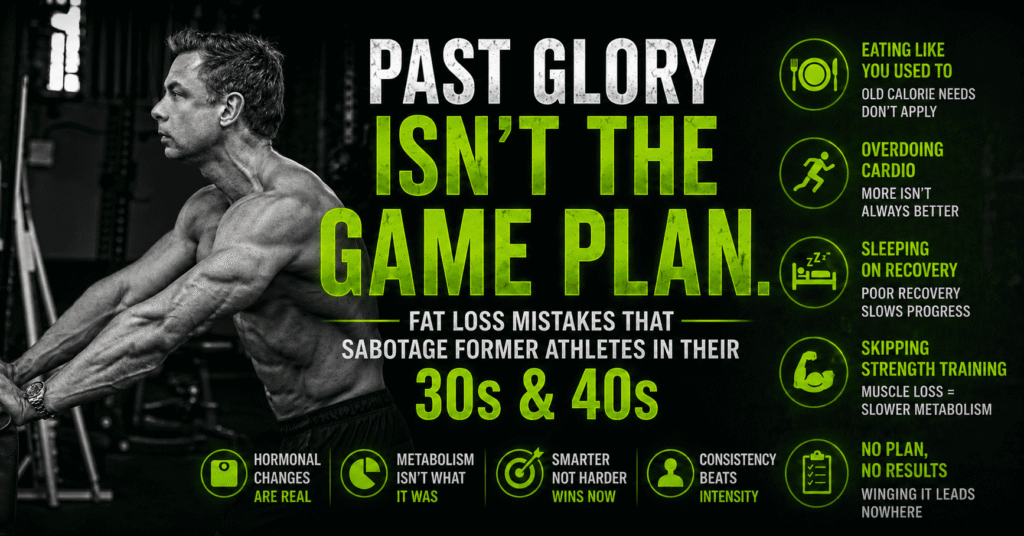
A former Division 1 swimmer walked into my gym last fall. He’d retired from competition at 22, gone into finance, and was now 38 years old carrying 35 pounds more than his college walk-on weight. He’d tried to “train like he used to.” Two-a-days. Sprints. Long swims. The weight wouldn’t budge, and his shoulders had been hurting for six months.
He sat down across from me and said something that captures the entire former-athlete problem: “I’m doing what worked at 22. Why isn’t it working now?”
The answer is simple and uncomfortable. What worked at 22 was a 4,500-calorie daily burn from 20 hours of training a week, the metabolic profile of a young athlete in season, eight hours of sleep arranged around training, and a body that recovered between sessions like it was being paid to. What he’s doing at 38 is the same training volume layered onto a sedentary work life, six hours of broken sleep, chronic stress, and a body that needs twice as long to recover from half the work.
Most former athletes I see make the same mistake. They try to recreate the training intensity of their competitive years without recreating any of the recovery conditions that made that intensity possible. The result is usually injury, stalled progress, or both.
This article is the honest breakdown of what’s actually changed in your body since retirement, why your old fat loss tactics are now actively counterproductive, and how to build a body composition strategy that fits your current life instead of the one you had a decade ago.
Stuck in old habits that aren’t working anymore? Start with a free consultation.
Why Do Former Athletes Struggle With Fat Loss?
Former athletes struggle with fat loss because their daily calorie expenditure drops dramatically after retirement while their eating habits, training expectations, and self-image often stay frozen at competitive levels. The body that handled 5,000 calories a day at 22 is the same body trying to maintain on 2,200 calories at 38, and the gap is where the weight gain happens.
What Actually Changes After You Stop Competing
Your training volume drops by 50 to 80 percent overnight when you retire. The 20 to 30 hours per week of structured practice, conditioning, and competition disappear, and the structured meal plan from your team nutritionist disappears with them. Your body, which was burning 4,000 to 5,000 calories daily, now burns 2,200 to 2,800 daily. That’s a 1,500 to 2,500 calorie shift that almost nobody adjusts their eating to match.
Hormones also shift over the years. Testosterone declines. Growth hormone output decreases. Cortisol from desk work, sleep loss, and family stress climbs. Recovery capacity drops. The metabolic environment that supported high-volume training as a 22-year-old is gone by 35, and aggressive training in that new environment produces injury instead of adaptation.
Sleep is the most underappreciated change. Most former athletes sleep less now than they did in college. The naps are gone, the structured rest is gone, and six broken hours has replaced eight protected hours. Recovery suffers, and body composition suffers along with it.
The Identity Problem
Former athletes often still see themselves as athletes. The training mindset, the willingness to push through pain, the assumption that more is better, all of these served them well in college. None of them serve a 38-year-old finance professional trying to lose 20 pounds.
The mindset shift required is real. You’re not in the athlete population anymore. You’re in the recreational adult population, and the strategies that work for one don’t transfer cleanly to the other.
Athlete Body vs Post-Career Body
| Competitive Years | Post-Career Years |
| High daily calorie burn (4,000-5,000+) | Sedentary work, 2,200-2,800 calorie need |
| Structured recovery, scheduled rest | Chronic stress, broken sleep |
| High muscle retention stimulus from training | Reduced anabolic signal without consistent lifting |
| Performance goal-focused programming | Aesthetic or health goal-focused programming |
| Team accountability, scheduled training | Self-managed consistency, no external structure |
The body in column two needs a different strategy than the body in column one. Same person. Different system.
Learn how our team adapts training for former athletes and high-mileage adults.
The Worst Fat Loss Strategy Retired Athletes Still Use
The worst fat loss strategy I see in former athletes is trying to recreate their competitive training volume to “earn” the fat loss through punishment. Two-a-days. Daily sprints. Endless cardio. Aggressive deficits. The strategy looks disciplined on paper, but it destroys recovery, drives injury, and rarely produces lasting fat loss in a 38-year-old body.
What Worked at 22 Doesn’t Work at 41
Your competitive training worked because your body was built to absorb that volume. Young hormones. Daily structured nutrition. Eight hours of sleep arranged around training. Recovery support from athletic trainers and team facilities. Genetics that got you into the sport in the first place.
Take any of those variables away and the training volume that was productive becomes destructive. Take all of them away (which is what retirement does) and the same training volume produces fatigue, injury, and stalled progress.
The clients I work with who used to play competitive sports are often the most under-recovered people in the gym. They’re trying to do what they used to do with none of the support that made what they used to do possible.
Signs You’re Using the Wrong Fat Loss Strategy
Constant soreness that never fully clears between sessions. Joint pain in the shoulders, knees, or lower back. Stalled fat loss despite hard training. Declining strength in the gym. Sleep problems that started after you began training harder. Mood changes, irritability, lower libido. Recurring injuries in the same areas.
These signs aren’t telling you to push harder. They’re telling you that recovery has fallen behind training, and the gap is widening.
Old Athlete Mindset vs Sustainable Fat Loss Mindset
| Old Athlete Mindset | Sustainable Fat Loss Mindset |
| More conditioning is always better | Better recovery produces better results |
| Burn more calories per session | Preserve muscle and metabolic rate |
| Train harder daily | Train strategically 3-4 days a week |
| Ignore pain and push through | Manage inflammation and adjust load |
| Aggressive deficits accelerate fat loss | Moderate sustainable deficits produce real results |
The mindset on the right produces better body composition outcomes for former athletes than the mindset on the left, every time.
Explore structured body recomposition programs designed for former athletes.
Best Fat Loss Strategies Tailored for Former Competitive Athletes
The best fat loss strategy for former athletes is one that respects the body you currently have, not the body you used to have. Moderate caloric deficit. High protein. Resistance training as the foundation. Strategic NEAT and walking. Aggressive sleep prioritization. Stress management. That’s the framework, and it works.
How Can Former Athletes Lose Fat Without Losing Muscle?
Former athletes lose fat without losing muscle by prioritizing resistance training, maintaining high protein intake, avoiding aggressive caloric deficits, and managing recovery capacity. The training pattern that works is three to four resistance sessions per week with compound lifts and progressive overload, paired with daily walking and a moderate deficit of 300 to 500 calories.
The trap former athletes fall into is using cardio as the primary fat loss tool. Cardio burns calories, but it doesn’t preserve muscle. Resistance training preserves muscle. Lose the muscle, and the body composition you used to have when you were competing is gone permanently, not just temporarily.
A 38-year-old former athlete with 20 pounds of unwanted body fat needs to lift weights. Not run more. Not bike more. Lift weights. Three or four sessions per week. Heavy enough to provide a real muscle retention signal.
Muscle-Preserving Fat Loss vs Scale-Focused Weight Loss
| Muscle-Preserving Fat Loss | Scale-Focused Weight Loss |
| Slower scale drops (0.5-1% bodyweight per week) | Faster scale drops (2-3 pounds per week) |
| Hormones stay supported | Hormones suppress under aggressive deficit |
| Strength holds or progresses | Strength declines significantly |
| Better long-term adherence | Higher rebound risk |
| Body composition improves visibly | Lighter, but softer appearance |
The muscle-preserving column produces the body that former athletes actually want when they imagine fat loss. The scale-focused column produces a smaller, weaker version of the current body.
Why Resistance Training Matters More Now
When you were 22, your body retained muscle aggressively because of youth, hormones, and consistent training stimulus. Now your body needs an active resistance training signal to hold onto muscle. Without that signal, muscle quietly disappears year over year, and by 50, the former athlete who quit lifting has lost 10 to 15 pounds of muscle they used to have at 22.
Lifting weights three or four times per week isn’t optional for body composition in a former athlete. It’s the only intervention that prevents the slow downgrade.
Learn how our coaching philosophy supports body composition for former athletes.
How Former Athletes Should Adjust Macros for Efficient Fat Loss
Macro priorities for former athletes shift from performance fueling toward body composition support. Protein climbs in importance. Carbohydrates get matched to actual training volume, which is much lower than it used to be. Fat intake stays moderate for hormonal health. Total calories drop to match the new daily expenditure.
Protein Targets for Former Athletes
Protein at 0.8 to 1 gram per pound of bodyweight, daily. For a 180-pound former athlete trying to lose fat, that’s 144 to 180 grams of protein per day, every day. Most former athletes I see eat half that amount, because they’re no longer following the team meal plan that handled it for them.
Protein preserves muscle during fat loss. Protein increases satiety, which makes the deficit easier to sustain. Protein has the highest thermic effect of any macronutrient. And former athletes need it more than ever, because their training volume can no longer mask suboptimal nutrition the way it used to.
Why Carb Intake Must Match Activity Levels
When you were competing, carbs fueled three-hour training sessions. Now you’re doing 45-minute lifts. The carb intake that supported athletic performance is excessive for the current training load, and the surplus shows up as fat.
A simple rule for former athletes: carbs scale with training. Training day intake is higher. Rest day intake is lower. The total weekly carb load fits the actual energy demand of current training, not the demand of training that ended a decade ago.
The Biggest Nutrition Mistake Ex-Athletes Make
The biggest nutrition mistake is eating like you’re still in season when you’re not. Big meals. High carb intake. Frequent refeeds. Liberal calorie attitude. All of that worked when you were burning 5,000 calories per day, and none of it works when you’re burning 2,500.
The fix isn’t exotic. Track calories honestly for one week, compare your actual intake to your current daily expenditure, and close the gap that’s almost certainly there.
Macro Priorities During Competitive Sports vs Fat Loss Phase
| Competitive Career | Post-Career Fat Loss Phase |
| Performance fueling priority | Body composition priority |
| High carb tolerance and need | Carb intake matches actual training |
| Massive daily calorie output | Controlled, moderated intake |
| Recovery-focused eating around sessions | Satiety-focused eating throughout day |
| Frequent refeeds | Strategic, less frequent refeeds |
Browse fitness tools and resources that support lean body composition.
Fat Loss Training Program for Ex-Athletes With Joint Issues
Most former athletes carry some form of joint history. Lower back, knees, shoulders, hips. The training that produces fat loss for these clients has to respect existing damage while still providing the resistance training signal that preserves muscle. The good news is that the choice between safety and effectiveness is mostly false. You can train hard without using the specific exercises that aggravate your old injuries.
Joint-Friendly Substitutions
For former athletes with cranky lower backs, the safety bar squat or front squat usually outperforms the conventional back squat. Trap bar deadlifts are easier on the spine than conventional deadlifts. Hip thrusts and Romanian deadlifts hit the posterior chain without the same axial loading demand.
For shoulder issues, neutral grip pressing (using dumbbells or specialty bars) often replaces straight barbell pressing. Cable lateral raises replace heavy dumbbell laterals. Pull-ups can replace overhead pressing for upper body pulling work without aggravating the rotator cuff.
For knee issues, walking lunges and step-ups can replace deep barbell squats. Leg press at a reduced range of motion works for many clients. Cycling and incline walking replace running for conditioning.
Low-Impact Conditioning Ideas for Fat Loss in Ex-Athletes
Incline treadmill walking at a 12-15% grade. Stationary cycling at moderate intensity. Rowing at steady state. Assault bike intervals when conditioning is needed. Sled pushes for those with gym access. Swimming for full joint relief. Long outdoor walks at brisk pace.
Avoid daily running on hard surfaces, daily HIIT, plyometrics in older joints, and any conditioning that aggravates a specific injury history.
High-Impact vs Joint-Friendly Fat Loss Methods
| High-Impact Approach | Joint-Friendly Alternative |
| Sprint intervals on track | Assault bike or rowing intervals |
| Long-distance running on pavement | Incline treadmill walking |
| Box jumps and plyometrics | Loaded carries and sled pushes |
| Daily HIIT classes | Two to three moderate cardio sessions per week |
| Heavy axial barbell loading | Machine-supported or trap bar variations |
The right column produces equivalent fat loss with significantly less injury risk in former athlete populations.
Work with coaches who understand athletic backgrounds and injury history.
How Former Athletes Can Manage Hunger During Aggressive Fat Loss
Hunger management for former athletes is partly a behavioral skill and partly a strategy question. The behavioral piece comes from years of structured eating around training. The strategy piece comes from how the deficit is set up. Get both right and hunger stays manageable. Get either wrong and the deficit breaks within two weeks.
Why Most Former Athletes Are Hungrier Than They Used to Be
Two reasons. First, the appetite signaling that adapted to high-volume training is still calibrated to a different daily calorie need. Your body still expects 4,000 calories some days, even though you’re trying to eat 2,200. Second, sleep and stress have changed. Underslept, stressed adults are hungrier than well-rested ones, independent of activity level.
The hunger isn’t a willpower problem. It’s a signaling problem, and the fix is partly structural (eating in a way that addresses the signal) and partly behavioral (sleep and stress, which directly affect hunger hormones).
Satiety Strategies That Actually Work
Protein-first meals. Protein at every meal, and the rest of the meal built around it. This single change reduces total daily hunger more than any other intervention.
Meal timing consistency. Eating at predictable times trains hunger to show up at predictable times. Chaotic eating produces chaotic hunger.
High-volume foods. Vegetables, lean proteins, broth-based soups. Foods with high mass relative to calorie content produce satiety without breaking the deficit.
Hydration. Most adults are mildly dehydrated, and thirst registers as hunger. Two to three liters of water daily for an active adult.
Sleep. Seven to nine hours nightly drops ghrelin and raises leptin, both of which reduce hunger.
Reduced liquid calories. Liquid calories produce less satiety than solid food, so cut juice, smoothies, and most coffee drinks for the duration of the cut.
The Refeed Question for Former Athletes
Former athletes often respond well to strategic refeeds, more than the general population does. A scheduled higher-carb day or meal once or twice a week can support training performance, restore some metabolic markers, and break the psychological grind of a long cut. The refeed isn’t a cheat day. It’s a planned calorie increase, primarily through carbohydrates, used as a tool.
For someone running a 16-week cut, a refeed every 10 to 14 days often improves both adherence and results.
Mindset Strategies to Regain Leanness After Athletic Retirement
The hardest thing for former athletes to lose isn’t body fat. It’s the belief that they should still perform like they did at 22. The identity shift is the underrated variable in former athlete fat loss, and the clients who do well with body composition in their 30s and 40s are the ones who finally let the old version of themselves go.
Reframing Success
Success at 22 was tied to performance metrics. Wins. Times. Stats. Rankings. Success at 38 needs a different definition. Body composition. Strength. Energy. Sleep quality. Mood stability. Long-term joint health. The metrics that mattered in college are no longer the metrics that should drive training decisions.
When former athletes shift to non-competitive metrics, training stops being a vehicle for proving they’re still athletes and starts being a tool for the life they actually have.
The Comparison Problem
Former athletes often compare themselves to their own past selves. The mirror shows a 38-year-old, but the comparison is to a 22-year-old in peak season, and that comparison is permanent disappointment. No 38-year-old should look like or train like their 22-year-old self, and the attempt destroys both body and mind.
The better comparison is to where you were last quarter, last year, or where you’d be without any training intervention. By those metrics, most former athletes are doing fine. By the comparison to their college self, they will always feel like they’re failing.
Aging Intelligently
Aging intelligently means training in a way that lets you train for the next 30 years, not just the next 6 months. The strategy that gets you lean in 12 weeks but breaks you down for two years afterward is not a winning strategy at 38. The strategy that gets you lean in 16 to 20 weeks and leaves you healthier, stronger, and more resilient is.
Former athletes need to play a longer game now. The short game served them in competition. The long game serves them in retirement.
Get a customized strategy built around your current body, lifestyle, and goals.
Expert Viewpoint: The Smartest Fat Loss Approach for Former Athletes
Fifteen years of working with retired athletes in New York has shown me a clear pattern. The ones who succeed at fat loss in their 30s and 40s are the ones who stop trying to be the athlete they used to be and start training the body they actually have.
Their fat loss strategy looks unimpressive on paper. Three or four resistance sessions per week. Daily walking. Eight hours of sleep most nights. A moderate deficit. Protein at every meal. No two-a-days. No daily sprints. No punishment cardio. Nothing that would have been considered “serious training” in their college locker room.
But the strategy works because it respects what’s actually different now. Less recovery capacity. More joint history. Higher daily stress. Lower hormonal output. Less time. The training plan fits the life, not the other way around.
The former athletes who fail at fat loss are the ones still trying to earn it through volume. They train hard, get injured, take time off, come back stronger, train hard again, and get injured again. The cycle eats years. The body composition never holds. And the strength they did have when they retired slowly disappears under accumulated wear.
If you used to compete and you’re struggling with fat loss now, the answer isn’t more sessions. It’s better sessions, executed within a recovery framework your current life can support. Lift heavy three days a week. Walk daily. Sleep more. Eat enough protein. Run a moderate deficit. Give it 16 weeks.
The body underneath responds. It always has.
Simple. Not easy. Absolutely achievable.
Frequently Asked Questions
Why do former athletes gain weight after retirement?
Daily calorie expenditure drops by 1,500 to 2,500 calories after retirement while eating habits often stay calibrated to competitive years, creating a sustained calorie surplus that produces gradual fat gain.
What is the best fat loss strategy for retired athletes?
A moderate caloric deficit, protein at 0.8 to 1 gram per pound bodyweight, three to four resistance training sessions per week, daily walking, and prioritized sleep produces sustainable fat loss without injury.
Can former athletes lose fat without losing muscle?
Yes, with resistance training three or four times per week, adequate protein intake, and a moderate rather than aggressive deficit, muscle preservation during fat loss is fully achievable.
How often should former athletes exercise for weight loss?
Three to four resistance training sessions per week paired with 7,000 to 10,000 daily steps produces strong fat loss results without the recovery debt that excessive training creates in older bodies.
What diet works best for fat loss in ex-athletes?
A protein-prioritized, moderate-carb diet with carbohydrate intake matched to current training volume rather than past athletic demand, plus a 300 to 500 calorie daily deficit, produces the best results.
Are peptides or supplements helpful for former athlete fat loss?
Most fat loss outcomes are driven by nutrition, training, and recovery rather than supplementation, and decisions about peptide therapy require physician guidance based on individual health context.
How long does it take former athletes to lose body fat?
A realistic timeline for noticeable body composition change is 12 to 20 weeks of consistent caloric deficit, resistance training, and adequate sleep, with the full transformation often taking 6 to 9 months.
What workouts are best for fat loss after an athletic career?
Compound lifts (squats, deadlifts, presses, rows, pull-ups) with progressive overload, supplemented by low-impact cardio like incline walking, cycling, or rowing produces the best fat loss results in former athlete populations.
Maik Wiedenbach is a New York City-based personal trainer, fitness author, and founder of Maik Wiedenbach Fitness. He has spent over 15 years helping former competitive athletes adapt their training and nutrition to their current lives while protecting strength, joints, and long-term health.
“`html
“`

Maik Wiedenbach is a Hall of Fame swimmer turned bodybuilding champion and fitness model featured in Muscle & Fitness and Men’s Journal. An NYU adjunct professor and award-winning coach, he founded New York’s most sought-after personal training gym.