
A client walked into the gym last spring and dropped a stack of fitness articles on the bench. He was 43, an attorney, and he’d been told by three separate online sources that “natural muscle building is basically impossible after 40 without testosterone replacement.” He looked tired, slightly defeated, and ready to either book a TRT consultation or quit lifting entirely.
I asked him what his current routine looked like. Five sessions a week. Two hours of cardio on top of lifting. Six hours of sleep on a good night. Protein intake somewhere around 90 grams a day on a 195-pound frame. No deload weeks in two years. Constant shoulder pain.
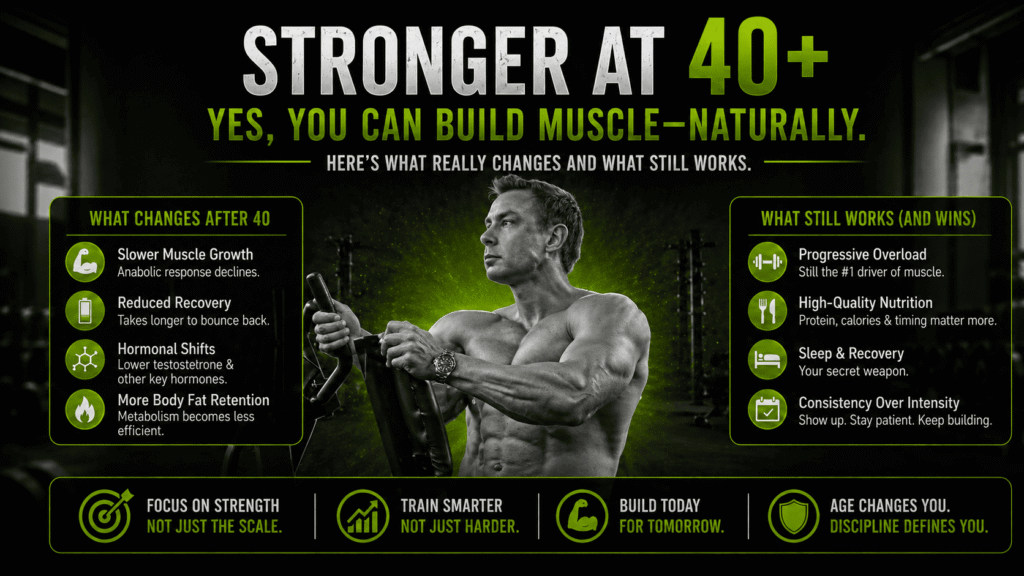
His problem wasn’t his testosterone level. His problem was that he was training like a 22-year-old, recovering like a 50-year-old, and eating like a man who hadn’t read a nutrition article in a decade. The hormonal decline that everyone blames after 40 is real, but it’s almost never the biggest variable in why someone can’t build muscle.
The truth is that men over 40 can absolutely gain muscle naturally. The strategy just has to change. What worked in your 20s breaks your body now. What works now is smarter programming, better recovery, higher protein, and the willingness to train three or four times a week instead of six.
This article is the honest breakdown of what changes with age, what stays the same, and how to build muscle after 40 without grinding yourself into chronic injury.
Frustrated with stalled muscle growth? Start with a free consultation.
Can You Naturally Build Muscle After 40?
Yes, you can naturally build muscle after 40. The rate of muscle gain is slightly slower than in your 20s, and the recovery demand is higher, but the underlying biology of muscle protein synthesis still works. What changes is the margin for error. In your 20s, you could do almost anything in the gym and still grow. In your 40s, the strategy has to be deliberate.
The fitness industry has built an entire marketing channel around the idea that natural muscle growth ends at 40, because that narrative sells testosterone clinics, online TRT programs, and “anti-aging” peptide protocols. The reality is more boring. Most men over 40 who can’t build muscle aren’t suffering from low testosterone. They’re suffering from low protein intake, inconsistent training, poor sleep, and the assumption that the workouts that worked in college will work forever.
What Slows Down (And What Doesn’t)
Muscle protein synthesis is slightly less responsive to a given training stimulus after 40. The technical term is anabolic resistance, and it means you need a slightly higher protein dose per meal and a slightly higher training stimulus to produce the same growth signal you got at 25.
That said, muscle protein synthesis doesn’t stop. It doesn’t even drop dramatically. It just becomes a bit less efficient, and the response to a smart training and nutrition program is still strong enough to add meaningful muscle in your 40s, 50s, and beyond.
What does slow down significantly is recovery. The same hard session that you bounced back from in 36 hours at 25 might take 72 hours to fully recover from at 45. Training frequency, total volume, and intensity all have to be calibrated to that slower recovery window. Push past it, and you train under accumulated fatigue, which produces injury rather than growth.
The Hormonal Reality
Testosterone declines roughly 1 to 2 percent per year after age 30. By 45, your testosterone is meaningfully lower than it was at 25, but it’s usually still well within the normal range that supports muscle growth. Significant clinical decline that actually impairs muscle building is relatively uncommon in men who train consistently, eat enough protein, sleep well, and manage stress.
If you’re concerned about hormonal status, the right move is bloodwork with a physician, not a self-diagnosed assumption that age is the problem. Total testosterone, free testosterone, SHBG, and a basic metabolic panel give a clearer picture than any online symptom checker.
What Actually Changes With Age and Muscle Growth
Several things change with age that affect muscle building, and understanding the changes is what separates productive training from frustrating training. The biggest shifts happen in recovery capacity, hormonal output, joint history, and lifestyle structure, and each one needs a specific adjustment.
Muscle Building in Your 20s vs Over 40
| Variable | In Your 20s | After 40 |
| Recovery speed | 24-36 hours between sessions | 48-72 hours for some lifts |
| Training volume tolerance | High weekly sets, low injury risk | Moderate weekly sets, higher injury risk |
| Sleep requirements | 6-7 hours sometimes enough | 7-9 hours required for recovery |
| Joint stress tolerance | High, most exercises work | Selective, some exercises need substitution |
| Hormonal environment | Peak testosterone and growth hormone | Gradual decline, supportable through lifestyle |
| Injury risk | Low, fast recovery from minor issues | Higher, longer recovery from minor issues |
| Nutrition precision | Forgiving, room for error | Tighter, protein matters more |
| Muscle retention difficulty | Easy, almost automatic | Requires consistent training stimulus |
The right column isn’t a death sentence. It’s a different operating environment that responds to a different strategy.
Why Recovery Capacity Drops
Recovery isn’t just muscle repair. It’s nervous system recovery, hormonal recovery, joint and connective tissue recovery, and sleep-dependent restoration. All four slow down with age. Sleep architecture changes, so deep sleep and REM both shrink. Cortisol clearance becomes less efficient. Growth hormone, which peaks during early-night deep sleep, declines. Connective tissue heals slower.
The practical effect is that the cumulative training stress that you handled at 25 produces accumulated fatigue at 45. Sessions that should feel productive start feeling depleting, and the body responds by holding water, declining in performance, and quietly losing motivation.
The fix is fewer hard sessions, longer recovery windows, and better sleep. Three or four well-recovered sessions outperform six under-recovered ones.
The Joint History Problem
Most men over 40 have some accumulated joint history. Lower back issues from years of desk work. Shoulder problems from old bench press habits. Knee issues from sports or running. The exercises that were fine at 25 sometimes aren’t fine at 45, not because the body has failed but because the wear has accumulated.
The training program needs to accommodate the joint history, not pretend it doesn’t exist. Specific exercises can usually be substituted for joint-friendly alternatives without losing the training effect.
Learn how our team approaches sustainable muscle growth for men over 40.
Best Natural Muscle Building Plan for Men Over Forty
The best natural muscle building plan for men over 40 prioritizes recovery, uses compound lifts as the foundation, runs three or four sessions per week, and progresses through deliberate progressive overload rather than excessive volume. The plan looks unimpressive on paper next to the daily training routines that bodybuilding magazines used to promote, but it produces consistent muscle gain without injury, which is more than most aggressive plans manage.
Training Frequency and Structure
Three to four resistance training sessions per week is the sweet spot for most men over 40. Two sessions is the minimum that produces growth. Five or more sessions per week is rarely sustainable past a few months without recovery issues, joint flare-ups, or motivation collapse.
Two structures work well at this frequency:
Three-day full body split. Each session covers the whole body with compound lifts. Each muscle group gets trained three times per week. Recovery is distributed evenly across the week. This is the highest-yield structure for busy professionals who need maximum efficiency from limited training time.
Four-day upper/lower split. Two upper body sessions and two lower body sessions per week. Each muscle group gets trained twice per week. Total weekly volume is higher than the three-day full body, which suits intermediate to advanced lifters who can recover from the additional load.
Full Body vs Bro Split for Men Over 40
| Factor | Full Body (3x/week) | Bro Split (5x/week) |
| Frequency per muscle group | 3x weekly | 1x weekly |
| Recovery demand | Distributed, manageable | Concentrated, fatiguing |
| Joint stress per session | Moderate, varied | Heavy on isolated areas |
| Time efficiency | High (3 sessions) | Low (5+ sessions) |
| Muscle retention if missed days | Strong (only miss one day of frequency) | Weak (miss a whole muscle group) |
| Sustainability past 40 | High | Low |
For men over 40, the full body or upper/lower structure outperforms the traditional five-day bro split almost every time.
Programming Priorities
Compound lifts as the foundation: squat variations, deadlift variations, presses (bench and overhead), rows, and pull-ups. These movements drive the bulk of muscle growth and produce the strongest hormonal response.
Three to four sets per major lift. Six to ten reps for most compound work. Eight to fifteen reps for accessory work. Rest periods of 90 seconds to 3 minutes between sets on compounds, shorter on accessories.
Progressive overload through small, consistent increases. Adding 2.5 to 5 pounds to a lift over four weeks counts as progress. The lifters who get bigger over years are the ones who add weight slowly and consistently, not the ones who chase huge weekly jumps.
A deload week every four to six weeks. Reduce weight by 30 to 40 percent, keep the movement patterns, let the joints and nervous system recover fully. Most men over 40 skip deloads and pay for it with accumulated injuries.
Apply for individualized programming designed for men over 40.
Strength Training Routine to Gain Muscle After Forty Naturally
The strength training routine that builds muscle after 40 maintains heavy compound lifts as the central driver, supplements with targeted accessory work, and uses moderate volume rather than excessive volume to drive growth. The goal is hard, productive sessions that you fully recover from, not punishing sessions that accumulate fatigue.
Best Compound Lifts for Men Over 40
The compound lifts that produce the most muscle growth for men over 40 are usually variations of the same lifts that work for everyone, sometimes modified for joint comfort.
For lower body: back squat or front squat (or safety bar squat if the lower back is sensitive), trap bar deadlift (often easier on the spine than conventional deadlift), Romanian deadlift, leg press, walking lunges.
For upper body push: barbell or dumbbell bench press, overhead press (or landmine press for shoulder-sensitive lifters), incline press, dips.
For upper body pull: pull-ups, chin-ups, barbell rows, dumbbell rows, cable rows, lat pulldowns.
These lifts cover the major movement patterns and produce the bulk of muscle growth. Everything else in the program is accessory work that supports these lifts.
How Heavy Should People Over 40 Lift?
Heavy enough to produce growth without compromising form or joints. For most men over 40, that means working at 70 to 85 percent of your one-rep max on compound lifts, with reps in the 5 to 10 range. Lighter weights for higher reps work too, but they tend to be less time-efficient.
The trap that men over 40 fall into is going too light “to protect the joints.” Light weights don’t protect joints. They just remove the muscle-building signal. The joints are protected by good form, appropriate exercise selection, deload weeks, and adequate recovery, not by lifting weights that don’t challenge the muscle.
How Often Should People Over 40 Lift Weights?
Three to four times per week is the sweet spot. Two times per week maintains muscle but builds slowly. Five or more times per week becomes hard to recover from for most men over 40 with normal lives.
The variable that matters most isn’t frequency per se. It’s whether you can recover between sessions. If you’re consistently going into the gym still sore from the last session, your frequency is too high or your volume per session is too high.
The Biggest Training Mistakes Killing Muscle Growth After 40
Skipping deloads. Most men over 40 train through fatigue indefinitely, and the body responds by stalling progress and accumulating soft-tissue damage.
Excessive volume. Adding sets and exercises chasing more growth almost always backfires past 40. Less volume done with heavier weight outperforms more volume done with submaximal weight.
Cardio interference. Doing significant cardio on the same day as lifting (or even the day before) suppresses the strength training adaptation. Separate cardio days, or keep cardio short and moderate.
Inconsistent training. The four sessions per week that you actually complete every week for six months will build more muscle than the six sessions per week you plan and execute three of.
Poor warm-ups. Cold lifting at 40 is how rotator cuffs tear and lower backs go out. A real warm-up takes 10 to 15 minutes and is non-negotiable.
Joint-Friendly Workouts to Build Muscle Naturally After Forty
Joint-friendly workouts replace high-risk exercises with comparable lifts that achieve the same muscle-building effect without aggravating common over-40 joint issues. Substitution doesn’t reduce training quality. It just means picking the version of an exercise that fits your specific joint history.
High-Risk Exercises vs Joint-Friendly Alternatives
| Higher-Risk Exercise | Joint-Friendly Alternative |
| Barbell back squat (lower back sensitive) | Safety bar squat or front squat |
| Conventional deadlift (lower back history) | Trap bar deadlift |
| Behind-the-neck press | Landmine press or neutral-grip overhead press |
| Heavy barbell bench press (shoulder issues) | Neutral-grip dumbbell press or floor press |
| Heavy dips (shoulder strain) | Close-grip bench press or push-ups |
| Upright rows | Cable lateral raises or face pulls |
| Barbell good mornings | Romanian deadlifts or hip thrusts |
| Deep barbell squats (knee issues) | Box squats or leg press at reduced range |
The right column produces the same muscle-building stimulus with less joint aggravation. Use the substitution that fits your specific history.
Programming Around Joint Issues
When a specific joint flares up, the answer isn’t to stop training entirely. The answer is to train around the issue while it heals. Shoulder problem? Lower body work continues unchanged. Knee problem? Upper body work continues unchanged. Lower back issue? Focus on movements that don’t load the spine axially.
Continuing to train through an injury, ignoring it, or pushing through pain almost always extends the problem and reduces muscle over time. Training around an injury preserves muscle, maintains the lifting habit, and lets the issue heal faster.
Mobility Work and Warm-Ups
Mobility work doesn’t build muscle directly, but it preserves the joint health that allows you to keep lifting heavy for decades. Ten to fifteen minutes of targeted mobility work before each session, focused on the joints you’re about to load, reduces injury risk significantly.
For warm-ups: start with general movement (rowing, walking, easy cycling) for five minutes, then specific mobility for the day’s lifts, then ramping warm-up sets at progressively heavier weights before the working sets.
Need help training around injuries or limitations? Contact the team directly.
How Should Protein Intake Change to Build Muscle After Forty?
Protein intake becomes more important after 40, not less. The phenomenon called anabolic resistance means that older muscle requires a slightly higher protein dose per meal to trigger the same muscle protein synthesis response. The practical implication is that protein needs to be higher, more evenly distributed across meals, and prioritized at every meal rather than concentrated in one or two.
Daily Protein Targets
Aim for 0.8 to 1.0 grams of protein per pound of bodyweight per day. For a 195-pound man over 40, that’s 156 to 195 grams of protein daily. Most men in this demographic eat half that amount and wonder why they can’t build muscle.
This is not a soft target. Hit it every day. The men who consistently hit their protein numbers build muscle. The men who hit it “most days” don’t.
Protein Distribution Across Meals
Spread protein across four meals per day, with each meal containing 35 to 50 grams of protein. The research on anabolic resistance suggests that older muscle responds best to higher protein doses per meal, around 35 to 40 grams, compared to the 25 to 30 grams that younger lifters need to trigger the same response.
The morning meal matters more than people realize. Most men over 40 eat very little protein at breakfast, which leaves a long overnight gap without meaningful muscle protein synthesis. Front-load protein early in the day.
Best Protein Sources
Lean meats: chicken, turkey, lean beef, pork tenderloin. Fish: salmon, cod, tuna, mahi-mahi. Eggs and egg whites. Greek yogurt and cottage cheese. Whey protein isolate for convenience. Casein for slower digestion at night.
Plant proteins (tofu, tempeh, legumes, pea protein) can work, but you typically need to eat more total volume to hit the same effective protein dose. For most men over 40, animal proteins make hitting the targets easier.
Leucine and Muscle Protein Synthesis
Leucine is the amino acid that primarily triggers muscle protein synthesis. The threshold for triggering a strong response in older muscle is roughly 3 grams of leucine per meal, which corresponds to about 35 to 40 grams of high-quality protein.
This is why a 25-gram protein meal can feel sufficient at 25 but produces a weaker response at 45. The leucine dose isn’t crossing the threshold consistently. Larger meals, or supplemental whey protein with high leucine content, address this.
Can You Still Gain Significant Muscle Naturally After Forty?
Yes, you can still gain significant muscle naturally after 40. The rate is slower than in your 20s, but the cumulative result over years of consistent training is substantial. Most men over 40 who follow a structured program with adequate protein and consistent training can add 5 to 10 pounds of lean muscle in their first year of focused work, and meaningful additional gains in subsequent years.
Realistic Expectations
A complete novice over 40 can gain roughly 1 pound of muscle per month for the first six to twelve months of consistent training. That’s 6 to 12 pounds of lean muscle in a year. The rate slows after that, but it doesn’t stop.
A returning lifter who used to train but stopped for years can experience “muscle memory” effect, where previously trained muscle returns faster than it built originally. This can produce 8 to 15 pounds of muscle in the first year.
An intermediate lifter who has been training consistently can expect 3 to 6 pounds of muscle per year through deliberate programming and progressive overload. The rate slows as you get more advanced, but the ceiling for natural muscle growth past 40 is much higher than the fitness industry suggests.
Body Recomposition Potential
Some men over 40 can lose fat and gain muscle simultaneously, especially if they’re returning to training after a layoff, are carrying significant body fat, or are correcting major nutrition gaps. The simultaneous changes produce dramatic visual results even when the scale moves slowly.
Body recomposition works best when training and protein are dialed in tightly, calorie intake sits at maintenance or slight deficit, and the lifter has either training history (returning) or higher starting body fat (newer lifter with stored fuel available).
Learn more about our coaching background and natural training philosophy.
Hormone-Friendly Training Strategies to Build Muscle After Forty
Hormone-friendly training strategies preserve and support the natural hormonal output that drives muscle growth, rather than suppressing it through excessive training stress. The goal is to train hard enough to produce a growth signal while protecting the recovery and lifestyle factors that keep testosterone, growth hormone, and thyroid output healthy.
Sleep as the Foundation
Sleep is the single most important hormonal lever for men over 40. Growth hormone peaks during deep sleep in the first half of the night. Testosterone responds to total sleep duration. Cortisol clearance depends on sleep quality. Short or fragmented sleep depresses all three.
Seven to nine hours per night. Consistent schedule. Cool, dark room. Screens off 60 minutes before bed. Limit alcohol, which destroys deep sleep architecture.
Avoiding Overtraining
Excessive training volume suppresses testosterone and elevates cortisol, both of which work against muscle growth. The men who train six days a week at high intensity often have worse hormonal profiles than men who train three or four days at high intensity, because the extra volume costs more recovery than it produces in adaptation.
If you’ve been training hard for years without a deload, the first hormone-friendly intervention is usually to reduce frequency, not increase it.
Stress Management
Chronic life stress (work pressure, financial stress, family pressure, poor sleep) keeps cortisol elevated, which competes with testosterone biochemically and suppresses muscle protein synthesis. The training plan can’t fix this on its own.
Stress management practices (structured downtime, boundaries on work hours, daily walking, time outside, social connection) function as hormonal interventions. They’re not optional for men over 40 who want to build muscle.
Natural Habits Supporting Hormone Health
Lift heavy with compound movements at least three times per week. Sleep 7 to 9 hours consistently. Eat enough total calories, not chronically under-eat. Hit protein at 0.8 to 1 gram per pound bodyweight. Maintain healthy body fat (12 to 18 percent for most men). Walk daily. Limit alcohol. Manage chronic stress actively. Get sunlight exposure for vitamin D and circadian regulation. Avoid recreational drug use that affects hormonal function.
These aren’t exciting. They work.
Natural Supplements That Actually Support Muscle Growth After Forty
The supplement industry sells men over 40 dozens of products with exotic claims. Most don’t work. A small handful of supplements have legitimate evidence behind them, and they’re the boring, cheap, well-studied ones.
Evidence-Based Supplements vs Overhyped Supplements
| Supplement | Evidence Level | Benefit | Worth It Past 40? |
| Creatine monohydrate | Very strong | Strength, muscle, cognition | Yes, daily |
| Whey protein isolate | Strong | Helps hit protein targets | Yes, as needed |
| Vitamin D3 | Strong (if deficient) | Hormonal support, bone health | Yes, with bloodwork |
| Omega-3 (EPA/DHA) | Strong | Inflammation reduction, joint health | Yes, daily |
| Magnesium glycinate | Moderate | Sleep, muscle function | Yes, often helpful |
| “Test boosters” (tribulus, etc.) | Weak to none | Marketing claims, minimal effect | No |
| Proprietary “men’s vitality” blends | Weak | Vague claims, expensive | No |
| Pre-workouts with stimulant overload | Negative | Mostly caffeine, stress on the body | No |
| HGH-releasing supplements (over the counter) | None | No meaningful effect | No |
The first five supplements have decades of research behind them. The last four are marketing exercises that take money from men over 40 looking for shortcuts. The honest list of useful supplements is short.
Creatine for Men Over 40
Creatine monohydrate is probably the highest-yield supplement for men over 40. It supports muscle protein synthesis, improves strength and power output, helps preserve muscle during caloric restriction, and has emerging evidence for cognitive benefits in aging populations. Five grams daily, no loading phase needed, taken at any time of day.
Vitamin D and Hormones
Vitamin D deficiency is common in men over 40, especially those living at higher latitudes or working indoors. Low vitamin D correlates with lower testosterone, worse mood, and impaired immune function. A simple blood test reveals where you stand, and supplementation (typically 2,000 to 5,000 IU daily depending on baseline) can correct deficiency.
This is a physician conversation, not a self-diagnosis. Get the bloodwork.
Explore recommended training tools and products.
How to Recover Optimally When Building Muscle After Forty
Recovery is the variable that determines whether your training produces muscle growth or accumulated fatigue. For men over 40, recovery is more important than training intensity, because the body that doesn’t recover doesn’t grow no matter how hard you trained.
Sleep Quality and Quantity
Seven to nine hours nightly, consistent schedule, dark and cool environment. Sleep is the single highest-yield recovery variable, and it’s the one most men over 40 are willing to sacrifice for work or family demands.
If you can only fix one thing about your recovery, fix sleep. Everything else compounds from there.
Daily Walking
Walking is active recovery without recovery debt. It improves circulation, reduces cortisol, supports digestion, and burns calories without taxing the muscular or nervous system. Seven thousand to ten thousand steps daily is the target for most adults, and it’s especially valuable on rest days.
Active Recovery and Mobility
Light movement on rest days outperforms total inactivity for muscle recovery. Easy bike riding, walking, swimming, light yoga, or basic mobility work all improve recovery by increasing blood flow without adding training stress.
Twenty to thirty minutes of light activity on rest days is enough.
Deloading
A deload week every four to six weeks. Reduce weight on all lifts by 30 to 40 percent, keep the movement patterns, finish sessions feeling fresh rather than depleted. This gives joints, connective tissue, and the nervous system a chance to fully recover from accumulated training stress.
Men over 40 who skip deloads pay for it with injury, stalled progress, and motivation collapse over time.
Stress Reduction and Hydration
Chronic life stress raises cortisol and impairs muscle recovery. The training plan can’t fix this on its own. Structured downtime, boundaries on work hours, and time spent on non-training activities all support recovery.
Hydration matters more than most people realize. Mild dehydration impairs performance, recovery, and cognitive function. Aim for clear or light yellow urine throughout the day.
Natural Muscle Building Schedule for Busy Professionals Over Forty
The natural muscle building schedule for busy professionals over 40 prioritizes efficiency, recovery, and consistency over volume. The goal is a sustainable program that fits into a demanding work life and produces muscle growth over months and years, not a perfect program that lasts six weeks before collapsing under schedule pressure.
Time-Efficient Training
Sessions of 45 to 60 minutes, three or four days per week. That’s three to four hours of total training time, which fits into almost any schedule. The session structure prioritizes compound lifts, runs warm-up to working sets efficiently, and avoids the social or filler activities that stretch gym time without adding training value.
Minimal Effective Volume
The minimum amount of training that produces muscle growth, not the maximum amount your schedule can tolerate. For most busy professionals over 40, that’s 10 to 15 working sets per muscle group per week, distributed across three or four sessions. More volume than that costs more recovery than it produces in growth.
Three-Day Plan for Busy Professionals
Monday: Full body strength (legs primary). Wednesday: Full body strength (upper primary). Friday: Full body strength (mixed). Sixty minutes per session, compound lifts, progressive overload. Four rest days for recovery and daily walking.
Four-Day Upper/Lower for Intermediates
Monday: Upper body. Tuesday: Lower body. Thursday: Upper body. Friday: Lower body. Three rest days for recovery, with daily walking throughout the week.
Travel and Work Stress Adjustments
When work or travel disrupts the routine, the priority is maintaining frequency over total volume. A 30-minute session in a hotel gym, hitting two or three compound lifts hard, preserves the training stimulus better than skipping the week and trying to catch up later.
The men who succeed with muscle building past 40 are the ones who adapt the plan to their lives, not the ones who try to force their lives around an inflexible plan.
Apply for customized coaching and programming.
Expert Viewpoint: Building Muscle After 40 Naturally Is Absolutely Possible, But the Strategy Must Change
Fifteen years of training men over 40 in New York has shown me that natural muscle growth isn’t the question. The question is whether the man is willing to train smarter than he did at 25.
The men who succeed after 40 do less in the gym, not more. Three or four sessions per week instead of six. Compound lifts as the foundation instead of endless isolation work. Deload weeks every four to six weeks instead of training through fatigue indefinitely. Heavy weight with manageable volume instead of moderate weight with excessive volume. Seven to nine hours of sleep instead of grinding through six. Protein at every meal instead of one big chicken meal at dinner.
The men who fail after 40 are still trying to be the lifter they were in college. They train through pain. They skip recovery. They underrate sleep. They underrate protein. They overrate cardio. They chase the next supplement instead of fixing the basics. And they wonder why their bodies aren’t responding to training the way they used to.
If you’re over 40 and you want to build muscle naturally, the path forward isn’t complicated. Lift heavy three or four times a week. Eat enough protein. Sleep enough hours. Walk daily. Take deload weeks. Train around your joint history rather than through it. Give it 6 to 12 months. The muscle responds.
The hormonal decline that the industry blames for everything is real, but it’s almost never the biggest variable. The biggest variable is whether the training plan respects the body you actually have at 45 rather than the body you used to have at 25.
Simple. Not easy. Absolutely achievable.
Ready to build a muscle-building strategy that fits your current life? Reach out for a consultation.
Frequently Asked Questions
Can you naturally build muscle after 40?
Yes, men over 40 can build meaningful muscle naturally through structured resistance training, adequate protein at 0.8 to 1 gram per pound bodyweight, consistent sleep, and progressive overload, though the rate is slightly slower than in younger lifters.
Is it harder to build muscle after age 40?
Muscle building is slightly harder after 40 due to reduced recovery capacity, slightly slower protein synthesis, and lower hormonal output, but the underlying biology still supports growth when training and nutrition are dialed in.
How long does it take to gain muscle after 40?
Most men over 40 can gain 6 to 12 pounds of lean muscle in their first year of structured training, with 3 to 6 pounds per year as a realistic ongoing rate for intermediate lifters.
What is the best workout to build muscle after 40?
A three or four day full body or upper/lower split with compound lifts, heavy weights in the 6 to 10 rep range, deload weeks every 4 to 6 weeks, and consistent progressive overload produces the best results.
How often should men over 40 lift weights?
Three to four resistance training sessions per week is the sweet spot for most men over 40, balancing growth stimulus with the recovery capacity required to train consistently year over year.
What foods help build muscle naturally after 40?
Lean meats, fish, eggs, Greek yogurt, cottage cheese, and whey protein support the higher protein needs of men over 40, with each meal containing 35 to 50 grams of high-quality protein.
Can men over 40 still gain lean muscle mass?
Yes, lean muscle gain is fully achievable past 40 through consistent resistance training, adequate protein, prioritized sleep, and a calorie intake that supports muscle building rather than chronic restriction.
What supplements support muscle growth after 40?
Creatine monohydrate, whey protein, vitamin D3 if deficient, omega-3 fatty acids, and magnesium have the strongest evidence for supporting muscle growth and recovery in men over 40.
How can you build muscle after 40 without steroids?
Natural muscle building after 40 relies on heavy compound lifting three or four times per week, protein at 0.8 to 1 gram per pound bodyweight, seven to nine hours of sleep, deload weeks every 4 to 6 weeks, and patience over 12 to 24 months.
What recovery habits matter most after 40?
Consistent 7 to 9 hours of sleep, daily walking, deload weeks every 4 to 6 weeks, stress management, and adequate hydration matter more for men over 40 than for younger lifters.
Maik Wiedenbach is a New York City-based personal trainer, fitness author, and founder of Maik Wiedenbach Fitness. He has spent over 15 years helping men over 40 build muscle naturally through structured strength training, recovery-focused programming, and evidence-based nutrition.

Maik Wiedenbach is a Hall of Fame swimmer turned bodybuilding champion and fitness model featured in Muscle & Fitness and Men’s Journal. An NYU adjunct professor and award-winning coach, he founded New York’s most sought-after personal training gym.