
A client sat across from me last spring and said something I’ve heard a hundred times. “I lost 60 pounds. Now I can’t eat anything without gaining. My metabolism is broken.”
She’d done it the hard way. Aggressive deficit. Two hours of cardio most days. Minimal resistance training. Sixty pounds in about seven months. And now, three months past her lowest weight, the scale was creeping back up while she was eating less than she ever had.
Her conclusion: the diet broke her.
The actual story: her body did exactly what it’s designed to do during a survival event, and nobody warned her that the maintenance phase was a separate skill from the loss phase.
The conversation about maintenance almost never happens in fitness content. Everyone wants to talk about how to lose the weight. Almost nobody talks about what your metabolism looks like on the other side of a major fat loss phase, why hunger feels different, why your maintenance calories are lower than the formulas predict, and why so many people who lose significant weight end up regaining it within two years.
Your metabolism is not broken. It’s adapted. There’s a real difference, and the difference determines whether you spend the next five years dieting in cycles or whether you actually keep what you built.
Stuck after a major fat loss phase? Start with a free consultation.
How Does Metabolism Change After Significant Weight Loss?
The short answer is that your metabolism slows down after significant weight loss. The longer answer is that the slowdown comes from four separate sources, and they’re not all permanent.
A smaller body burns fewer calories at rest, and that’s the largest and most predictable factor. If you lost 50 pounds, your resting metabolic rate dropped right along with the weight. There’s nothing pathological about the change. It’s basic energy economics.
The second factor is adaptive thermogenesis. Your body becomes more metabolically efficient under sustained caloric restriction, which means it burns fewer calories than the math predicts at your new weight. A long-term follow-up study on the contestants of The Biggest Loser, published in the journal Obesity, found that six years after the show their resting metabolic rate remained roughly 500 calories per day below predicted values. Most people don’t lose weight that aggressively, so the adaptation is smaller, but the mechanism is the same.
The third factor is reduced NEAT, or non-exercise activity. After a sustained deficit, you move less without realizing it. Fewer fidgets. Less pacing. Slower walking. This can account for 100 to 400 fewer calories burned daily.
The fourth factor is hormonal. Leptin drops. Ghrelin rises. Thyroid output decreases. You’re hungrier than you used to be at the same level of fullness, and your body’s basic metabolic signaling has shifted toward conservation.
Normal Metabolic Adaptation vs Severe Dieting Response
| Normal Weight Loss Adaptation | Aggressive Dieting Response |
| Modest calorie reduction needed for maintenance | Major drop in maintenance calories |
| Mild increase in hunger | Constant, intrusive hunger |
| Training performance holds | Strength and energy decline |
| Gradual, predictable fat loss | Plateaus followed by rebound |
| Sustainable daily energy | Chronic fatigue, poor sleep |
The takeaway here is straightforward. Modest deficits and longer timelines produce mild adaptation that’s manageable. Aggressive deficits and short timelines produce a much larger adaptation that takes months to recover from.
Learn how our team approaches sustainable body composition instead of crash-diet fat loss.
Does Metabolism Slow Down After Weight Loss?
Yes. But “slow” is the wrong word for what’s happening. Your metabolism is adapting, not breaking. The distinction matters because adaptation is reversible. Damage is not.
What Is Adaptive Thermogenesis?
Adaptive thermogenesis is the metabolic slowdown that occurs beyond what weight loss alone would predict. If a formula says you should burn 1,950 calories at your new weight, you might actually burn 1,750. That 200-calorie gap is the adaptation.
It happens because your body interprets a sustained deficit as a survival event. It downregulates non-essential energy expenditure. Body temperature drops slightly. Heart rate decreases. Subconscious movement reduces. Thyroid output declines. None of these are dramatic on their own, but together they add up to a meaningful daily calorie reduction.
The deeper and longer the deficit, the larger the adaptation. The more lean mass you lost, the larger the adaptation. The faster you lost the weight, the larger the adaptation.
Why Hunger Increases After Dieting
Leptin is the hormone that tells your brain you have enough stored energy on board. When you lose body fat, your leptin drops, and as it drops, hunger increases while satiety decreases.
Ghrelin works in the opposite direction by signaling hunger, and after a sustained deficit, ghrelin levels rise above pre-diet baseline and stay elevated for months. Research suggests these hormonal changes can persist for at least a year after weight loss, even in people who’ve maintained their new weight successfully.
What this means in practice: your body is not betraying you. It’s executing a hormonal program designed to drive weight regain. The hunger is real and biological. Willpower is not the solution. Strategy is.
The Relationship Between Muscle Mass and Metabolism
Every pound of muscle burns roughly 6 to 7 calories per day at rest. Lose 10 pounds of muscle during a fat loss phase, and you’ve reduced your resting metabolic rate by 60 to 70 calories daily. That sounds small. Over a year, it’s roughly 22,000 to 25,000 calories, or about 6 to 7 pounds of potential fat gain.
Muscle is the metabolism factor that’s actually in your control. You can’t undo the leptin drop overnight. You can’t manufacture more thyroid hormone. But you can build and protect muscle. And every pound of muscle preserved or rebuilt is a pound of metabolic insurance against regain.
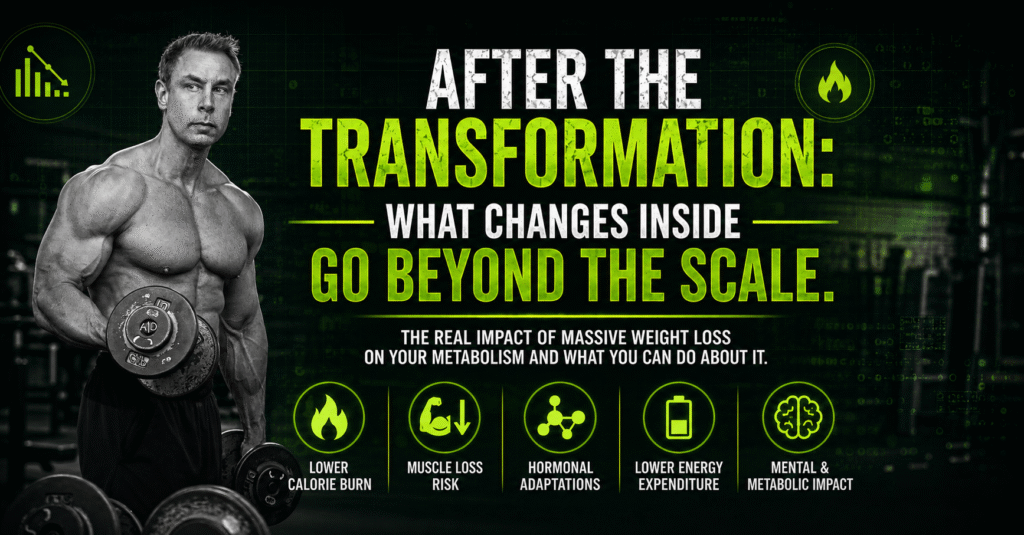
Key Takeaway: Metabolism slows after weight loss for four reasons: a smaller body, adaptive thermogenesis, reduced daily movement, and hormonal shifts in hunger and satiety. None of these mean your metabolism is broken. They mean your body has adapted, and the adaptation can be managed with the right strategy.
Signs of Healthy Metabolic Adaptation vs Excessive Diet Stress
Healthy adaptation looks like moderate hunger that responds to a good meal, stable training performance, consistent recovery, sleep that holds together, and a maintenance calorie level that’s slightly lower than the formulas predict.
Excessive diet stress looks like constant fatigue, intrusive cravings, cold hands and feet, sleep that’s broken or shallow, strength dropping in the gym, irritability, and weight that keeps creeping up despite what feels like restrained eating.
If you’re in the second column, the answer is not more restriction. It’s recovery.
Work with experienced coaches who understand metabolic adaptation and sustainable fat loss recovery.
Why Does Weight Regain Happen Despite Maintaining Healthy Habits?
Weight regain after dieting often happens because appetite increases while calorie expenditure decreases, making long-term maintenance harder than the loss phase ever was.
Most people frame weight regain as a willpower failure. It’s not. It’s a biological feedback loop that’s been studied for decades. The body that just lost weight is not metabolically the same as a body that’s never been overweight at the same size. It runs leaner on calories. It signals hunger more aggressively. And it does this for at least a year, often longer.
Why Maintenance Is Harder Than Fat Loss
Fat loss has a clear daily structure. Hit the deficit. Train. Sleep. Repeat. The feedback is visible on the scale within weeks.
Maintenance has none of that. The scale isn’t supposed to move. Calories are higher than they were during the cut, which feels like permission. Tracking feels less urgent because you’ve “made it.” But your maintenance calories are now lower than they used to be at this body weight, and your appetite is higher than it used to be at this body fat percentage. The gap between what you can eat and what you want to eat is wider than it’s ever been.
That’s the trap. Most people drift through it without realizing they’re drifting until they’ve put back 10 or 15 pounds.
The Psychological Side of Weight Regain
After a long deficit, food becomes loaded. You spent months saying no to foods you used to eat without thinking, and when the cut ends, your relationship with food doesn’t reset overnight. Some people swing into rebound eating that looks like celebration but functions like a binge. Others stay restrictive and develop a fear of normal food, which usually breaks at some point and produces a larger swing.
The healthiest maintenance approach treats food the same way it treated the cut: tracked, structured, planned. Not forever. But long enough that your new body weight stabilizes and your hunger signaling normalizes, which can take six to twelve months.
Why Most Diets Fail Long Term
The diet didn’t fail. The transition out of it did. Almost every commercial weight loss program ends at the moment the user reaches goal weight. There’s no maintenance protocol. No reverse diet. No structured plan for the year after. So people regain, blame themselves, and start the cycle again.
Real fat loss success is measured at the three-year mark, not the three-month mark.
Download sustainable nutrition and training systems designed for long-term body composition success.
Reverse Dieting and How to Support Metabolism After Weight Loss
Reverse dieting is the practice of slowly increasing calories after a fat loss phase to recover metabolic rate, restore hormone signaling, and stabilize weight at a sustainable maintenance level. It’s not magic. It doesn’t “repair” your metabolism in the way some online claims suggest. But it works as a structured exit from a deficit, and that structure is what most people are missing.
How Reverse Dieting Works
You add calories back gradually. Most protocols use 50 to 150 calories per week, distributed primarily through carbohydrate intake. You weigh daily and average weekly. As long as the weekly average is stable or trending up at a rate you’re comfortable with, you keep adding. If weight starts climbing faster than expected, you hold at the current intake for a few weeks before adding more.
The goal is twofold. First, find your new maintenance calorie level, which is almost always higher than where you ended the cut. Second, give your hormones time to recalibrate. Leptin recovery, thyroid normalization, and ghrelin reduction all benefit from sustained eating at maintenance.
Who Benefits Most From Reverse Dieting
People who dieted aggressively. People who ended the cut at very low body fat. People who are training seriously and need their performance to recover. People who have a history of yo-yo dieting and want to break the cycle.
People who don’t benefit as much: those who lost weight slowly through modest adjustments and never developed significant adaptation. They can usually transition to maintenance in a few weeks without a formal reverse.
Common Reverse Dieting Mistakes
Adding calories too fast and panicking when the scale moves up two pounds in a week. That’s water, glycogen, and food in transit. It’s not fat.
Adding calories only through “clean” food and ignoring the actual numbers. The macros matter more than the source.
Stopping the reverse the moment the scale moves. The whole point is to let your maintenance recover. Stopping early defeats the purpose.
Aggressive Post-Diet Eating vs Structured Reverse Dieting
| Aggressive Rebound Eating | Structured Reverse Dieting |
| Calories spike 800 to 1,500 above cut overnight | Calories increase 50 to 150 per week |
| Fat regain risk is high | Weight stabilizes gradually |
| Energy swings, digestive distress | Energy and recovery improve steadily |
| Loss of dietary structure | Tracking and structure remain in place |
| Emotional eating cycles activate | Long-term adherence stays intact |
Explore evidence-based fat loss and recovery systems built for long-term metabolic health.
How to Keep Metabolism High After Reaching Goal Weight
You can’t restore your metabolism to its pre-diet level overnight. But you can preserve and rebuild what you have through a small number of high-impact habits.
Strength Training Plan to Support Metabolism
Three to four resistance training sessions per week. Compound lifts at the core: squats, deadlifts, presses, rows, pull-ups. Progressive overload is non-negotiable. Adding weight, reps, or sets over time is what tells your body to hold onto muscle.
Two sessions per week is the minimum that produces meaningful muscle retention in most adults. Four sessions is the upper end of what most people can recover from while also living a normal life. Five or six sessions is fine for serious lifters with good recovery, but it’s not required for metabolic protection.
Why Muscle Mass Matters After Weight Loss
Muscle is metabolically active tissue. It’s also the only tissue that responds to training stress by getting larger and more functional. Fat doesn’t do that. Bone density improves with training, but slowly. Muscle is the active lever.
A man who finishes a fat loss phase carrying 160 pounds of mostly lean tissue is metabolically very different from a man who finishes at 160 pounds with significantly less muscle and more body fat. Same scale weight. Completely different daily calorie expenditure. Completely different long-term risk of regain.
The Most Important Lifestyle Habits for Metabolic Health
The list is short and unglamorous.
Prioritize resistance training three to four times per week. Keep protein at 0.7 to 1 gram per pound of bodyweight. Walk 7,000 to 10,000 steps daily. Sleep 7 to 9 hours. Avoid sustained aggressive calorie cuts. Manage stress at a level your nervous system can handle. Schedule structured maintenance phases between any future fat loss attempts.
That’s the list. There’s nothing exotic on it. The people who execute it consistently keep their weight off. The people who chase the next protocol usually don’t.
Best Eating Patterns to Stabilize Metabolism Post Weight Loss
Once you’ve reverse-dieted to a sustainable maintenance, the question becomes how to eat in a way that holds the weight without making food the center of your daily mental load.
How Much Should You Eat After Losing Weight?
Your maintenance calorie level after a significant fat loss phase is usually 10 to 15 percent below what standard formulas predict. If a calculator says you should maintain on 2,400 calories, your actual maintenance might be closer to 2,000 to 2,200 for the first year after the cut.
This gap closes over time as your metabolism recovers, but it doesn’t close to zero. Most people who’ve lost significant weight will always run slightly below predicted maintenance compared to someone who never carried the extra weight.
The practical move: find your actual maintenance through a few weeks of consistent eating and daily weighing, not through a calculator.
Why Chronic Dieting Backfires
If you spend years in low-grade caloric restriction, your body never gets the signal to come out of conservation mode. Hormones stay suppressed. Hunger stays elevated. Training performance stays compromised. You’re stuck in a permanent half-diet that produces neither real fat loss nor real metabolic recovery.
Cycling through structured deficits and structured maintenance phases produces better long-term results than living in a permanent mild deficit.
Flexible Nutrition vs Restrictive Dieting
Flexible nutrition means hitting calorie and protein targets while eating foods you actually enjoy. It doesn’t mean junk food on demand. It means that the foods you eat are chosen by you for reasons that include taste, social context, and convenience, not just by a rule system you inherited from a meal plan.
Restrictive dieting works for short periods. It rarely holds for years. Most people who maintain significant weight loss over five or ten years are eating flexibly with structure, not following the same rigid plan they used to lose the weight.
Sustainable Post-Diet Habits vs Rebound Behaviors
| Sustainable Habits | Rebound Behaviors |
| Consistent protein at every meal | Wildly variable protein intake |
| Structured meal timing most days | Chaotic eating, skipping then overeating |
| Strength training 3 to 4x per week | Cardio-heavy, no resistance work |
| Scheduled maintenance phases | Constant low-grade dieting |
| Tracking as a periodic audit | Either obsessive tracking or none at all |
Get a personalized strategy for maintaining fat loss while protecting metabolic health.
How to Measure Metabolic Rate Accurately After Losing Weight
This is the question people ask hoping for a number. The honest answer is that the gold-standard tests are expensive and not available to most people, but you don’t actually need them.
Why Online Metabolism Calculators Are Often Wrong
Calculators use population averages. They assume your metabolic rate is what a person of your age, height, weight, and activity level would typically have. They don’t account for the metabolic adaptation that comes from significant weight loss, your specific lean mass, your training history, or your hormone status.
For someone who’s never dieted, a calculator estimate is usually within 10 percent of reality. For someone post-significant-weight-loss, it can be 15 to 20 percent high.
The Best Real-World Indicators of Metabolic Health
Daily energy. Are you waking up rested and getting through the day without crashes?
Training performance. Are your lifts holding or progressing? Is your recovery between sessions reasonable?
Body temperature. Cold hands and feet, especially in the morning, can indicate sustained metabolic suppression.
Sleep. Are you falling asleep in reasonable time and staying asleep through the night?
Hunger pattern. Is your hunger predictable and tied to meal timing, or is it constant and intrusive?
Weight stability. Over a 4-week average, is your weight stable at your current intake?
These markers together tell you more about your metabolic health than any single calculator number.
When to Seek Professional Assessment
If you’ve executed the basics consistently for six months and you’re still struggling with maintenance, or if your training performance is collapsing despite adequate calories, it’s worth ruling out medical issues. Thyroid panels. Sex hormone panels. Iron studies. Professional organizations like the Endocrine Society publish guidelines on screening for hormonal conditions that affect metabolism.
This is a physician’s territory, not a trainer’s. If something feels off and the lifestyle factors are dialed in, the next step is bloodwork.
Meet our trainers who help clients maintain results long term.
Expert Viewpoint: The Goal Is Not Just Weight Loss. It’s Metabolic Sustainability.
Fifteen years of working with people through fat loss has shown me that the loss phase is the easy part. Most people can run a deficit for a few months if they’re motivated. The hard part is what comes next.
Your metabolism adapts to a deficit because your body is trying to keep you alive through what it interprets as a famine. That adaptation isn’t damage. It’s design. Once you accept that the adaptation is real, the strategy becomes obvious. Eat enough. Train hard enough to protect muscle. Sleep enough. Move enough. And give your body time to recalibrate after the cut ends.
The people who keep their weight off long term don’t have better genetics or stronger willpower than the people who regain. They have structure that extends past the goal weight. They reverse-diet instead of bingeing. They keep training. They keep tracking, at least periodically. They treat maintenance as its own skill rather than an absence of dieting.
If you’ve lost significant weight and you’re worried your metabolism is broken, it’s almost certainly not. It’s adapted. The recovery is slower than the loss was, but it’s real, and the work is straightforward. Build muscle. Eat at maintenance. Sleep. Walk. Let your hormones settle. Give it twelve months before you judge where you actually land.
Simple. Not easy. Absolutely achievable.
Ready to plan the next phase the right way? Reach out for a personalized strategy.
Frequently Asked Questions
Does metabolism slow down after weight loss?
Yes, metabolism slows after significant weight loss due to a smaller body size, adaptive thermogenesis, reduced daily movement, and hormonal shifts that increase hunger and decrease satiety.
How can you boost metabolism after losing weight?
Build and preserve muscle through resistance training, eat adequate protein at 0.7 to 1 gram per pound of bodyweight, walk daily, sleep 7 to 9 hours, and avoid sustained aggressive calorie cuts.
What is metabolic adaptation after dieting?
Metabolic adaptation is the metabolic slowdown beyond what weight loss alone would predict, caused by reduced thyroid output, lower body temperature, and decreased non-exercise activity in response to sustained caloric restriction.
Why is it harder to maintain weight loss long-term?
Maintenance is harder because appetite hormones drive hunger higher for months after dieting while calorie expenditure stays lower, creating a daily gap between what you can eat and what you want to eat.
Can reverse dieting repair metabolism?
Reverse dieting supports metabolic recovery by gradually restoring calorie intake and hormone signaling, but it does not magically repair adaptation. It provides structure for the transition from deficit to maintenance.
How long does it take metabolism to recover after weight loss?
Most metabolic recovery happens over 6 to 12 months of consistent eating at maintenance, though some adaptation can persist for years, particularly after aggressive or repeated dieting cycles.
What causes weight regain after dieting?
Weight regain is driven by elevated hunger hormones, suppressed satiety signaling, reduced daily calorie expenditure, and the absence of a structured maintenance plan after reaching goal weight.
Can strength training improve metabolism after weight loss?
Yes, resistance training builds and preserves muscle, which increases resting metabolic rate and protects against the lean mass loss that drives long-term regain.
How many calories should you eat after losing weight?
Most people who’ve lost significant weight maintain on 10 to 15 percent fewer calories than standard formulas predict, so finding your actual maintenance through consistent eating and weekly weight averaging is more accurate than calculators.
What are the signs of a slowed metabolism after dieting?
Persistent fatigue, cold hands and feet, intrusive hunger, poor training recovery, broken sleep, and weight stability or gain at calorie levels that should produce loss are common signs of significant metabolic adaptation.
Maik Wiedenbach is a New York City-based personal trainer, fitness author, and founder of Maik Wiedenbach Fitness. He has spent over 15 years helping clients lose fat sustainably and protect their metabolic health for the long term.
“`html
“`

Maik Wiedenbach is a Hall of Fame swimmer turned bodybuilding champion and fitness model featured in Muscle & Fitness and Men’s Journal. An NYU adjunct professor and award-winning coach, he founded New York’s most sought-after personal training gym.