
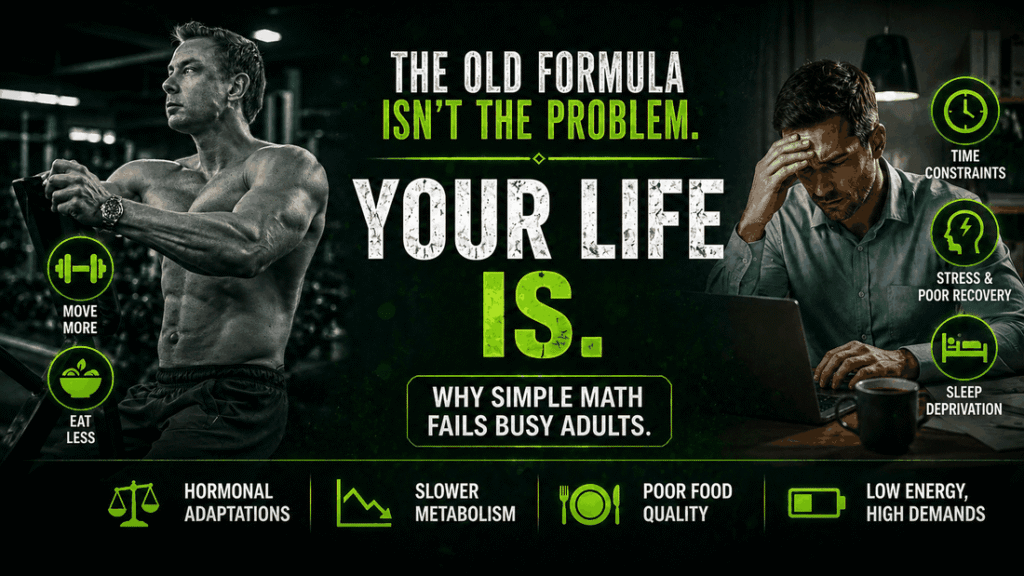
A client emailed me on a Sunday night. She’d been “doing everything right” for four months. Eating less. Moving more. Logging her food in an app. Walking the dog twice a day. Three Peloton sessions a week. The scale hadn’t moved in seven weeks.
Her message ended with one line: “If calories in versus calories out is real, why isn’t this working?”
It’s real. The first law of thermodynamics doesn’t have exceptions. But the slogan “eat less, move more” hides three problems that ruin its usefulness in practice. First, most people are not eating as little as they think. Second, “moving more” through structured exercise doesn’t change daily calorie expenditure as much as people assume. And third, the body responds to a sustained deficit by quietly reducing the calories it burns, which means the deficit you started with isn’t the deficit you have six weeks later.
So the equation is true. The execution is where it falls apart. And if you’ve been told for years that fat loss is “just calories in versus calories out,” nobody’s ever sat you down and walked you through why that statement, while technically correct, almost guarantees you’ll be confused when results stall.
This article is the breakdown of what’s actually happening when “eat less, move more” stops producing results, and how to fix the situation without doubling down on a strategy that’s already failing.
Stalled out and not sure why? Start with a free consultation.
Why Is “Eat Less Move More” Not Working for Fat Loss?
“Eat less, move more” stops working when underestimated calorie intake, metabolic adaptation, reduced non-exercise activity, and hormonal shifts combine to erase the deficit you believed you were maintaining. The math is right. The data going into the math is wrong.
Here’s what’s almost always happening when someone says the formula isn’t working.
The “eat less” half is rarely as restrictive as the person believes. Portion estimation errors compound over weeks. A few tablespoons of olive oil that go untracked. Bites of food while cooking. A weekend meal that adds 1,500 calories in a single sitting. The week ends with no actual deficit even though five out of seven days felt disciplined.
The “move more” half is usually a smaller calorie source than people assume. A 45-minute strength session burns roughly 200 to 300 calories, and a spin class might burn 400. Meanwhile, your daily non-exercise activity quietly drops. Fewer steps. Less fidgeting. Less standing while you’re on the phone. That decline can wipe out 200 to 500 calories per day under sustained restriction, often more than offsetting the structured exercise calories entirely.
Traditional Diet Advice vs Real Metabolic Response
| Traditional Advice | What Actually Happens |
| Eat fewer calories | Metabolism adapts downward over weeks |
| Do more cardio | Recovery worsens, NEAT decreases, hunger climbs |
| Skip meals | Hunger hormones rise, evening overeating spikes |
| Train harder daily | Cortisol accumulates, water retention masks fat loss |
| Watch the scale | Muscle loss is invisible until clothes stop fitting |
This isn’t a flaw in physics. It’s a gap between the simplicity of the slogan and the complexity of the system the slogan is trying to control.
Learn how our evidence-based coaching approach differs from crash dieting.
Metabolic Reasons “Eat Less Move More” Fails for Many People
Your body is designed to survive caloric restriction, not to lean out for a beach vacation. When the deficit is sustained long enough, the body responds with a coordinated set of adaptations that all push in the same direction: reduce energy output, increase energy intake, restore equilibrium.
This is where most online fitness advice breaks down. It treats the human body as a furnace with a fixed burn rate. The body is closer to a thermostat that adjusts the burn rate based on incoming fuel.
The first adaptation is adaptive thermogenesis. Your resting metabolic rate drops below what your current body weight would predict. The drop is small in modest deficits and larger in aggressive ones. Over months, it can add up to 200 or 300 calories per day below expected.
The second adaptation is hormonal. Leptin, the satiety hormone that signals stored energy, falls. Ghrelin, the hunger hormone, rises. Thyroid output decreases slightly. Sex hormones, particularly in women, can shift in ways that affect water retention, hunger, and energy. Professional organizations like the Endocrine Society publish guidelines on the hormonal changes that accompany sustained caloric restriction.
The third adaptation is muscle loss. In a deficit without adequate protein and resistance training, the body burns muscle alongside fat. Less muscle means a lower resting metabolic rate, which means the deficit you started with shrinks even if your food intake stays identical.
The fourth adaptation is recovery debt. When you stack a calorie deficit on top of frequent training and poor sleep, recovery falls behind, cortisol stays elevated, and the body holds water. The scale doesn’t budge for weeks. Most people assume nothing is happening. Fat may actually be coming off underneath, but it’s masked by water retention until the cortisol drops.
Signs of Healthy Fat Loss vs Metabolic Slowdown
Healthy fat loss feels like stable energy, decent sleep, manageable hunger, training performance that holds or improves, and consistent weekly weight movement when averaged across daily fluctuations.
Metabolic slowdown feels like constant fatigue, cold hands and feet, intense food cravings, broken sleep, training performance that’s declining, irritability that surprises you, and weight that won’t move despite restraint that feels punishing.
If you’re in the second column, you don’t need to eat less. You need to address recovery, hormones, and execution quality.
What Causes a Weight Loss Plateau Even in a Calorie Deficit?
A calorie deficit can stop producing visible results when metabolism adapts, daily movement declines, recovery worsens, or stress hormones increase water retention enough to mask actual fat loss.
The frustrating part about plateaus is that they often happen when the deficit is most real. You’ve been at it for two or three months. Adherence is high. The early progress was clear. Then the scale stops, and the assumption is that something is broken.
What’s Usually Behind the Plateau
Inaccurate tracking that worked at first becomes a bigger problem as the gap between estimated and actual intake widens. A 200-calorie daily underestimate didn’t matter when your deficit was 600. It matters a lot when your deficit has shrunk to 200 due to adaptation, because now it’s erased the deficit entirely.
Hidden calories from oils, sauces, drinks, bites, and weekend meals are the single most common cause of plateaus that “shouldn’t be happening.” Research published through the National Institutes of Health has consistently documented that people, including trained dietitians, underestimate calorie intake by 20 to 50 percent without precise measurement.
Reduced movement outside structured workouts is the second most common cause. As the deficit continues, you walk slower, fidget less, sit longer, and take the elevator more often without realizing it. This can wipe out 200 to 400 daily calories.
Water retention from cortisol elevation can hide actual fat loss for weeks. Your fat is decreasing. The scale isn’t moving because water is holding the number steady. Stress, poor sleep, hard training, and aggressive dieting all push cortisol up.
Overestimated calorie burn from cardio and step counters can add up. Most fitness trackers overestimate exercise calories by 15 to 50 percent. People then “eat back” calories they didn’t actually burn.
Fat Loss Plateau Causes and Solutions
| Plateau Cause | What It Looks Like | Recommended Adjustment |
| Chronic under-eating | Constant fatigue, cravings, low body temperature | Increase calories strategically, take a diet break |
| Too much cardio | Poor recovery, stalled lifts, water retention | Reduce cardio, add resistance training |
| Poor sleep | Daily weight swings, weekend overeating | Improve sleep hygiene, target 7 to 9 hours |
| Stress overload | Belly bloat, midsection water retention | Reduce training volume, address life stressors |
| Low protein intake | Muscle loss, soft appearance despite weight loss | Increase to 0.7 to 1g per pound of bodyweight |
| Hidden calorie creep | “Eating clean” but no movement on the scale | Weigh food for 7 days, audit honestly |
The fix depends on which cause is actually driving the stall. Almost nobody plateaus for a single reason. It’s usually two or three of these working together.
Hormonal Issues That Make “Eat Less Move More” Ineffective
Hormones can stall fat loss in ways that have nothing to do with caloric arithmetic. The deficit can be real and verified, and the scale still won’t move if the hormonal environment is wrong.
This section is one where I want to be careful. I’m a trainer, not an endocrinologist. If you suspect a hormonal issue is in the way, the next step is bloodwork with a physician, not a self-diagnosis based on internet symptoms. What I can tell you is which conditions to consider and what to bring up with your doctor.
Insulin Resistance
Insulin resistance impairs the body’s ability to mobilize stored fat for energy. It’s often associated with central body fat that resists almost any dieting approach. Resistance training and reduced refined carbohydrate intake are the most effective lifestyle interventions. Fasting insulin, fasting glucose, and HbA1c provide useful markers.
Cortisol Dysregulation
Chronic stress, poor sleep, and overtraining elevate cortisol. Elevated cortisol promotes water retention, especially around the midsection, and shifts fat storage toward the abdomen. People in this pattern often feel “puffy” rather than fat, and the scale tells a confusing story.
Thyroid Dysfunction
Hypothyroidism reduces metabolic rate and promotes weight gain or stalled loss. Symptoms include cold intolerance, fatigue, hair thinning, and slowed digestion. A TSH, free T3, and free T4 panel can identify it.
Menopause and Perimenopause
For women, the years around menopause involve significant hormonal change that affects fat storage patterns, insulin sensitivity, sleep quality, and recovery capacity. The same training and nutrition approach that worked at 35 often produces different results at 50. Adjustments around protein intake, resistance training, and sleep optimization become more important, not less.
Testosterone Decline
For men, testosterone declines roughly 1 to 2 percent per year after age 30. Significant decline affects muscle preservation, fat distribution, energy, and motivation. Sleep, resistance training, and adequate calorie intake support natural testosterone production. Persistent symptoms warrant a physician evaluation.
Key Takeaway: Hormonal conditions can stall fat loss independent of caloric arithmetic. If lifestyle factors are genuinely dialed in and progress has stopped, a physician evaluation with comprehensive bloodwork is the appropriate next step, not further calorie cutting.
Reach out for a customized strategy that accounts for lifestyle, recovery, and metabolic health.
How Stress and Sleep Sabotage Results From Eating Less Overall
The two variables that derail more fat loss attempts than any other are sleep and stress. They’re also the two that most fitness content underweights, because they don’t sell programs.
A University of Chicago study found that sleep-restricted subjects, sleeping 5.5 hours versus 8.5, lost 60 percent more muscle and 55 percent less fat on identical calorie intakes. Same food. Same deficit. Dramatically worse body composition because of sleep alone.
Why Exhausted People Often Stop Losing Fat
When you’re underslept, leptin drops and ghrelin rises. You’re hungrier and less satisfied at the same calorie intake. Decision-making in the prefrontal cortex degrades, which means food choices get worse as the day goes on. Insulin sensitivity drops, which makes the body more inclined to store calories as fat than burn them. Recovery from training suffers. Cortisol rises. Water retention increases.
You can be in a real caloric deficit, eat the exact same food, and lose less fat simply because you’re not sleeping enough. This is one of the most undervalued levers in fat loss.
The Hidden Cost of “Always Being On”
High-stress professional environments produce chronic low-grade cortisol elevation. The body interprets this as a sustained threat and responds by holding water, storing visceral fat, and increasing cravings for calorie-dense food.
The fix isn’t always more training or stricter dieting. Often it’s structured downtime, boundaries around work hours, and stress management practices that bring cortisol back to normal patterns. For high-stress clients, I’ve seen visible body composition changes within three weeks just from reducing training volume and improving sleep, with no changes to nutrition.
Sleep Deprivation and Hunger Hormones
After one week of sleeping less than six hours per night, most people eat 200 to 400 additional calories per day without realizing it. Over a month, that’s enough to erase a modest deficit and produce slight weight gain. Over a year, it’s enough to undo what should have been a successful fat loss phase.
The recommendation is simple, even when it feels impossible to execute: 7 to 9 hours per night, consistent schedule, cool dark room, screens off 60 minutes before bed. This is more important than your exact macros.
How to Accurately Track Intake When Fat Loss Has Plateaued
If your fat loss has stalled and you suspect tracking is part of the problem, you don’t need a permanent overhaul. You need one honest week.
What Most People Miss
Portion distortion is the largest tracking error. People estimate by eye and consistently underestimate. A “small handful of nuts” can be 200 to 400 calories. A “drizzle of olive oil” is usually two to four tablespoons, or 240 to 480 calories.
Liquid calories disappear from mental tally. Specialty coffee drinks. Smoothies. Juice. Alcohol. A craft beer is 200 to 300 calories. Two of them on a Friday night is up to 600 calories that most people don’t log.
Weekend overconsumption erases weekday discipline. Five days at a 400-calorie deficit equals 2,000. Two days at a 1,000-calorie surplus equals 2,000. Net weekly deficit: zero.
Restaurant meals are calorie-dense in ways most apps can’t capture accurately. The same dish at two different restaurants can vary by 300 to 600 calories depending on portion size and preparation.
The One-Week Honest Audit
For seven days, weigh every solid food before eating it. Log every drink. Log bites taken while cooking. Don’t change your eating, just measure it. This is data collection, not dieting.
At the end of the week, you’ll have an accurate calorie average. Compare it to your target. The gap, if there is one, is almost always larger than people expect.
Common Tracking Mistakes vs Smarter Adjustments
| Tracking Mistake | Why It Hurts Progress | Better Strategy |
| Guessing portions | Underestimation compounds daily | Use a food scale for 1 to 2 weeks |
| Ignoring weekends | Weekly surplus erases weekday deficit | Track 7 days, not 5 |
| Excessive restriction | Triggers rebound eating | Set a moderate deficit you can hold |
| Doing more cardio when stalled | Adds recovery debt without addressing root cause | Prioritize strength training and tracking |
| Chasing daily scale changes | Discouragement drives quitting | Track measurements, photos, weekly averages |
Most people don’t need to track forever. They need to track honestly for one week every month or two, just to make sure their estimate hasn’t drifted.
Download structured fat loss systems designed for busy professionals.
Advanced Fat Loss Strategies When Simple Calorie Cutting Fails
If you’ve audited your intake, dialed in protein, prioritized strength training, addressed sleep and stress, and the plateau still hasn’t broken, you’ve earned the right to consider more advanced strategies.
Why Diet Breaks Sometimes Accelerate Fat Loss
A diet break is a planned period of eating at maintenance, typically 1 to 2 weeks, in the middle of a longer fat loss phase. It gives leptin a chance to rebound, lets cortisol drop, restores training performance, and breaks the psychological grind of sustained restriction.
Studies on diet breaks suggest that people who include them as part of a longer fat loss strategy often end up at similar or better outcomes than people who push straight through. The total fat loss isn’t smaller, and the experience is much more sustainable.
If you’ve been in a deficit for 12 weeks or more and progress has stalled, a structured 1 to 2 week diet break at maintenance is often more productive than cutting another 200 calories.
The Importance of Preserving Muscle
Muscle is what determines how you look at any given body fat percentage, what your metabolic rate looks like during and after the cut, and how likely you are to regain the weight afterward. Resistance training three to four times per week with progressive overload protects muscle. Protein at 0.7 to 1 gram per pound of bodyweight supports muscle. Avoiding aggressive deficits supports muscle.
You can lose weight without protecting muscle. You can’t get lean and stay lean without it.
Non-Exercise Activity Hacks When Traditional Cardio Is Failing
Cardio burns calories during the session, then you stop. NEAT burns calories all day, and you don’t notice it. For most adults with stalled fat loss, adding 2,000 daily steps does more for the deficit than adding another cardio session does, and it doesn’t cost recovery.
High-impact NEAT strategies: walking meetings, standing desk for part of the day, post-meal walks, taking the stairs, parking farther away, walking phone calls, a daily evening walk with a partner, weekend hikes instead of indoor leisure.
These sound trivial. Combined over a week, they’re often the difference between a deficit that produces results and a deficit that doesn’t.
Explore structured fitness and nutrition systems designed for sustainable body composition results.
Expert Viewpoint: Why Smarter Fat Loss Always Beats Simply Eating Less
Fifteen years in the gym has taught me one thing about “eat less, move more” that doesn’t fit on a slogan. The principle is correct. The execution is where 90 percent of people fail, and they don’t fail because they’re undisciplined. They fail because nobody told them that the system they’re trying to control adapts to their inputs in ways that quietly invalidate the formula.
You don’t need to eat less than you already are. You need to know what you’re actually eating, protect your muscle, manage your recovery, sleep enough, and adjust your strategy as your body changes. That’s it.
When fat loss stalls, the answer is almost never “more discipline.” The answer is “better diagnosis.” Find the actual gap. Close it. Give it three to four weeks. Reassess from data, not from feelings.
The clients who get this right stop bouncing between aggressive cuts and rebound eating. They build a fat loss strategy that holds up to real life: work stress, kids, travel, social meals, all of it. They lose the weight, keep the muscle, and stay lean afterward.
The clients who don’t get this right will spend the next decade restarting the same diet every January.
Pick which one you want to be. The fix is in the system you choose, not the willpower you summon.
Ready to build a strategy that actually holds? Reach out for a consultation.
Frequently Asked Questions
Why is eating less and moving more not working for weight loss?
The principle is correct, but underestimated calorie intake, reduced daily movement, metabolic adaptation, and hormonal shifts often erase the deficit you believe you’re maintaining.
Can hormones prevent weight loss despite diet and exercise?
Yes, conditions like hypothyroidism, insulin resistance, cortisol dysregulation, perimenopause, and significant testosterone decline can stall fat loss independent of caloric intake.
What are signs of metabolic adaptation?
Persistent fatigue, cold intolerance, intrusive hunger, declining training performance, broken sleep, and stalled weight loss at calorie levels that should produce loss are common signs.
Is insulin resistance making it harder to lose weight?
Insulin resistance impairs fat mobilization and is often associated with stubborn central body fat. Resistance training, reduced refined carbohydrates, and physician-guided evaluation are the primary interventions.
Can stress and cortisol stop fat loss?
Yes, chronically elevated cortisol promotes water retention, drives visceral fat storage, increases food cravings, and can mask weeks of actual fat loss on the scale.
Why am I gaining weight while eating less and exercising?
The most common causes are inaccurate calorie tracking, water retention from cortisol or sodium shifts, muscle loss reducing metabolic rate, and reduced non-exercise movement.
How can I restart weight loss after a plateau?
Conduct a 7-day honest tracking audit, increase protein, prioritize resistance training, add 2,000 daily steps, address sleep, and consider a 1 to 2 week diet break at maintenance.
What should I do when calorie restriction stops working?
Stop restricting further and audit execution instead. The fix is usually better tracking, more protein, better sleep, and reduced recovery debt, not deeper calorie cuts.
How does metabolism adapt during weight loss?
Resting metabolic rate decreases, daily non-exercise movement drops, hunger hormones rise, satiety hormones fall, and thyroid output decreases, collectively reducing daily calorie expenditure.
Do I need a diet break to start losing fat again?
If you’ve been in a sustained deficit for 12 weeks or longer and progress has stalled despite verified adherence, a 1 to 2 week diet break at maintenance often restores progress more effectively than further restriction.
Maik Wiedenbach is a New York City-based personal trainer, fitness author, and founder of Maik Wiedenbach Fitness. He has spent over 15 years helping clients diagnose why their fat loss stalls and build sustainable strategies that actually work.

Maik Wiedenbach is a Hall of Fame swimmer turned bodybuilding champion and fitness model featured in Muscle & Fitness and Men’s Journal. An NYU adjunct professor and award-winning coach, he founded New York’s most sought-after personal training gym.