

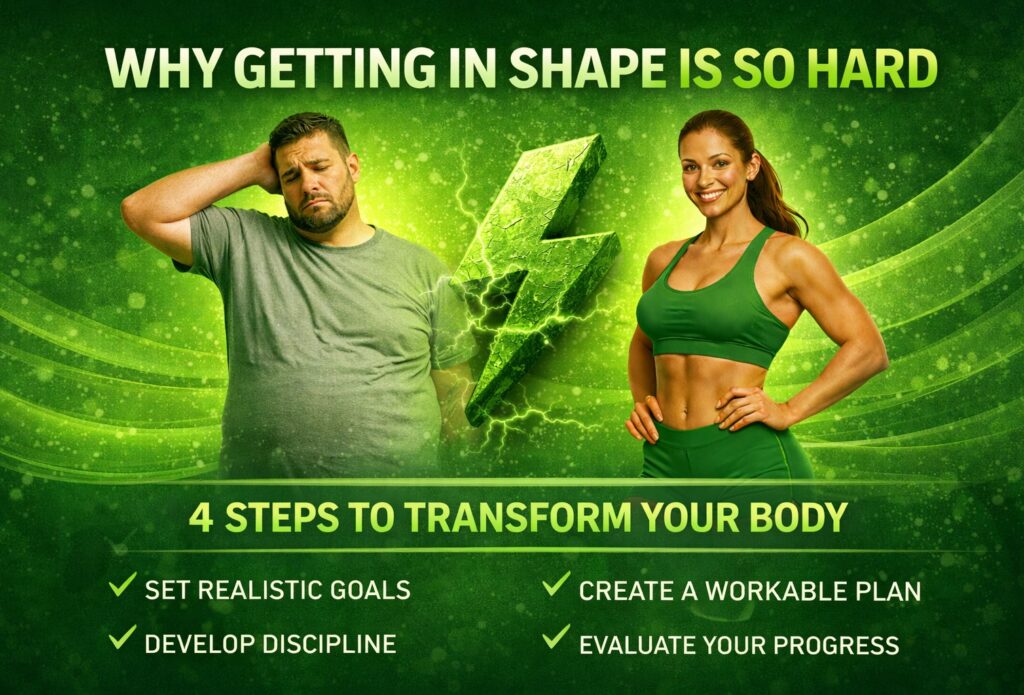
The fitness industry has an 80% dropout rate. That’s not because 80% of people lack willpower. It’s because the industry sells programs designed for Instagram, not real life. Six-day splits built for professional athletes. Elimination diets that ignore how humans actually eat. “Transformation challenges” that produce dramatic short-term results and predictable long-term failure.
I’ve trained hundreds of clients in New York City—executives working 70-hour weeks, parents juggling impossible schedules, people who’d “tried everything” and were convinced their bodies just wouldn’t respond. They weren’t broken. They were following shitty systems.
The truth is simpler than the industry wants you to believe. Getting in shape comes down to four things: consistent resistance training, adequate protein and reasonable nutrition, quality sleep, and accountability that survives when motivation disappears.
That’s it. No secrets. No revolutionary methods. No suffering required. Boring, I know.
What follows is the exact framework that actually works—not in theory, but in practice, for people with jobs and families and stress and imperfect schedules. The same principles I’ve used to help clients who’d failed repeatedly finally succeed.
Ready for a system designed around your actual life? Connect with coaches who understand real-world constraints.
What Are the Most Common Reasons People Fail to Get in Shape and How Can I Avoid Them?
Here’s the uncomfortable truth nobody wants to hear: the fitness industry profits when you fail. Gym memberships spike every January. Supplement companies sell magic pills. Instagram influencers push “21-day transformations” that work for approximately nobody in the real world.
The Centers for Disease Control and Prevention reports that only 28% of Americans meet both aerobic and muscle-strengthening guidelines. That means roughly 7 out of 10 adults aren’t getting adequate exercise despite widespread gym access and endless fitness content online.
So why the disconnect?
After working with hundreds of clients in New York City—from Wall Street executives to Broadway performers—I’ve identified four consistent failure patterns. These aren’t character flaws. They’re strategic errors that compound over time until someone gives up entirely.
Failure Pattern #1: The All-or-Nothing Approach
People start with unsustainable intensity. Six days a week. Two-hour sessions. Elimination diets. Within three weeks, life intervenes—a work deadline, a family obligation, a minor injury—and the whole system collapses. Instead of scaling back to something manageable, they quit entirely.
Failure Pattern #2: Program Hopping Without Consistency
Social media creates the illusion that variety equals progress. One week it’s CrossFit. The next, it’s a Pilates challenge. Then someone mentions kettlebells, and everything changes again. Muscles adapt to progressive overload, not novelty. Switching programs every few weeks guarantees you’ll never progress meaningfully in any direction.
Failure Pattern #3: Ignoring Recovery as Training
The “no days off” mentality sounds motivational on a poster. In practice, it leads to overtraining, hormonal dysfunction, and injury. Your body doesn’t build muscle during the workout—it builds muscle during sleep and rest days when tissue repair actually occurs.
Failure Pattern #4: Treating Nutrition as an Afterthought
You cannot out-train a bad diet. This phrase has become cliché because it remains stubbornly true. A single restaurant meal can exceed your daily caloric needs. Three protein shakes don’t compensate for skipping real food. Without addressing what goes into your body, what happens in the gym becomes almost irrelevant.
What Simple Step-by-Step System Can I Follow to Finally Get Lean and Stay Consistent?
Lasting body transformation requires what I call the Four Pillar Framework. Each pillar supports the others; remove one, and the structure becomes unstable.
The Four Pillars of Successful Transformation
- Strategic Resistance Training – Build lean tissue that elevates metabolism
- Targeted Nutrition – Fuel performance and recovery without restriction
- Optimized Sleep – Allow hormonal processes that drive physical change
- Structured Accountability – Create systems that survive motivation fluctuations
Let me break down each pillar with specific, actionable protocols.
Pillar One: Strategic Resistance Training
How Should Beginners Structure Weight Training for Visible Results?
The U.S. Department of Health and Human Services recommends muscle-strengthening activities targeting all major muscle groups at least twice weekly. For body composition goals, three to four sessions typically produces better outcomes.
Here’s what a realistic weekly structure looks like:
| Day | Focus | Duration | Key Movements |
| Monday | Upper Body Push | 45-55 min | Bench press, overhead press, tricep work |
| Tuesday | Lower Body | 45-55 min | Squats, Romanian deadlifts, lunges |
| Wednesday | Active Recovery | 20-30 min | Walking, light stretching, mobility |
| Thursday | Upper Body Pull | 45-55 min | Rows, pull-ups/lat pulldowns, bicep work |
| Friday | Full Body/Conditioning | 40-50 min | Compound movements, moderate cardio |
| Weekend | Rest or Light Activity | Variable | Recreation, not structured training |
Notice what’s missing: daily two-hour marathon sessions. High-intensity cardio every morning. The grueling six-day splits that professional bodybuilders use. Those protocols exist for people whose literal job is training. For working professionals with commutes, families, and stress loads, three to four focused sessions beat six mediocre ones.
Progressive Overload: The Principle Most People Ignore
Your body adapts to challenges. If you lift the same weight for the same reps indefinitely, your muscles have no reason to grow stronger. Progressive overload means systematically increasing demands over time.
This doesn’t require adding weight every session. Overload happens through:
- Adding 2.5-5 lbs when all sets hit target reps
- Increasing reps within the same weight
- Adding a set while maintaining form
- Improving movement quality and range of motion
Track your workouts. Write down weights, reps, and sets. If last week you squatted 135 lbs for 3 sets of 8, this week aim for 3 sets of 9 or 10. Small, consistent progress compounds into dramatic transformation over months.
→ Need a structured program designed for your specific goals? Explore coaching options that eliminate the guesswork.
Pillar Two: Targeted Nutrition for Body Transformation
How Can I Design a Realistic Nutrition Routine I Will Actually Stick to Long Term?
Nutrition doesn’t need to be complicated. It needs to be consistent. The fitness industry overcomplicates eating to sell meal plans, supplements, and “proprietary systems” that obscure basic principles.
Here’s what actually matters:
Protein intake determines muscle retention and growth. Research consistently shows 0.7-1 gram per pound of bodyweight supports training goals. For a 180-lb person, that’s 126-180 grams daily—distributed across meals rather than crammed into one or two sittings.
Total calories determine whether you gain, lose, or maintain weight. There’s no escaping thermodynamics. However, the source of those calories affects satiety, energy levels, and body composition. 2,000 calories from whole foods behaves differently in your body than 2,000 calories from processed snacks, even if the scale shows identical results initially.
Meal timing affects energy and recovery. Eating adequate carbohydrates before training improves performance. Consuming protein within a few hours post-workout supports muscle protein synthesis. Going to bed stuffed or hungry both disrupt sleep quality.
Daily Nutrition Framework for Transformation
- Meal 1 (Morning): Protein + complex carbs + fat → Example: eggs, oatmeal, avocado
- Meal 2 (Mid-day): Protein + vegetables + moderate carbs → Example: chicken breast, rice, roasted vegetables
- Meal 3 (Pre-training): Protein + easily digestible carbs → Example: Greek yogurt with fruit, or turkey sandwich
- Meal 4 (Post-training): Protein + carbs for recovery → Example: protein shake with banana, or lean meat with potatoes
- Meal 5 (Evening): Protein + vegetables + healthy fats → Example: salmon, leafy greens, olive oil
This framework isn’t a rigid prescription. It’s a template you adjust based on your schedule, preferences, and how your body responds. The goal is adequate protein, sufficient vegetables, appropriate calories, and timing that supports your training.
What About Supplements?
Supplements are exactly what the name implies: supplemental. They fill gaps in an already-solid nutritional foundation. They don’t replace real food.
Worth considering:
- Protein powder: Convenience when whole food isn’t practical
- Creatine monohydrate: Well-researched for strength and muscle gains
- Vitamin D: Most Americans are deficient, especially in northern climates
- Omega-3s: If you don’t eat fatty fish regularly
Not worth the marketing hype:
- Fat burners and “metabolism boosters”
- Most pre-workouts beyond basic caffeine
- BCAAs (if you’re eating adequate protein already)
- Anything promising dramatic results without effort
→ Looking for evidence-based supplementation guidance? Check available resources designed to support—not replace—proper nutrition.
Pillar Three: Sleep as a Training Variable
How Does Sleep Deprivation Sabotage Fitness Goals?
The National Institutes of Health documents that chronic sleep deprivation affects hormone regulation, metabolism, appetite, and cognitive function. For fitness goals specifically, the consequences are severe.
Poor sleep increases ghrelin (hunger hormone) and decreases leptin (satiety hormone). You wake up hungrier and feel less satisfied after eating. Lack of sleep does not make you fat by itself but you will crave more junk.
Insufficient sleep elevates cortisol, the stress hormone that promotes fat storage—particularly around the midsection. It also reduces testosterone and growth hormone, both critical for muscle development and fat metabolism.
One (small ) study from the University of Chicago found that dieters who slept 5.5 hours lost 55% less fat and 60% more muscle compared to those sleeping 8.5 hours—on identical calorie-restricted diets.
Translation: you can do everything else perfectly, but inadequate sleep will undermine your results.
How to Optimize Sleep for Body Transformation
| Strategy | Implementation | Why It Works |
| Consistent schedule | Same bed/wake times ±30 minutes, including weekends | Regulates circadian rhythm |
| Temperature control | Bedroom at 65-68°F (18-20°C) | Core temperature drop signals sleep onset |
| Light management | Dim lights 1-2 hours before bed; blackout curtains | Reduces melatonin suppression |
| Caffeine cutoff | None after 2 PM (or noon for slow metabolizers) | Half-life affects sleep quality hours later |
| Alcohol awareness | Minimize; none within 3 hours of bed | Disrupts REM cycles despite sedative effect |
| Screen boundaries | Blue light glasses or no screens 1 hour before bed | Preserves natural melatonin production |
Seven to nine hours isn’t optional. It’s when your body repairs tissue, consolidates motor learning from training sessions, and regulates the hormones that determine whether you build muscle or store fat.
Pillar Four: Accountability and Structure
How Can a Coach or Structured Program Help Someone Who Has Never Managed to Get in Shape Before?
Motivation fluctuates. Discipline fades. Life gets complicated.
The fitness industry sells motivation—inspirational quotes, high-energy classes, transformation photos. But motivation is a finite resource. When stress peaks or schedules collapse, motivation evaporates first.
Systems survive motivation failures. A structured program doesn’t require you to feel like training; it requires you to follow the plan. A coach provides external accountability that doesn’t depend on your internal state.
Data from the American Council on Exercise shows that individuals working with personal trainers demonstrate significantly higher adherence rates, better technique, and faster progress toward goals compared to self-directed exercisers.
This isn’t about lacking capability. It’s about environmental design. When you’ve paid for coaching, when someone expects you to show up, when your program has specific requirements—you perform differently than when everything depends on how you feel that morning.
Which Beginner-Friendly Program Should I Start If I Have Failed Multiple Times?
Previous failure usually indicates a mismatch between program demands and lifestyle capacity. The best program for you is one you’ll actually complete.
Ask these questions before starting anything:
- How many days per week can I realistically train for the next 12 weeks? Not when you are off but during a typical work week.
- What equipment do I have reliable access to? Home setup, commercial gym, hotel gyms while traveling?
- When during my day can I train consistently? Morning before work? Lunch hour? Evening?
- Do I need external accountability, or can I self-direct? Be honest about your track record.
- What’s my injury history? Certain movements may need modification.
A three-day full-body program done consistently beats a six-day advanced split done sporadically. Start conservative. Build the habit. Add complexity only after basic consistency is established.
→ Ready to work with professionals who design programs around your actual life? Schedule a consultation to discuss your specific situation.
What Mindset and Habit Changes Do I Need to Finally Transform My Body?
Technical knowledge matters less than behavioral change. You probably already know you should eat vegetables, lift weights, and sleep adequately. Knowing isn’t the obstacle.
Identity-Based Habit Formation
James Clear’s work on habit formation (detailed in Atomic Habits) distinguishes between outcome-based and identity-based habits. Outcome-based: “I want to lose 20 pounds.” Identity-based: “I am someone who prioritizes physical health.”
The first creates a finish line that, once crossed, removes motivation. The second creates ongoing alignment between your actions and self-concept.
When you identify as “someone who trains,” skipping workouts creates cognitive dissonance. Healthy eating becomes self-expression rather than deprivation. You’re not fighting against yourself—you’re acting consistently with who you believe yourself to be.
Process Goals Over Outcome Goals
Outcomes aren’t fully within your control. You can’t force your body to lose exactly two pounds per week or add exactly ten pounds to your bench press every month. Genetics, stress, sleep quality, and countless variables affect outcomes.
Process goals are controllable:
- Complete three training sessions this week
- Eat protein at every meal
- Be in bed by 10:30 PM on weeknights
- Track food intake for 6 out of 7 days
Hit your process targets consistently, and outcomes follow. Miss them, and no amount of outcome-wishing changes reality.
Mindset Shifts That Enable Transformation
- From “I’ll start Monday” → To “I’ll do something today, even if imperfect”
- From “I need motivation” → To “I need systems that don’t require motivation”
- From “All or nothing” → To “Something always beats nothing”
- From “I failed again” → To “I learned what doesn’t work for my life”
- From “It’s too hard” → To “It’s hard, and I’m doing it anyway”
What Practical Actions Can I Take This Week to Overcome Procrastination and Start Getting Fit?
Stop planning and start executing. Here’s your seven-day protocol:
Day 1: Audit Your Current Reality
Write down:
- What you actually ate yesterday (not what you think you should have eaten)
- How many hours you actually slept
- What physical activity you actually did
No judgment. Just data. You need an accurate baseline, not a flattering one.
Day 2: Design Your Training Schedule
Choose three specific days and times for training this week. Put them in your calendar as non-negotiable appointments. Decide now what you’ll do—even if it’s just 30 minutes of bodyweight movements at home.
Day 3: Execute Your First Training Session
Done beats perfect. Complete whatever you planned. If you don’t know what to do, try one of these. Then add one more next week.:
- 3 sets of 10 goblet squats (or bodyweight squats)
- 3 sets of 8 push-ups (modified from knees if needed)
- 3 sets of 10 dumbbell rows per arm (or inverted rows)
- 3 sets of 12 Romanian deadlifts (dumbbells or bodyweight good mornings)
- 2 sets of 30-second planks
Day 4: Protein Focus Day
At every meal today, ask: “Where’s the protein?” Aim for 25-40 grams per sitting. Track what you eat using an app like MyFitnessPal or Cronometer. See how close you get to your target.
Day 5: Execute Your Second Training Session
Follow through on your scheduled workout. Consistency matters more than intensity at this stage.
Day 6: Sleep Protocol Implementation
Tonight, commit to:
- Setting a firm bedtime
- Stopping screens 30 minutes before
- Keeping your bedroom cool and dark
Track how many hours you actually sleep.
Day 7: Review and Plan the Next Week
What worked? What didn’t? Adjust accordingly. Schedule next week’s training sessions. Identify one nutrition habit to improve.
→ Want a complete done-for-you system? Access structured programs designed for real-world implementation.
How Should I Track Progress to Stay Motivated and Actually Reach My Fitness Goals?
The scale lies—or at least tells an incomplete truth. Body weight fluctuates 2-5 pounds daily based on hydration, sodium intake, digestive contents, and hormonal cycles. Obsessing over daily weigh-ins leads to frustration and irrational decision-making.
A Multi-Metric Approach to Progress Tracking
| Metric | Frequency | What It Tells You |
| Scale weight | Weekly (same conditions) | General trend, not daily reality |
| Progress photos | Every 2-4 weeks | Visual changes the mirror misses |
| Body measurements | Monthly | Composition changes independent of weight |
| Strength tracking | Every workout | Performance improvement over time |
| Energy and mood | Daily awareness | Recovery status and sustainability |
| Sleep quality | Nightly | Recovery optimization |
| Clothing fit | Ongoing | Practical body composition indicator |
The Two-Week Minimum
Avoid making changes based on one bad week. Bodies don’t respond linearly. You might retain water, experience stress, or simply have natural fluctuation. Give any protocol at least two weeks before evaluating whether it’s working.
If you’re hitting process targets (training sessions completed, nutrition roughly on point, sleep adequate) but seeing no progress after 4-6 weeks, something needs adjustment. Either calories are too high, training isn’t challenging enough, or a medical factor warrants investigation.
What Are the Four Key Pillars of a Successful Body Transformation Plan I Can Follow from Home or Gym?
Let me synthesize everything into the complete framework:
Pillar Summary: The Complete System
PILLAR 1: RESISTANCE TRAINING
- 3-4 sessions per week
- Focus on compound movements (squats, deadlifts, presses, rows, pull-ups)
- Progressive overload: systematically increase demands
- Track every workout
- 45-60 minutes per session is sufficient
PILLAR 2: TARGETED NUTRITION
- 0.7-1g protein per pound of bodyweight
- Calories appropriate for your goal (slight deficit for fat loss, slight surplus for muscle gain, maintenance for recomposition)
- Protein distributed across 4-5 meals
- Vegetables at most meals
- Hydration: minimum half your bodyweight in ounces
PILLAR 3: OPTIMIZED SLEEP
- 7-9 hours per night
- Consistent schedule
- Cool, dark environment
- Limited alcohol and late caffeine
PILLAR 4: STRUCTURED ACCOUNTABILITY
- Clear program with specific requirements
- External accountability (coach, training partner, or community)
- Regular check-ins and adjustments
- Systems that survive motivation fluctuations
→ Discover how professional guidance accelerates these results. Learn about our approach to transformation that lasts.
How Can I Set Up Simple Daily Routines for Training, Eating, and Sleep That Lead to Visible Results?
Structure reduces decisions. Decision fatigue depletes willpower. The goal is automating as much as possible so healthy choices become default rather than requiring constant effort.
Sample Daily Framework
Morning (first 2 hours after waking):
- Hydrate immediately: 16-20 oz water
- Protein-focused breakfast within 1-2 hours of waking
- If morning training: eat 60-90 minutes before session or train fasted with post-workout meal planned
Midday:
- Substantial lunch with protein, complex carbs, vegetables
- Brief walk if sedentary work (even 10 minutes helps)
- Prepare or plan dinner to avoid evening decision fatigue
Pre-training (if afternoon/evening session):
- Light protein + carb snack 1-2 hours before
- Adequate hydration
Post-training:
- Protein + carbs within 2 hours
- Continue hydrating
Evening:
- Dinner with protein and vegetables
- Begin winding down 1-2 hours before target bedtime
- Reduce screen brightness or use blue light blocking
- Keep final meal 2-3 hours before sleep when possible
Before bed:
- Review tomorrow’s training plan
- Prep anything that reduces morning friction
- Cool room, dark environment, consistent bedtime
This isn’t a rigid schedule requiring monastic discipline. It’s a template you adapt. Maybe you train at 6 AM before work. Maybe you prefer evening sessions. The specific times matter less than the consistent structure.
The Real Reason Most Transformations Fail
The fitness industry wants you dependent on the next program, supplement, or trending approach. Permanent change requires something different: understanding principles deeply enough to apply them across changing circumstances.
Job changes. Injuries happen. Gyms close. Travel disrupts routines. The question isn’t whether disruption will occur—it will—but whether your foundation is solid enough to adapt without collapsing.
That’s why working with experienced coaches provides lasting value beyond any single program. You don’t just learn what to do; you learn why it works and how to adjust when conditions change.
→ Ready to build that foundation? Start with a consultation to discuss your specific goals, constraints, and history.
It’s not genetics. It’s not willpower. It’s not that they didn’t want it badly enough or didn’t try hard enough. It’s that they followed programs that were never designed for their actual lives—and then blamed themselves when those programs failed.
The fitness industry profits from your confusion. From your repeated attempts. From selling you the next thing after the last thing didn’t work. They don’t want you to understand that transformation comes from executing fundamentals consistently, because fundamentals don’t sell supplements or require expensive memberships.
Resistance training three to four times per week. Enough protein distributed across your meals. Seven to nine hours of sleep. Accountability structures that don’t depend on how motivated you feel on any given morning.
That’s the system. It’s not complicated. It’s not sexy. It doesn’t make for dramatic before-and-after content. But it works—reliably, predictably, for anyone willing to execute it consistently over months rather than frantically for weeks.
Your body wants to adapt. It’s literally designed to respond to the signals you give it. Lift weights progressively, and you’ll get stronger. Eat adequate protein in a reasonable caloric range, and your composition will change. Sleep enough, and your hormones will support the process instead of sabotaging it.
The compound effect of ordinary actions, done consistently, produces extraordinary results. That’s not motivation-speak. That’s physiology.
Start today. Follow the framework. Trust the process.
Your transformation isn’t a question of if. It’s a question of when you commit to doing it right.
Frequently Asked Questions
Why do most people fail to get in shape? Most people fail because they follow unsustainable programs, neglect recovery and sleep, ignore nutrition fundamentals, and lack accountability systems that survive when motivation drops.
How long does it take to see visible fitness results? Noticeable changes typically appear within 4-8 weeks of consistent training and nutrition, though significant transformation requires 3-6 months of adherence.
Can I get in shape working out only 3 days per week? Yes—three well-designed resistance training sessions produce excellent results for most people, especially when combined with proper nutrition and sleep.
Do I need a gym membership to transform my body? No—effective training can happen at home with minimal equipment; resistance bands, dumbbells, and bodyweight exercises provide sufficient stimulus for transformation.
What should I eat to lose fat and build muscle? Prioritize protein (0.7-1g per pound bodyweight), eat vegetables at most meals, maintain a slight caloric deficit for fat loss, and distribute protein across 4-5 daily meals.
How important is sleep for fitness goals? Critical—inadequate sleep disrupts hunger hormones, elevates cortisol, reduces anabolic hormones, and can cause dieters to lose 55% less fat even with identical calorie intake.
Should I do cardio or weights for fat loss? Resistance training should be primary; it preserves muscle mass during fat loss and elevates metabolism—cardio is supplemental, not foundational.
How do I stay consistent when motivation fades? Build systems that don’t require motivation: scheduled training sessions, prepared meals, external accountability through coaches or training partners, and process-focused goals.
Is hiring a personal trainer worth it? For most people, yes—trainer clients show significantly higher adherence rates, better technique, and faster progress compared to self-directed approaches.
What’s the best beginner workout program? The best program is one you’ll actually follow consistently; a simple three-day full-body routine with compound movements outperforms any complex plan done sporadically.

Maik Wiedenbach is a Hall of Fame swimmer turned bodybuilding champion and fitness model featured in Muscle & Fitness and Men’s Journal. An NYU adjunct professor and award-winning coach, he founded New York’s most sought-after personal training gym.