
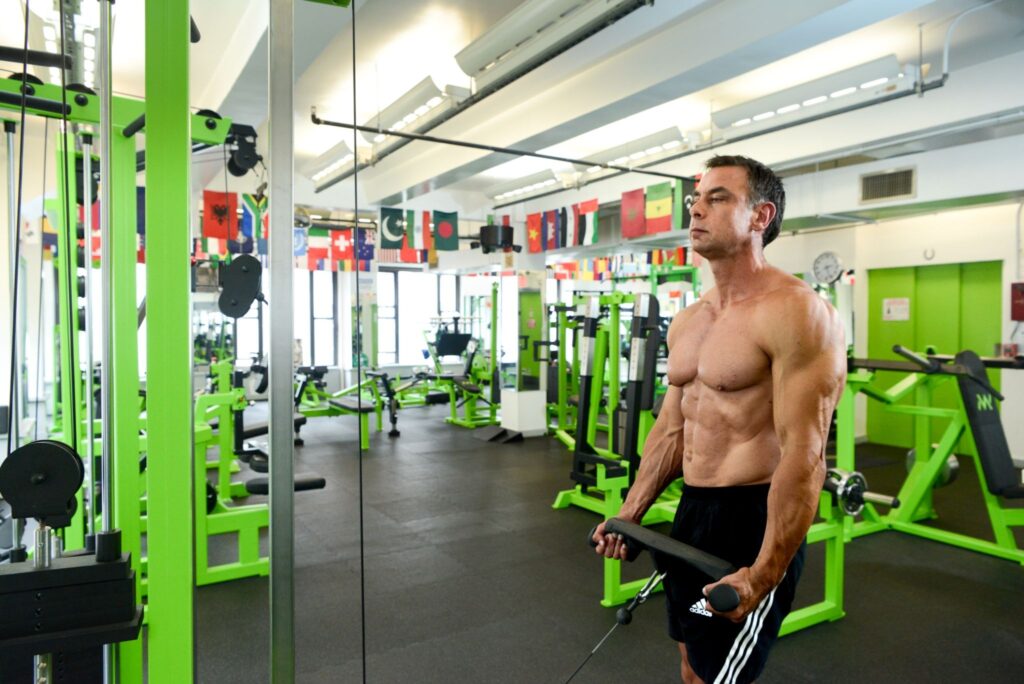
I watched a guy last week take four full seconds to lower a bicep curl, pause at the bottom, and crawl it back up, rep after rep, with a weight he could clearly handle for twice the load. He was sure the extra seconds were the secret. More time under tension, more muscle.
I understand why it feels true. The set burns, the muscle shakes, and slow feels serious in a way that clean, controlled repetitions somehow don’t. But the stopwatch isn’t the stimulus; those extra seconds only help when the target muscle is still doing the work.
I often use about thirty seconds of continuous tension as a practical coaching benchmark, although it isn’t a magical hypertrophy cutoff. Control the eccentric phase, eliminate unnecessary rest points, and progress the exercise without letting momentum or another muscle take over.
If you want a program built on what actually works, our team can set you up with one.
What Time Under Tension Actually Means (And How to Measure It)
Time under tension is the amount of time the target muscle remains loaded during a set. If you perform eight repetitions that each take roughly four seconds, the set lasts about thirty-two seconds; however, that doesn’t automatically mean the muscle received thirty-two seconds of useful tension.
You can lose tension by resting at lockout, bouncing through the bottom, shifting the load into another muscle, or letting gravity control the eccentric phase. So set duration and target-muscle tension are related, but they aren’t identical.
I track time under tension alongside load, repetitions, volume, and training frequency because one number rarely tells the full story. However, the external data still has to match the internal result: proper activation, stable positioning, and clean execution. That’s the basis of my data-driven approach to bodybuilding.
How to Read Tempo Notation Like 3-1-1-0
Tempo is written as four digits, one for each phase of a rep. A 3-1-1-0 means three seconds lowering the weight, a one-second pause at the bottom, one second lifting it, and no pause at the top.
The order always follows the same path: eccentric first, then the bottom position, then the concentric, then the top. So a 4-0-1-0 on a squat means a four-second descent, no pause at the bottom, a one-second drive up, and no pause at the top. Read it left to right and the prescription tells you exactly how to spend each rep.
| Tempo digit | Phase | What happens | Why it may be prescribed | Common mistake |
| First digit | Eccentric phase | The muscle lengthens while controlling the load | Maintains positioning and prevents the weight from dropping under gravity | Rushing the descent or losing tension |
| Second digit | Bottom transition or pause | The movement changes direction | Removes momentum when a pause is required | Bouncing out of the bottom |
| Third digit | Concentric phase | The muscle produces force to lift the load | Completes the repetition with intent | Deliberately crawling through the lift and unnecessarily reducing the load |
| Fourth digit | Top transition or pause | The movement resets or holds in the shortened position | Adds control when the exercise remains loaded there | Turning the top into a rest position |
Tempo notation tells you how to perform the repetition; it doesn’t prove that the target muscle remained under useful tension for every second.
How to Measure Time Under Tension per Set
Multiply the number of repetitions by the approximate duration of each repetition. Eight reps performed at roughly four seconds each create a set lasting about thirty-two seconds.
That calculation measures set duration, though, not perfect target-muscle tension. The clock keeps running if you rest at lockout, bounce through the transition, or shift the load into another muscle.
You don’t need a stopwatch for every working set. Use the number when it helps you standardize execution, but watch the movement first; thirty controlled seconds and thirty seconds of swinging, resting, and surviving aren’t the same set.
Does Time Under Tension Actually Matter for Muscle Growth?
It matters, but only as a proxy for something else, not as a driver in its own right. Time under tension roughly tracks with how much quality work a muscle did, so a decent amount of it usually means you trained well. Piling on more seconds by slowing down, however, doesn’t add growth if it forces you to strip the weight.
That distinction is the whole thesis of this article. Tension over time matters because tension matters, but the clock itself isn’t doing anything. What builds the muscle is what’s happening during those seconds, not the count on the timer.
The Real Driver: Mechanical Tension and Effective Reps
Yes, because a muscle needs to produce force over time for the set to become challenging. However, extending the set doesn’t automatically improve it; the target muscle still has to control the load, and the effort still has to be high enough to create a meaningful stimulus.
Mechanical Tension Over Time
Mechanical tension and time under tension aren’t competing ideas. The load creates resistance, while your execution determines which muscle handles it and how long that muscle remains involved.
If you rush the eccentric phase, bounce through the transition, or rest at a lockout that unloads the muscle, the set may last thirty seconds without delivering thirty productive seconds to the area you meant to train. That’s why I care more about continuous target-muscle tension than a stopwatch reading.
Sets performed closer to failure generally produce more hypertrophy, but there isn’t one exact repetition where the useful work suddenly begins. A 2024 meta-regression found that hypertrophy improved as sets ended closer to failure, which supports a gradual relationship rather than a fixed number of “effective reps.”
Where Tempo Fits
Tempo helps you keep the exercise honest. A controlled eccentric removes momentum, preserves your position, and makes it harder for another muscle to take over; the concentric phase should then be performed with intent rather than deliberately dragged out.
A 2025 Journal of Strength and Conditioning Research paper found minimal overall differences in hypertrophy between faster and slower repetition tempos. So tempo matters most as a way to maintain repeatable execution and tension, not as a contest to make every rep last longer.
The coaching philosophy behind this, and the credentials behind it, are worth a look.
Should I Do Slow Reps for More Time Under Tension?
Control the repetition, but don’t assume slower is always better.
I want the eccentric phase slow enough that you control the load instead of letting gravity take it. The concentric phase should be intentional, while the target muscle remains involved from the beginning of the rep to the end.
A 2025 meta-analysis found similar hypertrophy overall between faster and slower repetition tempos. The evidence doesn’t support one universal tempo or the claim that deliberately slow reps automatically produce more growth.
Controlled Reps vs Clock-Driven Reps
| Controlled repetition | Clock-driven repetition |
| The target muscle controls the range | The prescribed number of seconds controls the set |
| The eccentric phase remains deliberate | Every phase is extended whether it helps or not |
| The concentric phase is performed with intent | The lifting phase is deliberately slowed |
| Load, reps, and range can still progress | Tempo may become the only variable that progresses |
| The rhythm suits the exercise | Every exercise is forced into the same cadence |
| Tempo supports the training goal | Tempo becomes the training goal |
Slow repetitions can help you learn control or keep tension on a muscle you keep losing. They aren’t a superior hypertrophy method by default.
When Slow Reps for Muscle Growth Actually Help
Deliberately slower repetitions can help when they solve a specific execution problem.
I’ll slow the movement when a client:
- Rushes the eccentric phase
- Uses momentum to start the repetition
- Loses the target muscle through part of the range
- Needs to learn a new exercise
- Can’t maintain a stable position
- Is returning to an exercise with a lighter load
If someone can’t keep the lats involved during a pulldown, for example, slowing the eccentric phase and controlling the stretch can show him where the tension should remain. Once the movement is stable, we progress the load or repetitions without giving up that control.
The goal isn’t to graduate from slow reps to careless reps; it’s to use tempo until good execution becomes repeatable. Research has found that a broad range of repetition speeds can build muscle, while extremely slow training hasn’t shown a reliable advantage.
Is Time Under Tension Better Than Lifting Heavy?
You don’t need to choose between load and time under tension. The weight provides resistance; your execution determines which muscle handles it and how long that tension stays where you intended.
Getting stronger matters, but I define it as getting stronger in good form. If you add weight by shortening the range, bouncing through the eccentric phase, or letting another muscle initiate the movement, the number went up while the intended stimulus may have gone down. That’s why I treat the weight as a tool rather than the goal.
Lighter and heavier loads can both build muscle when the sets are sufficiently challenging. A systematic review and meta-analysis found broadly similar hypertrophy across low, moderate, and high loads, although heavier training produced greater gains in maximal strength.
So I want both: enough resistance to challenge the muscle and enough control to keep that resistance where it belongs. Progress the weight or repetitions, but only while the target muscle continues initiating and controlling the exercise.
What Load Does That Tempo Cannot
Load recruits high-threshold motor units and produces the mechanical tension that signals growth, and, on top of that, it gives you something concrete to progress over time. When you add weight to the bar month after month, you have proof the muscle is adapting.
Think of it in plain numbers. A lifter who takes his curl from 30 to 40 pounds over a few months with clean form has undeniably grown. A lifter who kept the same light dumbbell and just slowed it down has no such proof, and usually no such growth, because he never gave the biceps a reason to get bigger.
Tempo can’t do any of that on its own. You can slow a light weight down forever and never create the tension a heavier load produces, and you can’t really progress “seconds” the way you progress weight and reps. That’s why a program built around the clock tends to stall, while a program built around progressive overload keeps moving.
How to Combine Tempo Training and Heavy Work
The smart move is to let each do its job. Use heavier loads with a controlled tempo on your main lifts, so you get high tension and clean execution at the same time. Then, if you want to use slower tempos, save them for lighter isolation work where dropping the load costs you nothing.
That way, tempo sharpens your technique without ever capping your load. You keep chasing weight on the bar where it matters, and you use tempo as a quality cue rather than a replacement for intensity. A good session might pair a controlled, heavy press for your main work with a slower, lighter cable movement to finish, so you get heavy tension where it counts and slow control where dropping the load costs you nothing.
If you want tempo and load programmed together properly, our coaches can build that for you.
What’s the Ideal Tempo for Building Muscle?
There isn’t one ideal tempo for every lift. The useful tempo is the one that lets you control the eccentric phase, maintain target-muscle tension, and perform the concentric with intent without changing the movement merely to satisfy a stopwatch.
I normally coach a controlled negative rather than assigning every exercise the same duration. Two or three seconds may feel natural on a curl, while a squat, row, or press may use a different rhythm because the range and stability demands aren’t the same.
The latest meta-analysis found minimal overall hypertrophy differences between faster and slower repetition tempos. A broader review also found that several tempos can support muscle growth, with complete repetitions generally lasting between two and eight seconds.
Choose a tempo that fits the exercise, keeps the intended muscle working, and gives you room to progress.
Tempo Ranges That Keep Tension High Without Killing Load
A two-to-four-second lowering phase gives you the benefits people credit to tempo, better control, more tension through the range, no bouncing, while still letting you handle a real weight. The lifting phase should be intentional but not artificially dragged out, since grinding the concentric to a crawl only forces the load down.
Push the eccentric much past four seconds and you enter the zone where the tempo, not the muscle, becomes the limiting factor. At that point you’re training your patience more than your tissue, and you’ve quietly cut the load that was doing the work.
Eccentric Control and the Lengthened Position
Replacement
Eccentric Control and the Lengthened Position
The eccentric phase deserves attention because losing control there often removes tension from the target muscle. Lower the load deliberately, maintain your position, and let the muscle lengthen without bouncing into the next repetition.
However, eccentric tempo and long-muscle-length training are different variables. A slower negative doesn’t automatically make an exercise better at loading the stretched position, and an exercise can challenge a muscle at a long length without requiring an exaggerated eccentric duration.
On a Romanian deadlift, control the descent while the hips move back and the hamstrings remain loaded. On an incline curl, keep the shoulder stable as the elbow moves toward extension. The aim is to own the range, not to add arbitrary seconds after control is already established.
Current hypertrophy-technique recommendations favor controlled repetitions and ranges that emphasize longer muscle lengths, although the evidence doesn’t identify one eccentric duration as universally superior.
| Training variable | Role in hypertrophy | How time under tension relates | Practical priority |
| Target-muscle tension | Central training stimulus | Tension needs to remain on the intended muscle through the useful range | Highest |
| Exercise execution | Determines where the load goes | Controlled tempo limits momentum, rest points, and compensation | Highest |
| Effort | Determines how challenging the set becomes | A longer set still needs sufficient effort | High |
| Weekly volume | Provides repeated growth stimulus | Longer repetitions may reduce how many quality sets you can recover from | High |
| Progressive overload | Keeps training demands advancing | Load, reps, range, and control can all improve over time | High |
| Repetition tempo | Organizes how the movement is performed | Useful for control, teaching, and consistency | Supporting |
Is Time Under Tension Overrated for Hypertrophy?
Time under tension is overrated when it’s reduced to seconds on a stopwatch. It isn’t overrated when it means keeping the target muscle loaded instead of resting, bouncing, or shifting the exercise somewhere else.
The Three Most Common Ways Lifters Misuse It
- They maximize duration instead of tension: A longer repetition isn’t better when most of the extra time comes from an unloaded position.
- They let tempo replace progression: Adding seconds indefinitely gives you no clear reason to improve the load, repetitions, range, or execution.
- They confuse difficulty with productivity: A deliberately slow set can feel brutal because the tempo creates fatigue, but the burning sensation doesn’t prove that the target muscle received a better stimulus.
I don’t want fast, careless repetitions, and I don’t want every exercise performed in slow motion. I want controlled tension on the intended muscle while the measurable training variables continue to improve.
The Three Most Common Ways Lifters Misuse Time Under Tension
The first misuse is slowing reps so much that the load collapses, trading real tension for the sensation of effort. The second is treating time under tension as a number to maximize, adding seconds while ignoring whether the load or reps are actually progressing.
The third is the quietest and most common: using slow tempo as a socially acceptable way to avoid heavy, uncomfortable work. Grinding out super-slow reps with a light weight feels productive and looks disciplined, but it’s often just an escape hatch from the hard sets near failure that build the most muscle. I see it most with strong lifters who suddenly discover tempo right when the weights get heavy and intimidating, because the slow reps hand them a respectable-looking reason to back off the load while their progress quietly flatlines.
A Simple Time Under Tension Workout Framework That Respects Volume
You don’t need a tempo-based program. Instead, you need a normal, progressive program with controlled reps, and the time under tension will land where it should on its own. Pick your lifts, use a two-to-four-second eccentric, drive the concentric with intent, and take your hard sets close to failure.
Here’s what that looks like on a chest day. Press for your hard sets with a controlled lower and a strong drive, add a little weight whenever you earn it, and finish with a couple of controlled fly sets. Nowhere did you count a second, and your chest still got a full dose of productive time under tension.
Then let the real levers run the show. Add weight or reps over time, keep your weekly hard sets in a sensible range, and train each set with genuine effort. Tempo rides along as a quality control check, keeping your reps honest, while progressive overload does the building.
Expert Viewpoint: How I Use Time Under Tension With Real Clients
When a client rushes the eccentric phase, bounces through the transition, or lets another muscle start the repetition, I slow the movement down. The goal isn’t to collect more seconds; it’s to put the tension back where the exercise was supposed to place it.
I often use about thirty seconds of continuous target-muscle tension as a practical benchmark because it gives us enough time to perform a challenging set without turning every repetition into slow motion. However, I don’t stop a productive set because a timer expired, and I don’t extend a poor set merely to reach the number.
The load still needs to progress, but only in good form. If adding weight shortens the range, removes control, or shifts the work into another muscle, you didn’t create better overload; you changed the exercise. I want the weight, repetitions, or range improving while the intended muscle continues doing the work.
So control the negative, eliminate unnecessary rest points, and lift with intent. Don’t chase the slowest possible repetition; chase continuous tension you can measure, recover from, and progress.
Simple. Not easy. Absolutely achievable.
If you’ve got questions about your training or want to start, reach out and our team will help.
Frequently Asked Questions
How Do You Measure Time Under Tension per Set?
Multiply your reps by the seconds each rep takes. Eight reps at roughly four seconds each is about thirty-two seconds under tension. There’s no scientifically established time-under-tension window that every productive hypertrophy set must reach. Controlled repetitions in a normal working range will usually create enough set duration naturally, so measure it when it helps your consistency rather than treating the result as a pass-or-fail number.
What Is a Good Time Under Tension for a Set?
There’s no universal duration that maximizes muscle growth for every exercise. I often use about thirty seconds of continuous target-muscle tension as a practical benchmark, but execution, effort, range, and progression matter more than reaching an exact number.
Does Slow Lifting Build More Muscle Than Fast Lifting?
Controlled lifting keeps the intended muscle involved, but research has found no meaningful hypertrophy advantage from deliberately slower repetitions over faster, controlled tempos. Keep the eccentric phase deliberate and perform the concentric with intent; slow the repetition further only when it improves execution or solves a specific training problem.
Is Time Under Tension a Myth?
It’s real physiology, but a misused shortcut. Tension over time genuinely matters, yet chasing seconds at the expense of load and volume does not. The honest way to see it is as a quality cue for your reps, not a growth target to maximize.
Does Tempo Matter More Than the Weight You Lift?
Neither works well without the other. Load gives the muscle resistance to overcome, while tempo and execution determine where that resistance goes. Use a challenging weight, keep the target muscle under control, and progress the exercise without sacrificing the range or tension that made the set productive.
Maik Wiedenbach is a New York City-based personal trainer, fitness author, and founder of Maik Wiedenbach Fitness. He has spent over 20 years teaching lifters to chase controlled reps and progressive overload rather than the stopwatch.

Maik Wiedenbach is a Hall of Fame swimmer turned bodybuilding champion and fitness model featured in Muscle & Fitness and Men’s Journal. An NYU adjunct professor and award-winning coach, he founded New York’s most sought-after personal training gym.