

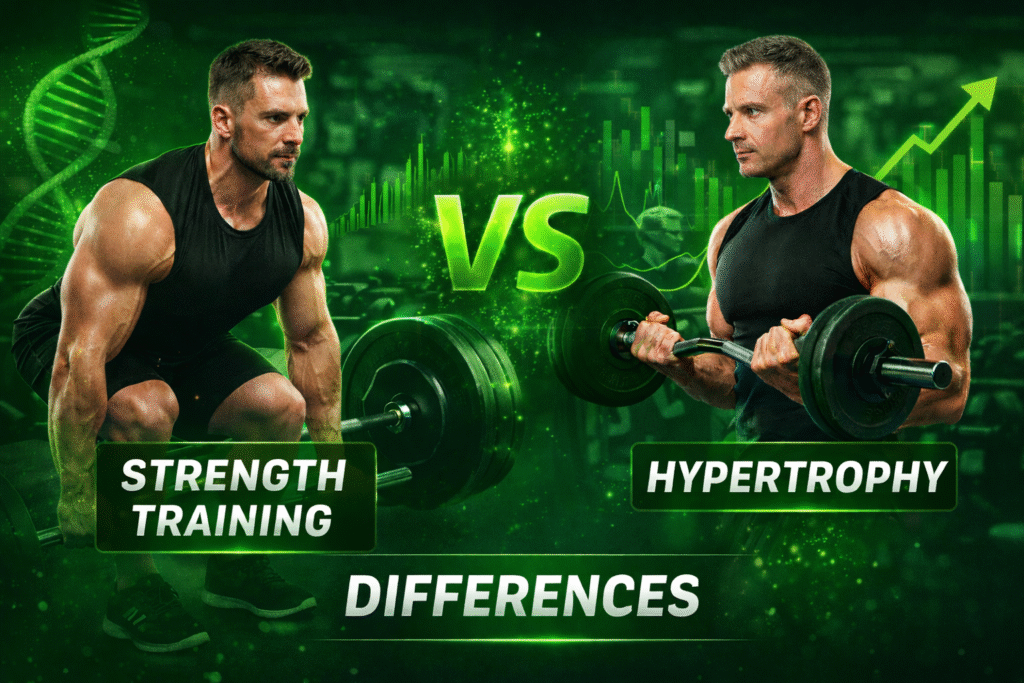
Walk into any gym, and you’ll hear people throwing around terms like “training for strength” or “hypertrophy work” like they’re mutually exclusive. The fitness industry loves to overcomplicate this with periodization schemes and conflicting rep range dogma. But here’s the truth: the difference is mostly about emphasis, not magical separation.
I’m cutting through the noise. No cherry-picked studies. No outdated bro-science. Just practical information about what changes between programs, who should focus on what, and how to combine both.
The reality? Most people don’t need to choose. You can pursue both with intelligent programming. But if you’re doing random workouts without a clear goal, you’re wasting time.
Ready to stop guessing and start making progress? Get a program designed for your goals.
Strength Training vs Hypertrophy: What’s Actually Different?
Strength Training (Power and Performance)
Strength training prioritizes one thing: increasing your maximum force output. The goal is lifting heavier weight, usually measured by your 1-rep max (1RM) on key lifts like squat, bench press, and deadlift.
The primary adaptations are neural. Your nervous system gets better at recruiting muscle fibers, improving coordination between muscles, and refining lifting technique. Yes, you build some muscle. But the focus is teaching your body to express the strength it already has more efficiently.
Typical strength training characteristics:
- Heavier loads (85-95%+ of 1RM)
- Lower reps (1-5, sometimes 3-6)
- Longer rest periods (3-5 minutes between sets)
- High specificity (practicing the exact lifts you want to improve)
- More frequent technique practice
Hypertrophy Training (Muscle Size and Growth)
Hypertrophy training prioritizes muscle growth. The goal is increasing cross-sectional area of muscle fibers, which makes you look bigger and more muscular.
The primary adaptations are structural. You’re creating mechanical tension, metabolic stress, and muscle damage that triggers growth. Your nervous system improves too, but that’s secondary to adding actual muscle tissue.
Typical hypertrophy training characteristics:
- Moderate loads (65-85% of 1RM)
- Higher reps (6-12, often extending to 15-20)
- Shorter rest periods (60-120 seconds, though longer is fine on compounds)
- More total volume (sets per muscle per week)
- Greater exercise variety to target muscles from different angles
- Training closer to muscular failure
The difference between strength training vs hypertrophy is mainly the goal and training emphasis. Strength training prioritizes heavier loads and skill practice to increase your 1-rep max, while hypertrophy training prioritizes enough weekly volume and proximity to failure to grow muscle size.
Which Is Better: Strength or Hypertrophy?
This is the wrong question. Better for what? Your goals determine the answer.
If Your Goal Is Muscle Size (Physique Focus)
Hypertrophy emphasis wins. You need sufficient weekly volume across different rep ranges, taken close enough to failure to stimulate growth. Chasing a bigger squat PR won’t directly give you bigger quads if you’re not accumulating enough volume.
Bodybuilders, physique competitors, and people training primarily for aesthetics should lean heavily toward hypertrophy programming. That doesn’t mean you ignore strength entirely. But size is the priority.
If Your Goal Is Performance (Lifting Heavy)
Strength emphasis wins. Powerlifters, Olympic weightlifters, and strength athletes need to practice their sport-specific movements with heavy loads. Specificity matters. You can’t get great at low-rep maximal lifts by only doing high-rep pump work.
The skill component is huge. A 500-pound deadlift requires technique practice at heavy loads, not just bigger muscles.
If You Want Both (Most People Should)
Hybrid programming is the answer for 90% of lifters. Often called “powerbuilding,” this approach combines heavy compound work for strength with higher-volume accessory work for size.
You get stronger on the movements that matter while building muscle across your entire physique. Unless you’re competing in a specific sport, this balanced approach delivers better overall results.
If you’re unsure which path to take, start with a hybrid approach for 8-12 weeks. You’ll build both strength and size while figuring out what you actually enjoy and respond to best.
Reps, Sets, and Intensity: What Actually Changes?
How Many Reps for Strength vs Hypertrophy?
Strength training: 1-5 reps (heavy enough that you can’t do more with good form). Personally, I would never drop below 3-4 reps as the injury risk is simply too high.
Hypertrophy training: 6-12 reps, though 12-20 also works. The moderate load lets you accumulate more volume before fatigue limits you.
Here’s the nuance: multiple rep ranges build muscle if taken close to failure. Sets of 5-8, 8-12, and 15-20 all stimulate similar hypertrophy when effort is matched. The difference is fatigue cost.
Heavy sets of 5 are systemically draining. Sets of 20+ become cardio before mechanical tension does its job. The 6-12 range works best for most people.
Training Intensity and Proximity to Failure
Strength: High percentages (85-95%+ of 1RM) but stays 1-3 reps from failure. Why? Grinding kills technique and increases injury risk.
Hypertrophy: Pushes closer to failure, especially on accessories. Taking sets within 0-2 reps of failure seems optimal, but you don’t need to fail every set.
Rest Times: Does It Matter?
Strength: 3-5 minutes between heavy sets for near-complete recovery.
Hypertrophy: 60-120 seconds traditionally, but resting longer on compounds is fine. If you’re doing heavy squats for 10 reps, taking 3 minutes lets you accumulate more volume than rushing with 60 seconds.
The strict 60-90 second rule is overblown. Rest as needed for quality. Just don’t turn workouts into social hour.
| Factor | Strength Focus | Hypertrophy Focus |
| Primary Goal | Increase 1RM / Max Force | Increase Muscle Size |
| Rep Range | 1-5 (sometimes 3-6) | 6-12 (also 12-20+) |
| Load (%1RM) | 85-95%+ | 65-85% |
| Sets per Exercise | 3-5 (fewer exercises) | 3-6 (more exercises) |
| Rest Time | 3-5 minutes | 60-120 seconds (longer on compounds is fine) |
| Proximity to Failure | 1-3 RIR on main lifts | 0-2 RIR, closer on accessories |
| Weekly Volume | Lower total sets | Higher total sets per muscle |
| Exercise Selection | Barbell compounds, low variation | Compounds + machines/cables/isolation |
| Progression Focus | Adding weight to the bar | Adding sets, reps, or load over time |
Does Hypertrophy Also Build Strength? (And Vice Versa)
Why Hypertrophy Helps Strength
Bigger muscles have more potential to produce force. Cross-sectional area correlates with strength potential. A 200-pound lifter with more muscle mass will generally have a higher strength ceiling than a 150-pound lifter, assuming reasonable training.
But potential isn’t the same as expression. You still need to practice heavy lifting to develop the neural patterns and technique for maximal force production.
Can You Get Stronger Without Hypertrophy?
Yes, especially early in your training career. Beginners make rapid strength gains through neural adaptations and improved technique with minimal muscle growth.
But long-term? Size matters. The world’s strongest humans are also very muscular. You can optimize for strength with minimal size gains if you stay extremely lean and focus purely on neural efficiency. But most people hit a ceiling without adding muscle mass.
Why You Might Gain Strength But Not Size
This frustrates a lot of people. You’re adding weight to the bar, but the mirror looks the same. Common reasons:
Not enough total volume. Three sets of five twice per week might build strength on that lift through practice, but it’s insufficient stimulus for meaningful hypertrophy.
Not close enough to failure. If every set stops 4-5 reps short of failure, you’re not creating enough mechanical tension to trigger growth.
Not enough calories or protein. You need a caloric surplus (or at minimum, maintenance) plus adequate protein (0.7-1.0g per pound of body weight) to build significant muscle.
Body recomposition is slow. You might be gaining muscle while losing fat simultaneously, making scale weight and appearance change slowly despite strength increases.
Equipment and Exercise Selection
Strength-Focused Selection
Barbell compounds dominate. Squat, bench, deadlift, overhead press. Maybe weighted pull-ups. That’s it.
Why so specific? You get better at what you practice. Want a bigger squat? Squat heavy frequently. Leg press builds quads but doesn’t improve squat technique.
Variation is minimal. Same movements for months or years, just heavier.
Hypertrophy-Focused Selection
More variety. Barbells, dumbbells, machines, cables, bodyweight. The goal is volume across all muscles.
Machines and cables are underrated. They let you isolate muscles without stability demands, so you can push closer to failure safely and accumulate volume with less fatigue.
Want bigger arms? Barbell curls, cable curls, hammer curls, preacher curls, extensions all contribute.
The “Big 3” Aren’t Enough for Hypertrophy
Squat, bench, deadlift are excellent. They should be in most programs. But they’re not sufficient.
Deadlifts don’t optimally target quads or upper back, in fact they are a poor muscle builder overall.. Bench hits chest but leaves biceps and rear delts undertrained.
For balanced growth, you need compounds plus isolation work.
Want a program that actually matches your goals and equipment access? Stop wasting time with cookie-cutter templates.
Sample Programs You Can Start This Week
Strength-Focused Template (3 Days/Week)
Day 1: Squat Focus
- Leg curls : 3 sets of 12
- Back Squat: 4 sets x 3-5 reps (heavy) one back off set for 15
- Calf Raises : 3 x 20
- Bulgarian Split Squat: 3 sets x 8-12 reps per leg
Day 2: Bench Press Focus
- Bench Press: 4 sets x 3-5 reps (heavy)
- Overhead Press: 3 sets x 5-8 reps
- Weighted Pull-ups or Rows: 4 sets x 5-8 reps
- Tricep Dips: 3 sets x 8-12 reps
Day 3: Deadlift Focus
- Deadlift: 4 sets x 3-5 reps (heavy)
- Leg Press: 3 sets x 6-10 reps
- Seated Row: 4 sets x 5-8 reps
- Pullovers: 3 sets x 12-15 reps
Rest 3-5 minutes between main lift sets, 2-3 minutes for accessories.
Hypertrophy-Focused Template (4 Days/Week Upper/Lower)
Target: 10-20 hard sets per muscle group per week
Day 1: Upper Body A
- Dumbbell Bench Press: 4 sets x 6-10 reps
- Seated Row: 4 sets x 8-12 reps
- Incline Dumbbell Press: 3 sets x 10-15 reps
- Lat pulldown : 3 sets x 12-15 reps
- Lateral Raises: 4 sets x 12-20 reps
- Tricep Pushdowns: 3 sets x 12-15 reps
- Incline DumbbellCurls: 3 sets x 10-15 reps
Day 2: Lower Body A
- Leg curls 4 sets x 12-15 reps
- Romanian Deadlift: 3 sets x 8-12 reps
- Leg Press: 3 sets x 12-15 reps
- Leg extensions: 4 sets x 12-15 reps
- Calf Raises: 4 sets x 12-20 reps
Day 3: Upper Body B
- SeatedOverhead Press: 4 sets x 6-10 reps
- Stiff arm Pulldown: 4 sets x 6-12 reps
- Cable flyes: 3 sets x 10-15 reps
- Lat Pulldowns: 3 sets x 12-15 reps
- Rear Delt Flyes: 4 sets x 12-20 reps
- Overhead Tricep Extension: 3 sets x 12-15 reps
- Hammer Curls: 3 sets x 10-15 reps
Day 4: Lower Body B
- Leg Extensions: 3 sets x 12-20 reps
- Seated Leg Curls: 3 sets x 12-15 reps
- Hack Squat: 4 sets x 8-12 reps
- Deadlift cable, toes elevated: 3 sets x 6-10 reps
- Lunges: 3 sets x 10-15 reps per leg
- Calf Raises: 4 sets x 12-20 reps
Rest 90-120 seconds between sets (longer on heavy compounds).
Hybrid Program (Powerbuilding Approach)
The best hybrid programs combining strength training and hypertrophy usually keep heavy work for the main lifts (to drive strength) and add higher-rep accessory volume (to drive muscle growth). This gives you the “best of both” without burning out.
Day 1: Lower Strength + Hypertrophy
- Squat: 4 sets x 3-5 reps (heavy)
- Romanian Deadlift: 4 sets x 8-12 reps
- Leg Press: 3 sets x 12-15 reps
- Leg Curls: 3 sets x 12-15 reps
- Calf Raises: 4 sets x 15-20 reps
Day 2: Upper Strength + Hypertrophy
- Bench Press: 4 sets x 3-5 reps (heavy)
- Barbell Row: 4 sets x 5-8 reps
- Incline Dumbbell Press: 3 sets x 10-12 reps
- Cable Rows: 3 sets x 12-15 reps
- Lateral Raises: 4 sets x 15-20 reps
- Triceps + Biceps: 3 sets each x 12-15 reps
Day 3: Lower Hypertrophy
- Front Squat: 4 sets x 8-12 reps
- Leg Press: 4 sets x 12-15 reps
- Walking Lunges: 3 sets x 12-15 reps per leg
- Leg Curls: 4 sets x 12-15 reps
- Leg Extensions: 3 sets x 15-20 reps
Day 4: Upper Hypertrophy
- Overhead Press: 4 sets x 6-10 reps
- Weighted Pull-ups: 4 sets x 6-12 reps
- Dumbbell Bench: 3 sets x 10-15 reps
- Lat Pulldowns: 3 sets x 12-15 reps
- Rear Delt + Side Delt work: 4 sets each x 12-20 reps
- Arms: 3-4 sets each x 12-15 reps
This gives you two strength-focused days for key lifts plus plenty of volume for growth.
Popular Training “Rules” Decoded
5/3/1
Jim Wendler’s strength progression: work in waves of 5, 3, then 1 rep, followed by deload. Good for intermediates, fair chance of burning out the CBS. The original is strength-focused, but hypertrophy templates exist.
6-12-25
Brutal tri-set: 6 reps, 12 reps, 25 reps back-to-back with minimal rest. Advanced intensity technique for massive pump. Not for beginners frequently, actually for nobody.
70/30 Rule
Programming balance: 70% hypertrophy work, 30% strength (or reverse based on goals). The concept makes sense, but the split isn’t magic. Adjust for your response.
Is 4 Sets of 10 Enough?
Depends. Once per week on one exercise? No. Multiple exercises, 2-3 times weekly? Yes. Total weekly volume matters: 10-20 hard sets per muscle group per week.
Transitioning Between Strength and Hypertrophy Cycles
Block periodization: Dedicate 4-8 weeks to one emphasis, then switch.
Example: 6 weeks strength (lower reps, heavier loads) → 6 weeks hypertrophy (higher volume, accessories) → repeat.
During strength blocks, include some high-rep accessories. During hypertrophy blocks, keep main lifts moderately heavy.
Deload every 8-10 weeks by reducing volume or intensity 40-50%.
Using a hybrid approach? You’re already getting both stimuli. Just manage fatigue and progress consistently.
Recovery and Fatigue Management
More isn’t always better. Fatigue without recovery kills progress.
Signs you’re not recovering:
- Performance dropping despite effort
- Persistent soreness
- Sleep quality tanking
- Motivation gone
- Getting sick frequently
- Joint pain increasing
Most people aren’t “overtrained.” They’re under-recovered: not sleeping enough, eating poorly, managing stress badly, or piling on volume without deloads.
Recovery priorities:
- 7-9 hours sleep (non-negotiable)
- 0.7-1.0g protein per pound bodyweight
- Sufficient calories
- Deloads every 8-10 weeks
- Managing life stress as much as possible
Training 40+? Recovery takes longer. You need more rest days, longer deloads, smarter exercise selection. But you can absolutely build strength and muscle.
FAQs: Honest Answers to Common Questions
What’s the difference between strength training and hypertrophy?
Strength training emphasizes maximal force production using heavier loads, lower reps, and longer rest to improve your 1RM. Hypertrophy training emphasizes muscle growth using moderate loads, higher reps, and more total volume.
Which is better: strength or hypertrophy?
Neither. Better for what? If you compete in powerlifting, strength focus wins. If you’re a bodybuilder, hypertrophy focus wins. Most people should use a hybrid approach to build both.
Can you combine strength and hypertrophy training?
Absolutely. Hybrid programs (powerbuilding) work extremely well for most lifters. Keep heavy work on main lifts, add volume through accessories. You get stronger while building muscle.
How many reps for strength vs hypertrophy?
Strength: typically 1-5 reps at 85-95%+ of 1RM, albeit you should avoid singles and doubles because of their high injury risk. Hypertrophy: typically 6-12 reps at 65-85% of 1RM, though 12-20+ reps also builds muscle when taken close to failure.
Does hypertrophy training also build strength?
Yes. Bigger muscles have more force-producing potential. But you still need to practice heavy lifting to develop the neural patterns and technique for maximal strength expression.
Why am I gaining strength but not size?
Common reasons: insufficient total volume, not training close enough to failure, inadequate calories or protein, or simply being early in your training career where neural adaptations dominate.
Is it better to lift heavier weights with less reps?
For strength development, yes. For hypertrophy, not necessarily. Multiple rep ranges build muscle effectively when effort is high. Heavier weights with fewer reps are more fatiguing and harder to accumulate sufficient volume.
Can beginners do both strength and hypertrophy simultaneously?
Yes. Beginners respond well to almost any reasonable program. A hybrid approach works great because you build the skill of heavy lifting while accumulating enough volume for growth. Don’t overthink it early on.
The Bottom Line: Stop Overthinking and Start Training
The strength vs hypertrophy debate is mostly academic noise. Both approaches build muscle. Both build strength. The difference is emphasis and optimization.
Here’s what actually matters:
- Pick a clear goal (strength, size, or both)
- Follow a structured program that matches that goal
- Train consistently for months, not weeks
- Eat adequate protein and calories
- Sleep enough to recover
- Progress systematically over time
Most people waste more time researching “optimal” programming than they spend actually training hard. The best program is the one you’ll follow consistently.
If your main goal is physique, lean toward hypertrophy methods. If you compete in a strength sport, lean toward strength methods. If you’re a normal human who wants to look good and be strong, use a hybrid approach.
Stop looking for magic rep ranges or perfect programs. Start lifting consistently, tracking progress, and adjusting based on what your body responds to.
Ready to stop spinning your wheels? Work with a coach who understands programming for real results, whether your goal is strength, size, or both.

Maik Wiedenbach is a Hall of Fame swimmer turned bodybuilding champion and fitness model featured in Muscle & Fitness and Men’s Journal. An NYU adjunct professor and award-winning coach, he founded New York’s most sought-after personal training gym.